
I drove home long enough to retrieve the folder where I kept Grace's important documents.
The house was exactly as I had left it. The kitchen still smelled faintly of scorched milk. A dish sat beside the sink. The clock above the stove ticked with irritating calm.
I opened the drawer and pulled out the folder.
Grace's identification.
Marriage certificate.
Insurance papers.
Medical documents.
And then I found the lease.
The address was in the Bronx.
The tenant wasn't Grace.
It was a corporation.
I remembered asking Ezekiel about it months earlier.
He had laughed and said it was connected to a client's storage operation.
At the time, I had believed him.
Now I stared at the paper and wondered how many times I had mistaken confidence for honesty.
Bennett called while I was still standing at the kitchen table.
“I checked the accounts.”
“What did you find?”
“Something that concerns me.”
He told me Ezekiel had withdrawn a large amount from a joint account weeks earlier. He had also tried to alter the beneficiary arrangements on a life insurance policy.
“For whom?”
“For the child.”
My hand tightened around the lease.
“What else?”
“Three days ago, he requested certified copies of the marriage certificate and prenatal records.”
“Why would he need those?”
“I don't know.”
His voice sharpened.
“But it suggests preparation. Not panic.”
I understood immediately.
“This was planned.”
“I said preparation,” Bennett replied. “Let the evidence tell us what it was preparation for.”
I gave him the Bronx address.
He went silent.
“You know it?”
“I know the building.”
That answer frightened me.
“Why?”
“I'll explain when I get there. Do not go inside alone.”
“I don't have time to wait.”
“You have less time if you walk into a trap.”
He told me to call the police and report that Grace had been removed from the hospital while medically unstable.
I did.
The dispatcher asked questions.
I answered as clearly as I could.
My daughter's name.
The hospital.
The delivery.
The newborn.
The time she had been taken.
The vehicle.
The address.
My fear that she might be held against her will.
Once the operator heard that Grace had recently given birth and had left the hospital while physically compromised, the questions became more urgent.
A patrol car would be sent.
I hung up and drove.
The city seemed endless.
Streetlights passed in long intervals. Storefronts were dark. A bus moved through an intersection almost empty of traffic.
I kept thinking of Grace.
As a child, she had hated sleeping with the bedroom door closed.
As a teenager, she had pretended not to cry when she was hurt.
As an adult, she had learned to make everything look manageable.
Perhaps too well.
At 2:11 in the morning, I reached the building.
It was older than I remembered.
Three stories.
Metal gate.
A weak bulb over the entrance.
The air smelled of rain trapped in concrete.
Then I saw the black SUV.
I recognized the dent on the front bumper.
I had seen that dent parked outside Grace's house.
I stopped walking.
For a moment, fear disappeared.
Not because I was safe.
Because I finally had somewhere to go.
I called Bennett.
He arrived minutes later with two security professionals and a woman carrying a folder.
A police cruiser pulled in behind them.
Bennett listened while I explained what Nadia had told me.
The officer initially looked skeptical.
That changed when Bennett described the hospital discharge, Grace's medical condition, and the possibility that she had been taken somewhere without freely consenting.
We entered the building.
The stairwell smelled of dust.
Second floor.
Apartment 2B.
I stood outside the door.
Bennett touched my arm.
“Let the officer handle this.”
I shook my head.
“She's my daughter.”
I knocked.
“Grace?”
No answer.
I knocked again.
“It's Mom.”
Silence.
Then something crashed inside.
I heard hurried footsteps.
A faint cry followed.
A baby's cry.
My knees nearly buckled.
“He's inside,” I whispered.
The officer stepped forward.
“Police. Open the door.”
Ezekiel answered.
“She's resting.”
“Open the door.”
“You can't come in.”
“Open it now.”
His voice became louder.
“I said she's resting.”
Then I realized something.
He wasn't asking about Grace.
He was trying to keep us outside.
“Ezekiel,” I shouted, “open this door.”
“Go home, Bernice.”
The officer looked at me.
Then there was a heavy sound from inside.
A thump.
And Grace's voice.
“Mom!”
Everything after that happened quickly.
The officer gave an order.
The door resisted.
The security man stepped forward.
The lock broke under the combined force.
We entered.
The apartment was nearly empty.
A cheap sofa.
Two plastic chairs.
A portable crib still folded on the floor.
Boxes of infant formula.
Pharmacy bags.
A blanket.
Ezekiel stood in the middle of the room wearing the same stained shirt from the hospital.
He looked caught rather than surprised.
Behind him was a bedroom.
Grace was sitting on a mattress without a bed frame.
Her hospital gown showed beneath a sweater.
Her hair was damp against her forehead.
Her face was pale.
And she was holding the baby.
She looked at me.
Then she began to cry.
No sound came from her.
That made it worse.
I crossed the room.
Ezekiel tried to move between us.
The officer stopped him.
“Stay there.”
I reached Grace and touched her cheek.
She was burning.
“Oh, sweetheart.”
She closed her eyes.
“Mom.”
The baby stirred against her chest.
I looked at him.
Tiny fingers.
Red skin.
A wrinkled little face.
Alive.
My grandson was alive.
I had been preparing myself to mourn both of them.
Instead, I was standing there touching my daughter's face while her newborn son breathed against her.
“Did he hurt you?”
Grace shook her head.
“He wouldn't let me call.”
“Why did he bring you here?”
She looked toward Ezekiel.
Her eyes filled with fear.
“He wanted me to sign things.”
Ezekiel immediately interrupted.
“This is being misunderstood.”
The officer told him to be quiet.
Bennett entered the bedroom.
“What things?”
Grace swallowed.
“Papers.”
“What papers?”
She pointed toward the living room.
“On the chair.”
The woman who had come with Bennett opened a gray folder.
Inside were documents.
Temporary authority over financial matters.
A beneficiary change.
A provisional guardianship form.
The proposed guardian was Leona Duarte.
Ezekiel's mother.
I stared at the name.
Suddenly the surname problem at the hospital made sense.
So did the hurried discharge.
So did the apartment.
So did the fear in Ezekiel's eyes.
Bennett read through the papers without expression.
“Did you sign any of these?”
Grace shook her head.
“No.”
“Did he pressure you?”
“Yes.”
“Tell me exactly what happened.”
Grace looked down at her baby.
“He kept saying I was too weak to handle things.”
Ezekiel stepped forward.
“I was trying to protect her.”
Grace flinched.
The officer pushed him back.
“You're finished talking for now.”
Grace continued.
“He said if something happened to me, his mother needed authority over the baby.”
My stomach turned.
“He knew I wouldn't agree, so he kept saying I wasn't thinking clearly.”
“Because you had just given birth?”
“Yes.”
“And the insurance?”
“He wanted control of it.”
Bennett's face hardened.
“What about the bank account?”
“He had already taken money.”
“How much?”
“I don't know.”
Grace's voice trembled.
“He said he needed it to solve a business problem.”
I sat beside her.
“Why didn't you tell me?”
She looked at me.
“Because I thought you'd say I was making everything bigger than it was.”
The words hurt more than anything Ezekiel had done that night.
I remembered every time Grace had hinted that something wasn't right.
Every time I had told her marriage required patience.
Every time I had praised Ezekiel for being responsible because he always spoke calmly in front of me.
I had mistaken quiet manipulation for stability.
I held her hand.
“Tell me everything now.”
She closed her eyes.
And began.
Ezekiel had been in debt for months.
A business investment had failed.
Then came the requests for money.
First small amounts.
Then larger ones.
He began talking about the baby's insurance as if it were an asset.
He wanted Grace to sign powers of attorney “just in case.”
His mother started visiting more frequently.
Leona told Grace she was too emotional.
She said new mothers became unreliable.
She suggested that important decisions should be left to people who understood money.
Grace resisted.
That resistance had made the arguments worse.
Two weeks earlier, Ezekiel had insisted the baby should be registered under Duarte rather than Miller.
He called it a financial necessity.
Grace refused.
After that, he began talking about what would happen if she became sick during delivery.
He wanted documents signed before the baby was born.
She refused again.
“He kept copies of my identification,” she whispered.
I looked toward the folder.
Bennett nodded.
“That explains the certified copies.”
A police officer approached with the documents.
“Mr. Bennett, we'll need these preserved.”
“Already making copies.”
Ezekiel looked at Grace.
“You don't understand what you're doing.”
She looked back.
For the first time since I had arrived, something changed in her face.
She was still frightened.
But underneath the fear was anger.
“I understand now.”
The officer placed handcuffs on Ezekiel.
He protested.
“You're making a mistake.”
No one answered.
He turned toward me.
“I never intended to hurt them.”
I looked at my daughter.
Then at the baby.
Then at the papers he had prepared while she was recovering from childbirth.
“Intentions don't erase what you did.”
An ambulance was called for Grace.
Her fever remained high.
The baby also needed observation.
As the paramedics prepared them, Grace caught my wrist.
“Don't let them take Leo.”
“I won't.”
She held my eyes.
“Promise.”
“I promise.”
The ambulance doors closed behind us.
For the first time that night, I allowed myself to breathe.
But Bennett's expression told me the story wasn't over.
He was holding a phone.
“What?”
He looked at me.
“We found the name of the company that owns the SUV.”
My stomach tightened.
“And?”
“It's connected to a private lender.”
“What does that mean?”
Bennett looked toward the ambulance carrying my daughter and grandson.
“It means Ezekiel's debts may be much larger than Grace knew.”
Click Here to continue read next: PART3: The papers were only the beginning, because the evidence behind the SUV revealed a plan far more deliberate than desperation
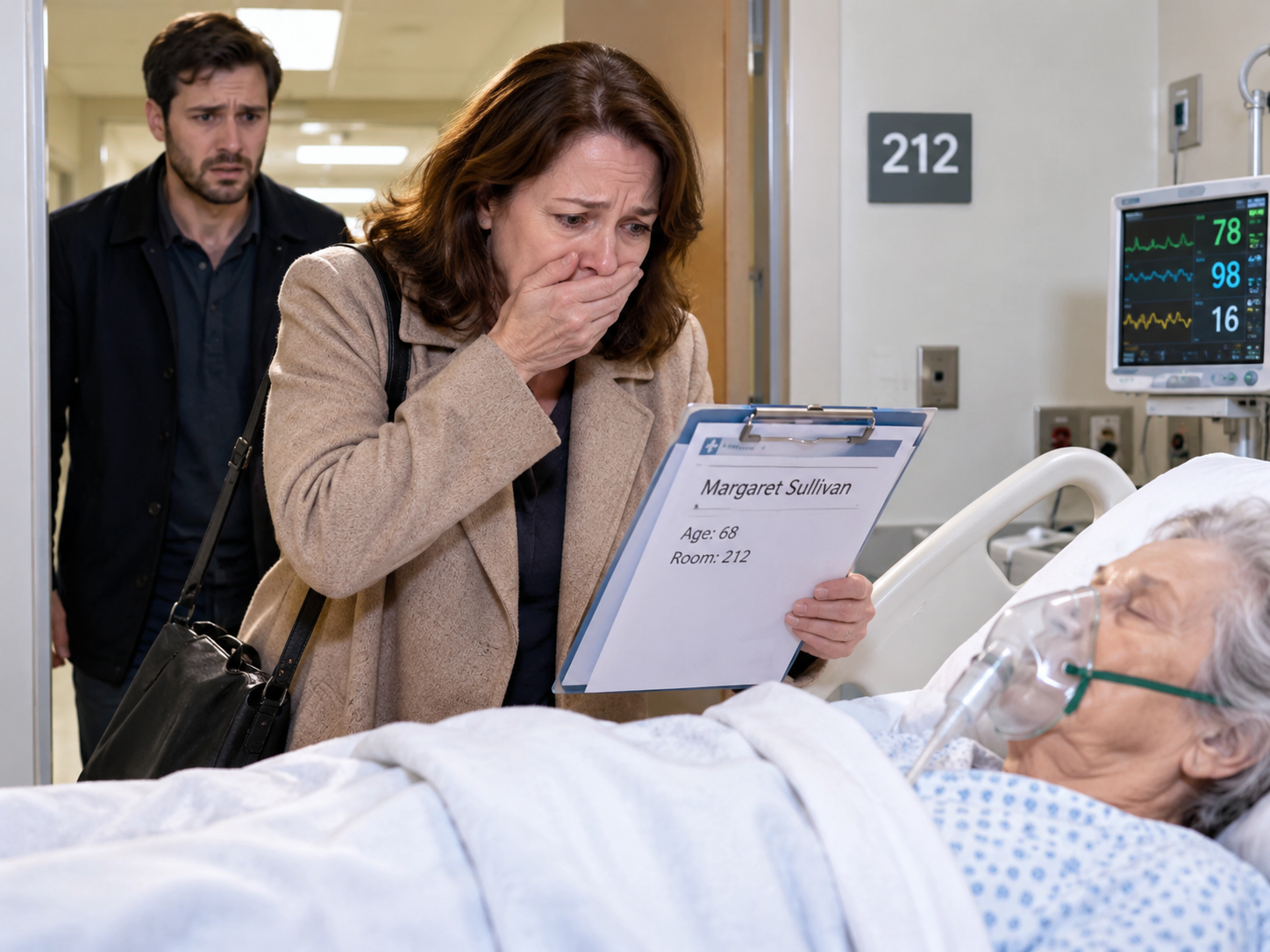
The room number was wrong, but the fear in my son-in-law’s face told me the mistake had been deliberate
Part 2 of 16

