
The house was quieter that winter.
Not empty.
Quiet.
There was a difference.
Leo was older now.
He ran through the hallway with a wooden train in his hand.
Grace had returned to work.
The nursery had become his favorite room.
The legal case was still active, but its daily presence had faded.
We no longer checked the mail with dread.
We no longer expected another envelope to change everything.
The accounts were protected.
The property was secure.
The court had established temporary arrangements.
The people who had once controlled Grace's life were now being held accountable through formal proceedings.
But healing did not arrive as a single event.
It arrived in small habits.
Grace sleeping through the night.
Grace laughing when Leo spilled cereal.
Grace going out with friends.
Grace making plans six months ahead.
Grace buying something without checking whether anyone else thought it was necessary.
One Saturday morning, she came downstairs carrying a box.
“What is that?”
“My wedding album.”
I looked at her.
“You're throwing it away?”
“No.”
She put it on the table.
“I don't know what I want to do with it.”
We opened it together.
There were photographs from before everything had gone wrong.
Grace in her wedding dress.
Her father smiling.
Me crying.
Ezekiel beside her.
Leona in the second row.
Martin near the back.
Adrian wasn't there.
Grace turned one page.
“I don't hate this photograph.”
“You don't have to.”
“I hate what came after.”
“That is different.”
She nodded.
Then she removed several photographs.
“What are you doing?”
“Keeping these.”
She kept the pictures of herself with her father.
With me.
With friends.
With people who had been part of her life before Ezekiel.
The rest went back into the box.
She closed the lid.
“I don't want him to own my memories.”
I smiled.
“He doesn't.”
She looked at me.
“I know that now.”
Later that month, the prosecutor contacted Bennett.
The case was moving toward resolution.
Several defendants had negotiated.
Others continued to contest the allegations.
Grace was asked whether she wanted to make a statement.
She said yes.
We helped her prepare.
But Bennett reminded her that the statement should belong to her.
Not to the attorneys.
Not to me.
Not to the prosecutor.
Her words.
Her experience.
Her choice.
She wrote it herself.
The morning she delivered it, she wore a simple dark suit.
She wasn't trembling.
I sat behind her.
She spoke clearly.
She described the pressure.
The isolation.
The documents.
The hospital.
The false death.
The fear.
But she also described what happened afterward.
She spoke about learning to trust her judgment again.
She spoke about Leo.
She spoke about her house.
She said she did not want her son to grow up believing that money gave people ownership over other human beings.
Then she said something I will never forget.
“I am not asking the court to restore the person I was before this happened. I am asking for the freedom to become the person I choose to be now.”
The room was silent.
She sat down.
I squeezed her hand.
She squeezed mine.
Outside the courthouse, reporters waited.
Grace declined to speak.
She had said what she needed to say.
That evening, we celebrated Leo's birthday at home.
There was cake.
There were balloons.
There was music.
The house was full.
At one point, Grace stood in the doorway and watched everyone.
“What?”
She smiled.
“Nothing.”
“You're thinking.”
“I am.”
“About what?”
“How different this room feels.”
I looked around.
The same dining room.
The same walls.
The same windows.
But the atmosphere was completely different.
This was no longer the house someone had tried to use as collateral.
It was the place where Leo took his first steps.
Where Grace painted the nursery.
Where we ate breakfast.
Where we laughed.
Where she rebuilt herself.
The house had become ordinary again.
That mattered.
The next morning, Bennett called with the final financial update.
Several accounts had been recovered.
The insurance arrangement had been corrected.
The attempted property transfer had been invalidated.
Some money could not be recovered.
Some questions would remain unanswered.
That was the nature of the case.
Not every missing dollar could be traced.
Not every private conversation could be reconstructed.
Not every motive could be proven.
But the central facts were established.
Grace had not consented to the plan.
She had not voluntarily surrendered her property.
She had not agreed to the guardianship arrangement.
She had not been abandoned.
And she had not died.
The lie had failed.
That afternoon, Grace and I walked to the park with Leo.
He ran ahead.
Grace watched him.
“He's getting fast.”
“He gets that from you.”
“No. I was never fast.”
“You were when you were young.”
She smiled.
“Did I tell you about the time I ran away from home at sixteen?”
“You made it to the corner.”
“I was rebellious.”
“You were hungry.”
She laughed.
The conversation was ordinary.
That was exactly what I wanted.
Ordinary.
There is a kind of luxury in ordinary life after surviving chaos.
You begin to value small things.
A quiet morning.
A child laughing.
A locked door.
A bank account only you control.
A phone call that brings good news.
A house where nobody is afraid.
Grace sat on a bench.
Leo climbed beside her.
She pulled him onto her lap.
He pointed toward a dog.
“Doggy.”
“Yes.”
“Big doggy.”
“Very big.”
He laughed.
I watched them.
For a moment, I remembered the hospital.
The false death call.
The room.
The apartment.
The night I had thought I had lost them.
Then I looked at the two people in front of me.
The memory remained.
But it no longer controlled the present.
On the walk home, Grace said something unexpected.
“I've decided not to sell the house.”
“I know.”
“I want Leo to grow up here.”
“I know.”
“And I want to change the name of the guest room.”
“To what?”
“Dad's room.”
I smiled.
Her father had died years earlier.
She had inherited the house partly because of him.
She wanted one room to hold the memories she had nearly lost.
“That sounds right.”
She nodded.
The legal case eventually reached its final stages.
The exact consequences differed for each person involved.
Some admitted wrongdoing.
Some continued to dispute allegations.
Some cooperated.
Some did not.
But the court records established the central financial scheme and the attempts to obtain control over Grace's property and related assets.
Ezekiel could no longer control the story through private conversations.
The documents existed.
The messages existed.
The witnesses existed.
The evidence remained.
Grace never needed to persuade everyone.
She only needed the truth to survive scrutiny.
And it did.
Years later, Leo would not remember the apartment.
He would not remember the hospital.
He would not remember the documents.
He would remember the house.
The nursery.
The backyard.
His mother laughing.
His grandmother making pancakes.
Those were the memories we wanted for him.
Not because the past should be erased.
Because children deserve a childhood that belongs to them.
One evening, Grace and I sat on the porch after Leo had gone to sleep.
The sky was dark.
The street was quiet.
She held a cup of tea between both hands.
“Mom?”
“Yes?”
“Do you ever wish you'd known sooner?”
I thought about it.
“Yes.”
She nodded.
“So do I.”
“But I also know something now.”
“What?”
“Knowing sooner would have changed the path.”
She looked at me.
“Would it have changed the ending?”
“I don't know.”
She smiled.
“Neither do I.”
That uncertainty no longer frightened us.
We had learned that life doesn't offer alternate versions.
There is only the path you actually walk.
And sometimes the path is ugly.
Sometimes you make mistakes.
Sometimes you trust the wrong person.
Sometimes you recognize the truth only after it has already hurt you.
But recognition still matters.
Choice still matters.
The next morning, Grace gave me a key.
“What is this?”
“A copy of the new house key.”
“I already have one.”
“This one is different.”
“How?”
“You're officially allowed to come over without knocking.”
I laughed.
“After everything we've been through, you finally trust me?”
She smiled.
“Completely.”
I hugged her.
She hugged me back.
There was no fear in that embrace.
No emergency.
No hospital.
No legal papers.
Just a mother and daughter.
Later that day, Grace took Leo outside.
I watched from the kitchen window.
He ran across the yard.
She followed.
He fell.
She helped him up.
He laughed.
She laughed.
The ordinary scene carried more meaning than any courtroom statement ever could.
Because this was what had been at stake.
Not merely a house.
Not merely money.
Not merely a legal case.
A life.
A family.
The ability to wake up without wondering who was secretly making decisions about you.
Grace had that now.
She had her own accounts.
Her own documents.
Her own home.
Her own voice.
And she had learned something that no one could take away from her again.
Trust should not require blindness.
Love should not require surrender.
Family should not mean obedience.
And asking questions is not betrayal.
Sometimes questions are how you save someone.
Sometimes they are how you save yourself.
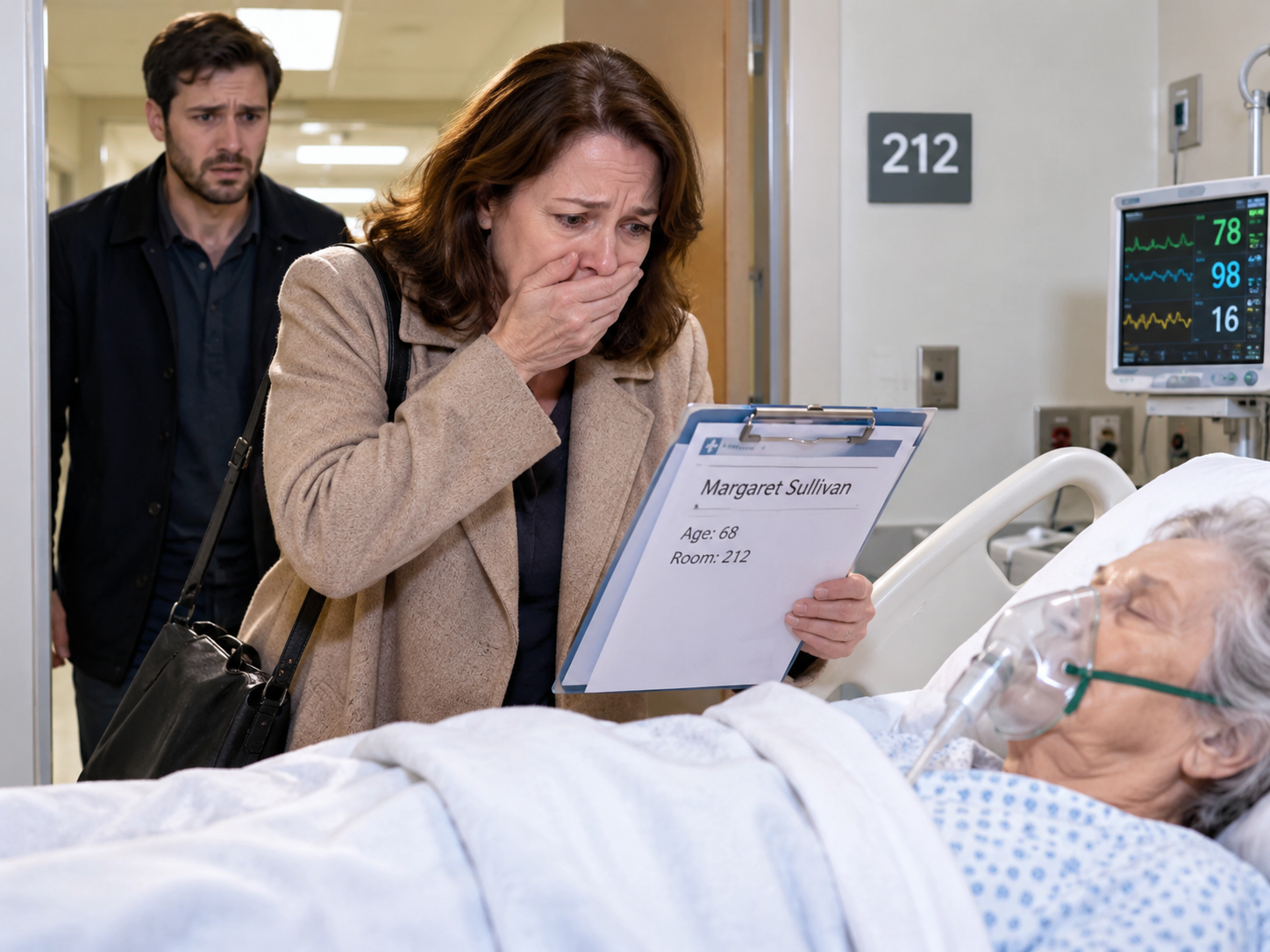
I still think about room 212.
I probably always will.
The room where I expected to find my daughter's body.
The room where I found a stranger instead.
At the time, it felt like a terrible mistake.
Later, I understood that the mistake had interrupted a carefully constructed lie.
The person who gave me the room number could not have known what would happen next.
Neither could Nadia.
Neither could Grace.
Neither could I.
But one wrong detail was enough.
That is what I remember whenever someone tells me that small things don't matter.
They do.
A pause matters.
A strange answer matters.
A document you don't understand matters.
A question that makes someone angry matters.
A feeling that something doesn't fit matters.
Not every suspicion is correct.
But neither should every suspicion be silenced.
Grace learned to listen to hers.
I learned to listen to hers.
And Leo grew up in a home where questions were welcomed.
That may have been the greatest change of all.
The people who tried to turn our family into a collection of assets never understood something simple.
A family is not a balance sheet.
A child is not collateral.
A home is not merely an amount on a page.
And a person cannot be reduced to the signature someone wants from them.
Grace had once believed she needed permission to trust herself.
She no longer did.
That was the real ending.
Not the arrest.
Not the documents.
Not the courtroom.
Not the money recovered.
Her freedom to make a decision and know it belonged to her.
Years after that night, when Leo was old enough to ask why his mother sometimes became quiet when hospitals appeared on television, Grace gave him a simple answer.
“Because something frightening happened before you could remember.”
“Were you scared?”
“Yes.”
“Was Grandma scared?”
“Yes.”
“What happened?”
Grace looked at me.
I let her answer.
“We found each other.”
Leo seemed satisfied.
He went back to his toy.
Grace looked at me afterward.
“Was that enough?”
I smiled.
“For him?”
“Yes.”
“For now.”
She nodded.
And that was enough for me too.
Because there are some truths children do not need all at once.
There are some wounds that become stories only after they stop bleeding.
And there are some nights that remain terrible even after the danger is gone.
But they do not have to remain the center of your life.
Grace chose not to let them.
Neither did I.
The night my son-in-law called crying and told me my daughter had died, I believed him for a few minutes.
Those minutes nearly changed everything.
Then I opened a door.
And behind it was not death.
It was my daughter.
Alive.
Afraid.
Holding her newborn son.
Waiting for someone to believe her.
I did not understand everything that night.
I did not know who had planned what.
I did not know how far the scheme reached.
I did not know how many documents existed or how many people had participated.
But I knew one thing.
The story I had been told did not fit what I was seeing.
So I kept looking.
That choice changed everything.
And in the end, that is what Grace and I carried forward.
Not the fear.
Not the betrayal.
Not the money.
Not even the legal victory.
We carried the lesson.
When something doesn't fit, ask.
When someone you love speaks, listen.
When trust breaks, don't surrender your judgment.
And when the truth finally appears, don't be afraid to build a new life around it.
Grace did.
Leo grew up surrounded by that truth.
And I remained close enough to watch it happen.
That was more than I had hoped for on the night the phone rang.
It was everything.
Click Here to continue read next: PART13: The final court documents brought one last surprise, forcing Grace to decide whether the truth was finally worth reopening an old wound
The room number was wrong, but the fear in my son-in-law’s face told me the mistake had been deliberate
Part 12 of 16

