
The house became very quiet after Bennett's call.
Grace sat against the pillows with Leo sleeping beside her.
I could hear the refrigerator humming downstairs.
For several seconds, neither of us spoke.
Then Grace whispered, “My house?”
I nodded.
Bennett had discovered that Ezekiel had been trying to prepare documents connected to the property.
He had apparently viewed the house as collateral.
If his debts could not be paid, the property might be used to satisfy them.
But there was a problem.
Grace's signature was required for several of the transfers.
That was why the papers mattered.
That was why the baby mattered.
That was why her condition mattered.
Ezekiel had not simply wanted control.
He needed Grace weakened enough to sign.
If she refused, he could try to make her appear incapable of making decisions.
I felt sick.
Grace looked toward Leo.
“So the baby wasn't the whole plan.”
“No.”
“He needed me to sign.”
“Yes.”
She closed her eyes.
“I almost did.”
“You didn't.”
“I almost believed him.”
I sat beside her.
“That doesn't make this your fault.”
She looked at me.
“I was exhausted. I had just given birth. I was bleeding. He kept telling me I wasn't thinking clearly.”
I took her hand.
“He was exploiting the fact that you were vulnerable.”
Bennett arrived later that morning.
He brought copies of the documents and explained everything carefully.
The attempted beneficiary change.
The guardianship request.
The financial withdrawals.
The property paperwork.
The correspondence with the lenders.
The conversation recovered from Ezekiel's phone.
Leona's involvement.
The black SUV.
The hospital records.
The security footage.
Piece by piece, the story stopped looking like a collection of strange events.
It became a pattern.
Grace listened without interrupting.
When Bennett finished, she looked exhausted.
“Is he going to prison?”
Bennett didn't promise anything.
“That depends on what prosecutors decide and what can be proven.”
I appreciated that.
We had spent one night surrounded by lies.
I wanted facts now.
Grace nodded.
“What happens to Leo?”
“For now, he's with you.”
“And Ezekiel?”
“His custody rights will be addressed through the proper process.”
Grace looked down at her son.
“I don't want him near us.”
“You can tell the court that.”
She nodded.
Later that afternoon, the police returned for another interview.
Grace described the months leading up to the delivery.
Ezekiel had become increasingly controlling about money.
He checked accounts.
He questioned purchases.
He wanted access to her records.
He asked what would happen to the house if she died.
At first, she believed he was simply anxious about becoming a father.
Then came Leona.
Leona had begun appearing without warning.
She criticized Grace's decisions.
She said motherhood would change her priorities.
She suggested that Grace should let Ezekiel handle financial matters.
She repeatedly praised her son for being “practical.”
Grace had resisted.
The arguments became more frequent.
Then Ezekiel began talking about the possibility of Grace becoming incapacitated during childbirth.
He wanted legal authority prepared in advance.
She refused.
The officer asked whether Ezekiel had ever physically assaulted her.
Grace shook her head.
“No.”
That answer mattered.
So did the next one.
“But I was afraid of what would happen if I kept saying no.”
The officer wrote carefully.
There are forms of control that leave no bruise.
Forms that rely on exhaustion, isolation, money, paperwork, and the repeated suggestion that another person cannot trust her own judgment.
Grace had lived inside that pressure for months.
I had not seen it.
Or perhaps I had seen pieces and chosen easier explanations.
That realization stayed with me.
After the interview, Grace and I sat alone.
“I owe you an apology,” I said.
She looked surprised.
“For what?”
“For not hearing you.”
She looked down.
“I didn't make it easy.”
“You asked me a question.”
“What question?”
“Whether I had ever let you be yourself.”
She smiled sadly.
“I remember.”
“I thought you were talking about independence.”
“I was.”
“And something else.”
“Yes.”
She breathed slowly.
“I was trying to tell you I didn't recognize myself anymore.”
I felt tears rise.
“I should have asked more.”
“I should have told you more.”
“We both stayed quiet.”
“For different reasons.”
I looked at her.
“Tell me now.”
She leaned back.
“I was ashamed.”
“Of him?”
“Of myself.”
“Why?”
“Because I thought I had made a terrible choice.”
I shook my head.
“You made a choice with the information you had.”
She smiled faintly.
“You sound like a lawyer.”
“I've spent too much time around Bennett.”
She laughed.
The sound was fragile but real.
Leo stirred.
Grace lifted him.
He opened his eyes for a moment, then settled against her.
“This is Leo,” she said.
“I know.”
“No. I mean his name.”
She smiled.
“I chose it before everything happened.”
I touched his tiny hand.
“It's a good name.”
“He deserves a peaceful life.”
“He will have one.”
Grace looked at me.
“Will I?”
I didn't answer immediately.
Then I said, “Not immediately.”
She nodded.
“But eventually?”
“We'll build it.”
That evening, Bennett called with another update.
Nadia had formally confirmed her statement.
The hospital clerk had confirmed the surname discrepancy.
The rear-camera footage had been preserved.
The medical records showed that Grace had been in no condition to leave without serious consideration.
And investigators had recovered additional messages.
Leona had discussed the possibility of taking temporary control of Leo if Grace became “uncooperative.”
That word made me furious.
Uncooperative.
As though refusing to surrender her child were a business inconvenience.
Bennett also told us that prosecutors were examining the financial transfers.
Some money had already disappeared.
Some accounts were frozen.
The property transfer had not been completed.
Grace still owned her home.
She stared at me when he said that.
“I thought I lost everything.”
“You almost did.”
She looked at Leo.
“But I didn't.”
“No.”
For the first time, the sentence sounded like more than relief.
It sounded like the beginning of something.
The next two days passed slowly.
Grace slept more.
Leo gained strength.
I learned the strange rhythm of newborn life.
Feeding.
Burping.
Crying.
Silence.
Then crying again.
The house filled with sounds I had never noticed before.
One afternoon, I found Grace standing by the window.
She was holding Leo against her chest.
“What are you thinking?”
“That I should have left sooner.”
I stood beside her.
“Maybe.”
She looked at me.
“But I also think I was waiting for proof.”
“Why?”
“Because when someone slowly convinces you that you're imagining things, you start needing evidence before you trust your own fear.”
I understood.
That was perhaps the cruelest part.
Ezekiel hadn't needed to lock every door.
He had only needed Grace to doubt herself.
She looked down at Leo.
“I don't want him to grow up thinking love means enduring everything.”
“Then he won't.”
“How do you know?”
“Because his mother knows better now.”
She smiled.
A week later, Grace returned to the hospital for a follow-up examination.
She was physically improving.
Emotionally, she was still fragile.
The doctor said recovery would take time.
I knew it would.
There were legal hearings ahead.
Financial investigations.
Custody decisions.
Questions about Leona.
Questions about the lenders.
Questions about how the hospital had allowed Grace to leave.
None of those things could be solved in one morning.
But the immediate danger had passed.
That night, after Grace and Leo returned home, we sat together in the kitchen.
The same kitchen where I had first heard the lie.
Grace looked around.
“Do you remember that night?”
“Yes.”
“What were you doing?”
“Burning milk.”
She laughed.
“You always burn it when you're upset.”
“I wasn't upset then.”
“You were.”
“I was making dinner.”
“You were worrying.”
I smiled.
She leaned back.
“Mom?”
“Yes?”
“Would you have believed him if the room had been empty?”
I thought about it.
“Yes.”
She nodded.
“I think I would have too.”
“That's why the wrong room mattered.”
“It saved you.”
“It saved us.”
Neither of us said anything for a while.
There was something strangely comforting about knowing that one ordinary mistake had interrupted a carefully constructed lie.
A wrong door.
A sleeping stranger.
A nurse who noticed fear.
A daughter who managed to speak three words.
Small things.
None of them had been heroic by themselves.
Together, they had been enough.
That night, Grace put Leo to bed.
I sat in the armchair nearby.
She came over and rested her hand on my shoulder.
“I don't blame you.”
I looked up.
“For what?”
“For believing me too late.”
My eyes filled.
“I blame myself enough for both of us.”
She shook her head.
“No.”
She sat beside me.
“You taught me to be strong.”
“I also taught you to endure.”
“Then we change the lesson.”
I smiled through tears.
“Deal.”
The house became quiet.
Leo slept.
Grace leaned her head against my shoulder.
For the first time since that phone call, I felt something close to peace.
Not complete peace.
There were still court dates.
Still documents.
Still questions.
Still the possibility that Ezekiel would try to reshape the story.
But Grace was alive.
Leo was alive.
And the truth was no longer trapped inside the walls of that apartment.
Months later, the legal process was still moving.
Ezekiel continued to deny that he had intended to harm anyone.
He claimed he had acted under financial pressure.
He said he was trying to protect his wife and child.
Other people could decide what those explanations meant.
I no longer needed to.
I had seen what happened.
I had seen my daughter sitting on a mattress in a hospital gown, holding her newborn while her husband tried to keep her mother outside.
I had seen the papers.
I had seen the messages.
I had seen the fear.
Most importantly, I had seen Grace choose herself again.
Sometimes people ask what I remember most about that night.
They expect me to say the moment we broke down the apartment door.
Or the sight of Leo.
Or Ezekiel being handcuffed.
But that isn't what stays with me.
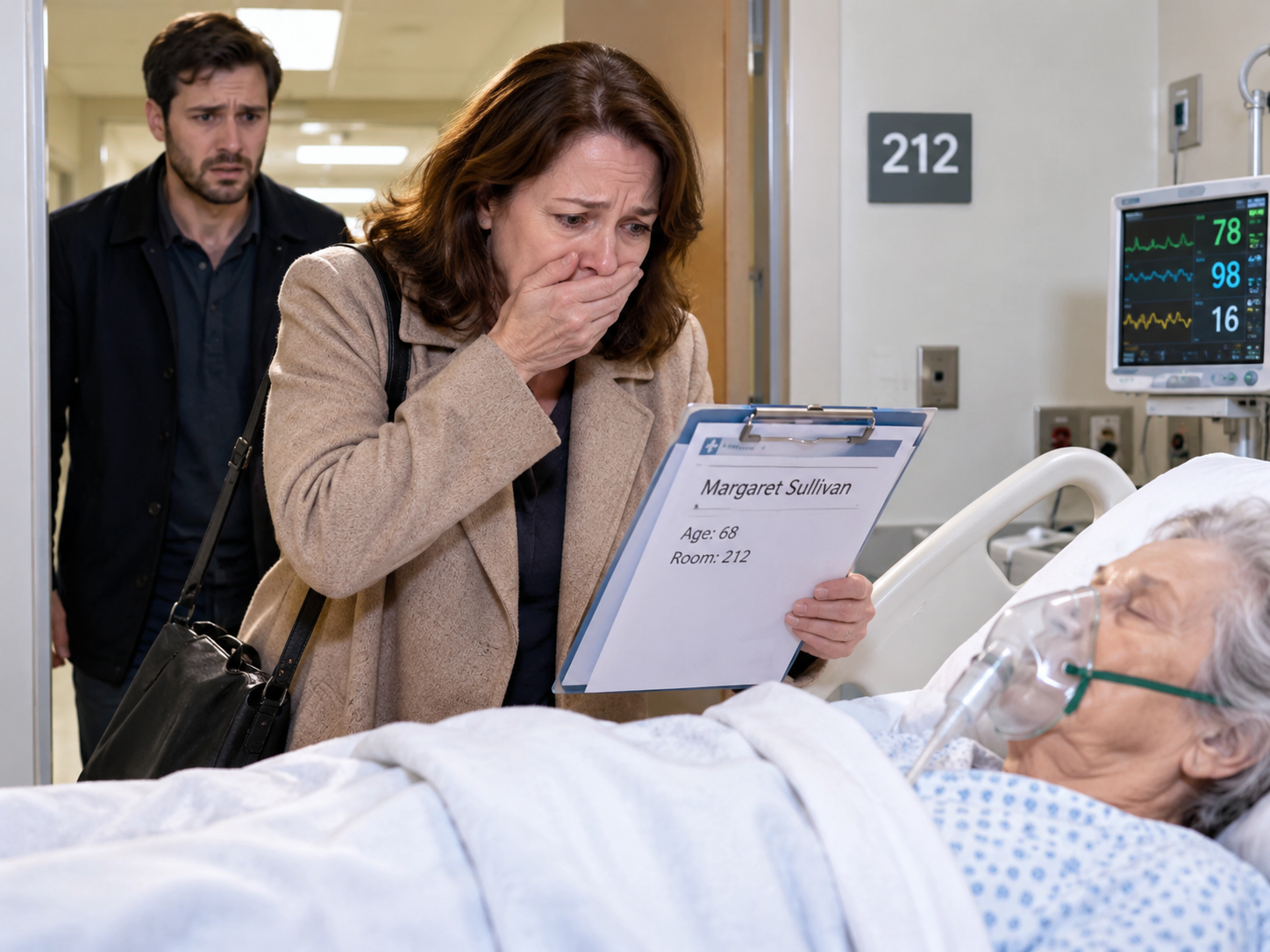
I remember the wrong room.
Room 212.
A room that belonged to a woman I had never met.
A room that should have been meaningless.
Instead, it was the first crack in the story I had been told.
I remember pulling back the sheet.
Seeing gray hair.
Seeing a stranger's sleeping face.
And realizing that grief had not yet been allowed to make me obedient.
That moment gave me one more chance to think.
One more chance to doubt.
One more chance to act.
If the room had contained Grace, I might have accepted the lie.
If the door had been locked, I might have walked away.
If Nadia had stayed silent, I might never have known.
If Grace had not whispered her warning, I might have trusted the man who called me.
So I don't believe instinct is always loud.
Sometimes it is only a small discomfort.
A wrong number.
A strange pause.
A look that doesn't match the words.
A door that shouldn't be closed.
That night, my instinct was not gentle.
It was inconvenient.
It made me question someone I loved.
It made me refuse the explanation I had been given.
And it brought me back through the hospital.
Through the service corridors.
Through the cold basement.
Through the city before dawn.
To a door on the second floor.
To my daughter.
To Leo.
To the truth.
Grace eventually stopped asking whether she could become herself again.
She simply began doing it.
She chose her own home.
Her own finances.
Her own boundaries.
Her own future.
And she learned, slowly, that asking for help did not make her weak.
I learned something too.
Being a mother does not mean deciding everything for your child.
Sometimes it means listening when she says she is afraid.
Sometimes it means accepting that she may make choices you would not make.
Sometimes it means staying close enough that when she finally reaches for you, you are there.
I had arrived late.
But I had arrived.
And when I think about that night now, I don't think about the death my son-in-law announced.
I think about the life he tried to hide.
My daughter was alive.
My grandson was alive.
And the truth, once found, could no longer be buried beneath a hospital sheet, a false room number, or a stack of carefully prepared papers.
Grace had survived.
Leo had survived.
And the three of us began again under the same roof, not because nothing had happened, but because everything had.
That difference mattered.
It still does.
Click Here to continue read next: PART5: The house was still legally Grace’s, but the documents waiting inside revealed how close Ezekiel had come to taking it from her
The room number was wrong, but the fear in my son-in-law’s face told me the mistake had been deliberate
Part 4 of 16

