
The phone rang just after nine that night. I almost let it go to voicemail because I was standing over a saucepan of milk that had already begun to scorch, but something in the repeated ringing made me reach for it.
“Mom?”
It was Ezekiel.
His voice was broken badly enough that for one second I couldn't understand the words. I heard him breathe, heard something metallic scrape in the background, and then he said the sentence that divided my life into everything before and everything after.
“Grace didn’t make it.”
I gripped the counter.
“What do you mean?”
“She died after the delivery.”
The kitchen seemed to tilt. I remember staring at the pale film forming on the milk while my hand tightened around the phone. Grace had gone to Mercy General that afternoon to have her first child. Her husband had promised to call me as soon as there was news. I had expected exhaustion, perhaps complications, but never those words.
“My daughter?”
Ezekiel began crying harder.
“I’m sorry. I’m so sorry.”
I don't remember turning off the stove. I don't remember finding my shoes. I remember only grabbing my coat and keys and walking outside with the phone still pressed against my ear while he gave me directions I already knew.
When I arrived at Mercy General, the emergency entrance was bright and crowded. A paramedic pushed an empty stretcher through the sliding doors. Someone was arguing quietly at the reception desk. A newborn cried somewhere beyond a set of double doors, and that sound struck me so sharply that I stopped walking.
A newborn.
My grandson had been born.
For one foolish, hopeful second, I wondered whether Ezekiel had somehow made a mistake.
Then I saw him.
He stood near the elevators wearing the same dark clothes he'd left home in that morning, except his shirt was wrinkled and his face looked drained. When he saw me, he crossed the lobby quickly.
“Where is she?” I asked.
He reached for my shoulders.
“Bernice, please.”
“Where is Grace?”
He looked toward the hallway.
“Room 212.”
I tried to move past him, but he blocked me.
“You don't need to see her right now.”
My stomach tightened.
“What does that mean?”
“She doesn't look like herself.”
“She's my daughter.”
“I know.”
“Then move.”
His fingers tightened briefly around my arms.
“You don't want that image in your head.”
There was something wrong with his eyes.
It wasn't grief.
Grief can make a person vacant. It can make someone collapse inward. But Ezekiel was watching me. Measuring me.
Fear flickered across his face.
Not the fear of a husband who had lost his wife.
The fear of a man who was afraid I might discover something.
I pulled away from him.
“I am going into that room.”
He stepped aside eventually, but not before saying quietly, “Please trust me.”
I walked down the corridor.
Room 212 was near the end.
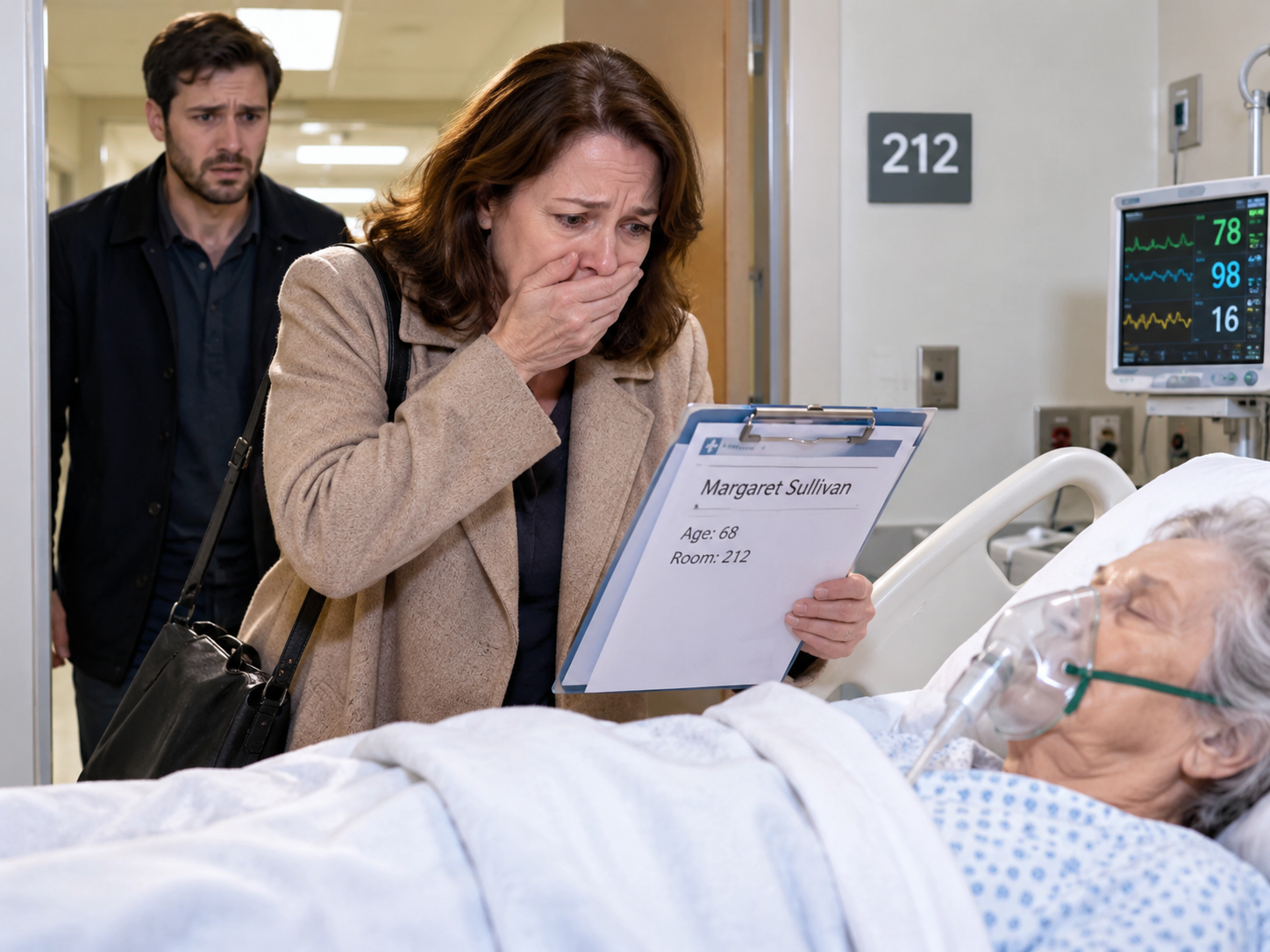
My hand hovered over the handle. For a moment, I couldn't breathe. I imagined Grace lying beneath white sheets, her face pale, her beautiful brown hair spread across the pillow. I imagined the baby beside her. I imagined a hundred terrible things.
Then I opened the door.
The room was dim.
There was a bed.
There was a person beneath the blanket.
But something immediately felt wrong.
The body was too small.
I moved closer.
The hair visible against the pillow was short and gray.
I froze.
I pulled the sheet down just enough to see the face.
An elderly woman stared back at me with closed eyes and an oxygen mask resting crookedly across her mouth.
She was alive.
She was also a complete stranger.
I stepped backward so quickly that my shoulder struck the wall.
My daughter was not in that bed.
I looked toward the doorway.
Ezekiel was gone.
My first thought was that someone had made a clerical mistake. Hospitals were large. Patients were moved. Room numbers could be confused.
But then I remembered his hands on my shoulders.
His warning.
His insistence that I shouldn't look.
I walked to the foot of the bed and picked up the chart.
Margaret Sullivan.
Sixty-eight.
Room 212.
I stared at the name until the letters blurred.
This wasn't an accident.
Someone had deliberately sent me here.
I left the room and pressed myself against the wall outside. A cart squeaked somewhere down the hall. Two nurses spoke quietly near the station. The ordinary sounds of the hospital suddenly felt unbearable.
I had been told my daughter was dead.
Yet her room contained another woman.
I forced myself to think.
Grace had given birth that afternoon. She should have been in Labor and Delivery or postpartum recovery, not this section of the hospital.
I followed the signs.
At the end of another corridor, I found a door marked Labor & Delivery — Restricted Area.
A card reader blinked beside it.
I stood there staring through the small glass panel.
Then a voice came from behind me.
“Can I help you?”
I turned.
A young nurse stood several feet away. Her hair was pulled into a tight ponytail, and fatigue showed beneath her eyes.
“My daughter gave birth here today,” I said.
The nurse's expression remained neutral.
“My son-in-law told me she died.”
Something changed in the nurse's face.
Only slightly.
But I saw it.
“She died?”
I nodded.
“Her name is Grace Miller.”
The nurse looked down.
That small movement frightened me more than a scream would have.
“Ma'am, you need to leave this area.”
“Please.”
I stepped closer.
“Just tell me whether she was here.”
The nurse looked toward the hallway cameras.
Then back at me.
“I can't discuss patients.”
“I'm her mother.”
The nurse swallowed.
“I can't talk here.”
My heart began pounding.
“Then where?”
She hesitated before speaking.
“Go downstairs. Basement level. Near the waste disposal room. Wait there.”
“Why?”
“My shift ends in ten minutes.”
Then she walked away.
I stood there for several seconds.
Every instinct told me to run after her.
Instead, I followed her instructions.
The basement smelled of disinfectant, damp cardboard, and cold metal. I waited beside a service door, listening to pipes rattle somewhere overhead.
Nine minutes later, the nurse appeared without her scrubs.
“My name is Nadia,” she said.
I nodded.
She looked frightened.
Then she said the words I had been terrified to hope for.
“Your daughter is alive.”
My knees weakened.
I put one hand against the wall.
“Where is she?”
Nadia shook her head.
“I don't know where she is now.”
“What happened?”
“She was taken out of the hospital.”
“By Ezekiel?”
“Yes.”
My throat tightened.
“When?”
“Around eight-forty.”
“That can't be. He called me afterward.”
“I know.”
Nadia explained that Grace had suffered heavy bleeding after delivery. She had been weak, intermittently confused, and nowhere near fit to leave without proper medical supervision. The baby had experienced mild breathing difficulty but was stable.
“They left anyway?”
“Your son-in-law signed paperwork.”
I stared at her.
“How could the hospital allow that?”
Nadia's mouth tightened.
“There were arguments. A doctor was involved. Then Ezekiel insisted he was taking responsibility.”
“Where did he take her?”
“I don't know.”
She hesitated.
“But I saw the vehicle.”
“What vehicle?”
“A black SUV.”
My pulse quickened.
“Was Grace conscious?”
“Barely. She was in a wheelchair. She was holding the baby at first, but she couldn't keep her arms up. Someone else carried him most of the way.”
I closed my eyes.
“Did he say where they were going?”
Nadia looked at me.
“He made a phone call. I heard him say they were leaving and that you didn't know anything. Then he said they'd arrive in about an hour.”
The room seemed suddenly colder.
“Who was waiting for them?”
“I don't know.”
Nadia continued quietly.
“There was another strange thing. When the paperwork was being processed, the baby's surname caused a problem.”
“What problem?”
“The father was listed differently.”
“How?”
“Ezekiel Duarte.”
I stared at her.
My son-in-law had always used Miller.
Duarte was his mother's family name, one he almost never mentioned.
“He said it was an error,” Nadia added. “Then he told the clerk not to disturb Grace.”
I couldn't speak.
Nadia reached for my hand.
“There was one more thing.”
I looked at her.
“Before they took your daughter away, she grabbed my wrist.”
My breath caught.
“She said, ‘If my mother comes, don't believe him.’”
Everything inside me went still.
“Who?”
“She didn't finish.”
I lowered my head.
For weeks Grace had seemed unhappy. She had once asked me whether I thought I had ever given her enough room to become her own person. I had brushed the question aside because I thought she was tired, emotional, overwhelmed by pregnancy.
Now I heard it differently.
My daughter had been trying to speak.
I hadn't listened.
Nadia squeezed my hand.
“You need to move quickly.”
“I will.”
“Don't confront him alone.”
I nodded.
Then I walked back upstairs.
Outside the hospital, the night air struck my face.
I sat behind the wheel and tried to start the car.
The first attempt failed because my hands were shaking.
The second did too.
On the third, the engine caught.
I didn't call Ezekiel.
I called my lawyer.
“Mr. Bennett?”
His voice came immediately.
“Bernice?”
“I need you to find my daughter.”
There was a pause.
“What's happened?”
“Ezekiel lied to me. Grace is alive, but he took her out of the hospital.”
Bennett's voice became very calm.
“Where are you?”
I told him.
Then he asked the question that changed what I did next.
“Do you have any idea where Ezekiel might have taken her?”
I thought of the documents I had kept for Grace.
And suddenly I remembered an address.
An apartment lease.
A corporation.
A place Ezekiel had once called a warehouse.
I hadn't thought about it in months.
Now I couldn't stop thinking about it.
Click Here to continue read next: PART2: The address hidden among my daughter’s papers led to a place my son-in-law had never wanted me to remember
The room number was wrong, but the fear in my son-in-law’s face told me the mistake had been deliberate
Part 1 of 16

