
Nearly a year after the accident, my daughter asked for chocolate cake again.
She didn't whisper it.
She didn't look toward the kitchen table afterward.
She simply said, “Mommy, can we make the chocolate one?”
I looked at her.
“The same kind?”
She nodded.
“With lots of frosting.”
I smiled.
“Lots?”
“Lots.”
We baked it together that afternoon.
She measured the flour.
I melted the chocolate.
She tasted the frosting and declared it needed more sugar.
I told her she was wrong.
She told me I was wrong.
We laughed.
The kitchen smelled warm and sweet.
For the first time, the smell of chocolate did not pull me backward.
It belonged to that afternoon.
Not the hospital.
Not the argument.
Not the fear.
Just us.
When the cake was finished, my daughter looked at the table.
The same table.
The same chairs.
The place where everything had changed.
She stood there quietly.
Then she said, “Let's eat here.”
I didn't ask whether she was sure.
She knew I would follow her lead.
We carried the cake to the table.
My daughter chose her seat.
Then she pointed at the chair across from her.
“Grandma can sit there.”
I looked at her.
“Are you inviting her?”
“Yes.”
“What about Aunt Vanessa?”
My daughter smiled.
“She can sit beside Grandma.”
I felt something loosen inside me.
Not because the past had disappeared.
Because my daughter was no longer being controlled by it.
My mother and Vanessa arrived together.
Neither of them knew what my daughter had planned.
My mother stepped into the kitchen and stopped when she saw the cake.
Her eyes filled immediately.
My daughter ran to her.
“Grandma!”
My mother hugged her only after my daughter opened her arms first.
I watched them.
A year earlier, my mother had held me back.
Now she was holding my daughter because my daughter had chosen to reach for her.
That difference mattered.
Vanessa stood near the doorway.
My daughter looked at her.
“You can come in.”
Vanessa smiled.
“Thank you.”
She came closer.
My daughter pointed to the chair.
“Sit there.”
Vanessa did.
No one touched the cake until my daughter picked up the knife.
She looked at all of us.
“I get the first piece.”
My mother laughed.
“Of course.”
My daughter cut the cake.
The knife moved cleanly through the frosting.
She placed the first piece on her plate.
Then she looked around.
“Who wants one?”
My mother raised her hand.
Vanessa laughed.
“I do.”
My daughter served them both.
Then she gave me a piece.
She saved herself the biggest one.
I smiled.
“Very fair.”
She nodded.
“I learned.”
We ate.
Nobody talked about what had happened.
Not because we were hiding it.
Because we no longer needed the accident to be the center of every gathering.
Eventually, my mother put down her fork.
“I want to say something.”
My daughter looked at her.
My mother hesitated.
“I know this day is happy, so I don't want to make it sad.”
My daughter shrugged.
“You can talk.”
My mother smiled.
“I am sorry.”
My daughter waited.
“I was wrong that day. I should have protected you first. I should have listened to you. I should never have made you feel that your fear was inconvenient.”
My daughter's expression remained serious.
Then she said, “You listen now.”
My mother nodded.
“I do.”
“Good.”
That was all.
No speech.
No dramatic forgiveness.
Just recognition.
Vanessa looked down at her plate.
Then she said, “I'm sorry too.”
My daughter looked at her.
“I know.”
“I know I hurt you.”
“Yes.”
“I can't change it.”
“No.”
“But I can make sure I never treat you like that again.”
My daughter considered her words.
Then she nodded.
“I know.”
I looked around the table.
The same people.
The same room.
A completely different family.
Not because nobody had made mistakes.
Because the mistakes had finally been acknowledged instead of buried.
My mother reached for another piece of cake.
My daughter laughed.
“Grandma, that's your second piece.”
My mother grinned.
“It's very good.”
“You said you were full.”
“I changed my mind.”
My daughter looked at Vanessa.
“You want another one?”
Vanessa smiled.
“Yes.”
My daughter cut another piece.
She handed it to her aunt.
For a moment, I simply watched.
There had been a time when I thought protecting my daughter meant keeping everyone who had hurt her away forever.
I understand now that it was more complicated.
Protection meant making sure she could say no.
It meant believing her when she was afraid.
It meant refusing to rush her toward forgiveness.
It meant letting other people prove through their actions that they had changed.
And it meant accepting that one day she might choose to open the door herself.
She had done that.
Not because anyone demanded it.
Not because she was pressured.
Because she was ready.
That was the part I had wanted most for her.
Choice.
The freedom to decide what happened next.
After dinner, my daughter helped me clear the plates.
She stopped beside the table.
“Mommy?”
“Yes?”
“Can we keep this table?”
I smiled.
“Of course.”
“I don't want to throw it away anymore.”
“Okay.”
She ran toward the living room.
I stayed behind for a moment.
My hand rested on the back of the chair where she had once been sitting when everything happened.
The memory was still there.
I didn't need to erase it.
It had taught me something I would never forget.
Family was not defined by who shared your blood.
It was defined by who listened when you said you were hurt.
Who respected your boundaries.
Who admitted when they were wrong.
Who stayed patient when forgiveness took longer than they wanted.
And who understood that love without accountability could become another way of asking the injured person to stay quiet.
My mother came back into the kitchen.
She stood beside me.
“You okay?”
“Yes.”
She looked at the table.
“It's strange.”
“What is?”
“That this used to be the place I was afraid to look at.”
I nodded.
“Me too.”
She smiled faintly.
“Your daughter changed all of us.”
I looked toward the living room.
“She shouldn't have had to.”
My mother lowered her eyes.
“No.”
We stood there quietly.
Then my daughter called from the other room.
“Mommy! Grandma! Come see this!”
My mother smiled.
“Coming.”
We walked into the living room.
My daughter had arranged her drawings across the floor.
There was one of the old kitchen table.
One of the park.
One of Grandma.
One of Aunt Vanessa.
And one of all of us eating cake.
She held the last picture up proudly.
“Look.”
I crouched beside her.
“It's beautiful.”
She smiled.
“I made everybody happy.”
I looked at the picture.
Then I looked at her.
“You made your own choice.”
She nodded.
“And that's better.”
She thought about it.
“Why?”
“Because nobody else gets to decide who you forgive.”
She smiled.
“Okay.”
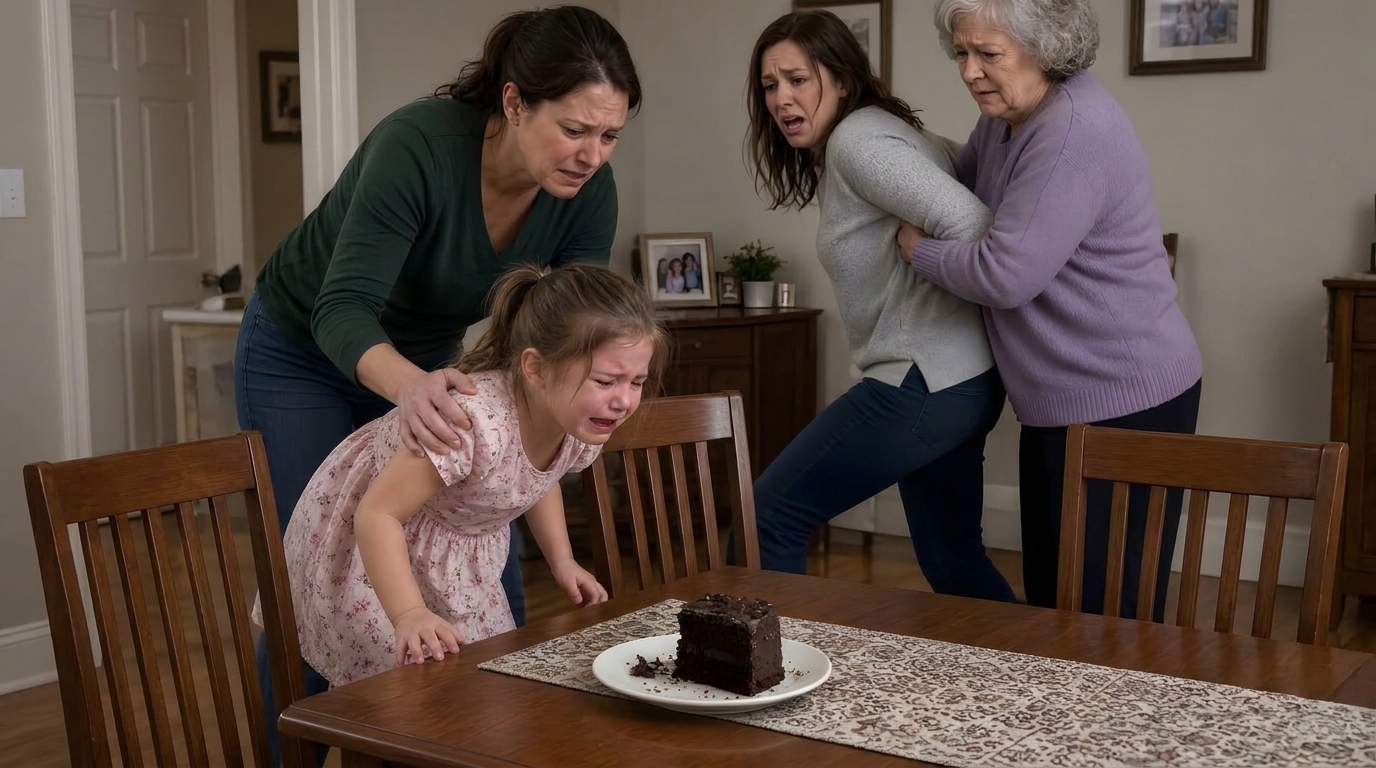
Years later, I knew I would probably still remember the sound of that chair scraping against the floor.
I would remember my daughter's cry.
I would remember my mother's hands on my arms.
I would remember Vanessa staring at the cake.
Those memories would not disappear.
But they no longer controlled us.
My daughter had reclaimed the table.
She had reclaimed chocolate cake.
She had reclaimed the choice to open the door.
And I had kept the promise I made when I pulled my arm free and reached for her.
She would never again have to wonder whether I would come when she needed me.
I would.
Even when coming meant disappointing someone.
Even when it meant being called difficult.
Even when it meant choosing a boundary over peace.
Because peace that required a child to stay silent was never peace.
And forgiveness that demanded forgetting was never forgiveness.
That afternoon, my daughter took my hand.
“Mommy?”
“Yes?”
“Can we have cake tomorrow too?”
I laughed.
“Maybe.”
She squeezed my fingers.
“I'll decide.”
“Yes,” I said.
“You will.”
And that was enough.
The End
Read more original stories on Feel Every Story.
The Moment My Daughter Looked at Me and Asked Why Nobody Had Stopped Her Aunt
Part 8 of 8

