
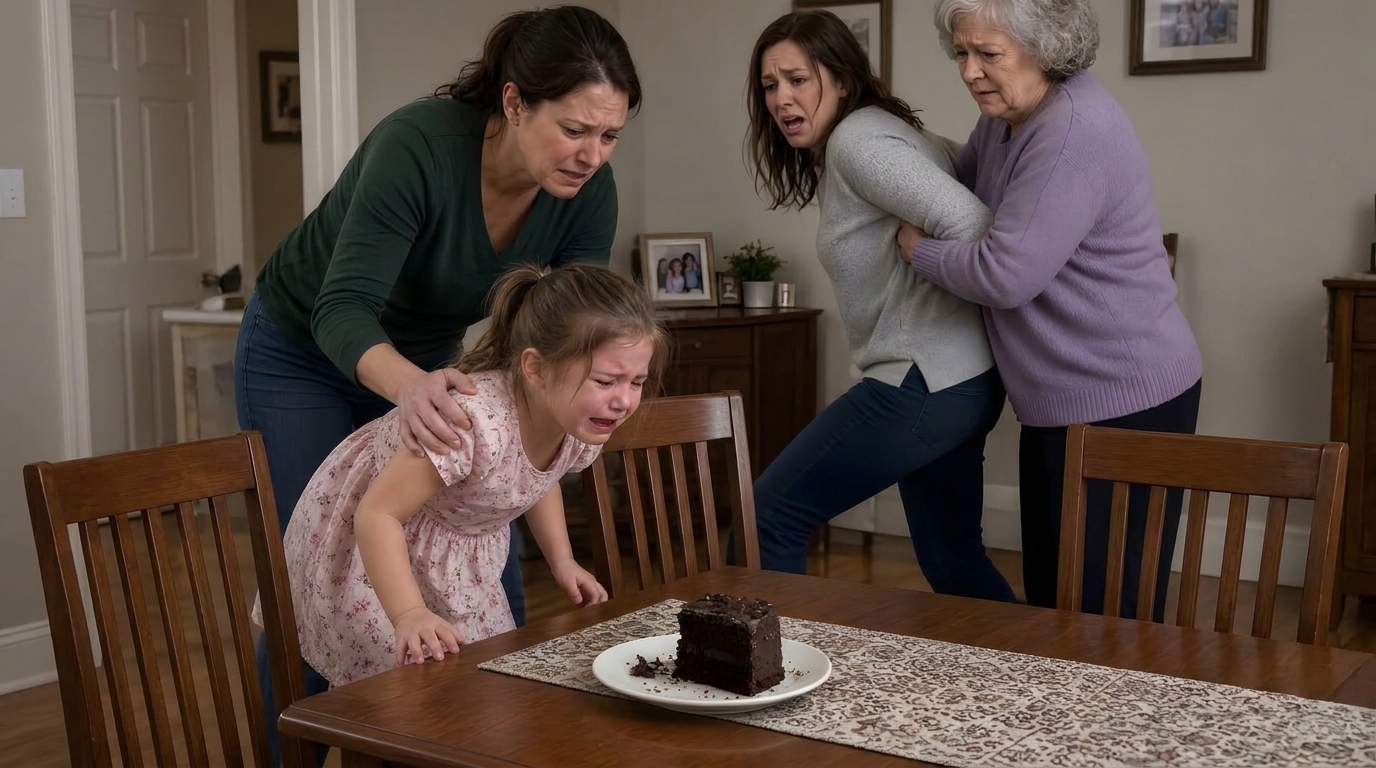
Three days passed before my daughter asked about Vanessa again.
By then, the bruise along her cheek had begun to fade from deep purple to a dull yellow near the edges. She was moving around the house more easily, though she still avoided the kitchen table. I had stopped asking whether she wanted to sit there. I simply let her choose.
That morning, she was at the counter eating toast when she suddenly asked, “Is Aunt Vanessa still sorry?”
I put the cup of milk beside her plate.
“I think she is.”
“Does she still want to see me?”
“Yes.”
My daughter looked down at the toast.
“Do I have to see her?”
“No.”
She took another bite.
“Ever?”
I paused.
“You don't have to decide that today.”
She seemed satisfied with that answer.
Then she asked the question I had been avoiding.
“Did Grandma know Aunt Vanessa was going to get mad?”
I stopped moving.
“No.”
“She looked like she knew.”
Children remember faces.
They remember hands.
They remember who moved toward them and who moved away.
I sat beside her.
“Grandma knew Vanessa was upset. She didn't know exactly what would happen.”
My daughter thought about it.
“Then why did Grandma stop you?”
I looked at her small fingers wrapped around the crust of toast.
“Because Grandma made a bad decision.”
“Is she sorry?”
“Yes.”
“Really?”
“I believe she is.”
My daughter nodded slowly.
Then she asked, “Does that mean she can come?”
“No.”
The answer came easily this time.
My daughter relaxed.
I realized something important. She had not been asking for permission to hate anyone. She had been trying to understand whether an apology erased a boundary.
I wanted her to learn the opposite.
An apology could matter without immediately restoring trust.
Forgiveness could exist without access.
Love could remain while distance was necessary.
That afternoon, my mother sent another message.
She wanted to drop off some groceries.
I told her she could leave them at the door.
She replied that she wanted to see me.
I said no.
A minute later, another message appeared.
“I am still your mother.”
I stared at the screen.
Then I typed the truth.
“So am I. And I am her mother.”
I didn't send anything else.
A few minutes later, the doorbell rang.
My daughter looked toward the hallway.
I went to the window.
My mother stood outside with two grocery bags.
Vanessa was not with her.
My daughter came to stand beside me.
“It's Grandma.”
“I know.”
“Are you going to let her in?”
“Not today.”
My mother lifted one of the bags.
I opened the door only after making sure my daughter remained in the living room.
“You didn't have to bring anything.”
“I know.”
She looked tired.
Not angry this time.
Just tired.
“I brought some fruit.”
“Thank you.”
She handed me the bags.
Then she stayed there.
“I won't come inside,” she said.
I nodded.
“I wanted you to know that.”
That mattered.
My mother looked past me toward the living room.
“Is she okay?”
“She is getting better.”
“Does she still ask about me?”
“Sometimes.”
My mother's eyes filled.
“Does she hate me?”
“No.”
“Then why can't I see her?”
“Because she doesn't want to yet.”
My mother closed her eyes for a moment.
“I miss her.”
“I know.”
“I miss you too.”
I swallowed.
“I know.”
She looked at me.
“You sound like you don't know what to do with me anymore.”
“I don't.”
The honesty surprised both of us.
My mother gave a small, sad smile.
“Neither do I.”
She stepped back.
“I'll go.”
Before she turned away, she said, “Tell her Grandma loves her.”
“I will.”
“And tell her I'm waiting.”
I shook my head.
“I won't tell her that.”
My mother stopped.
“Why?”
“Because that makes your waiting her responsibility.”
She looked at me for a long time.
Then she nodded.
“You're right.”
It was the first time she accepted one of my boundaries without arguing.
She walked away.
My daughter came to the doorway after I closed it.
“Was Grandma nice?”
“Yes.”
“Did she ask to come in?”
“Yes.”
“Did you say no?”
“Yes.”
My daughter smiled faintly.
“Good.”
That evening, she asked if we could bake something.
I thought she meant cookies.
Instead she said, “Can we make a small cake?”
I stared at her.
“Are you sure?”
She nodded.
“But not chocolate.”
“Okay.”
“And I get the first piece.”
I smiled.
“You absolutely do.”
We made a small vanilla cake together.
She poured the flour too quickly and covered the counter in white powder. She laughed when I tried to scrape it back into the bowl. When the batter was ready, she stood on a chair and watched me put the pan into the oven.
The smell filled the kitchen.
For a moment, I forgot the hospital.
I forgot the argument.
I forgot my mother's face at the door.
Then my daughter looked toward the old table.
“Can we eat somewhere else?”
“Of course.”
We carried the cake to the living room.
She chose the first piece.
She ate slowly.
Then she smiled.
“It's good.”
I smiled back.
That tiny smile felt like progress.
Not a dramatic healing.
Just progress.
Later that night, Vanessa sent another message.
She said she understood now that her apology could not be used to hurry my daughter.
She said she would stay away until I believed contact was appropriate.
Then she added one sentence that made me stop.
“I know I was angry over the cake, but I still don't understand why I reacted that way.”
I read it twice.
There was something honest in that admission.
Not enough to erase what happened.
But enough to suggest Vanessa was finally looking at herself instead of only asking other people to forgive her.
I replied that she should take the time to understand it.
Nothing more.
The next morning, my daughter woke from a nightmare.
She didn't cry.
She simply climbed into my bed and curled against me.
After a while, she whispered, “I dreamed the table moved.”
I held her.
“It's okay.”
“Was I bad?”
“No.”
“Was Aunt Vanessa bad?”
I thought carefully.
“Vanessa made a bad choice.”
My daughter was quiet.
“People can make bad choices and still love you?”
“Yes.”
“Can they do it again?”
“They can.”
“Then how do you know?”
“You watch what they do after.”
She considered that.
“Like Grandma?”
“Yes.”
“Grandma waited.”
“Yes.”
“That's good.”
“It is.”
My daughter closed her eyes.
I realized then that she was learning something I wished I had learned much earlier.
Trust wasn't a feeling you demanded.
It was something another person rebuilt through repeated choices.
By the end of the week, my mother stopped asking to visit.
Vanessa stopped sending messages.
The silence felt strange.
But it also felt peaceful.
Then, on Friday evening, my phone rang.
It was my mother.
I answered.
“Hello?”
Her voice was different.
“I need to tell you something about that day.”
I sat down.
“What?”
“I remembered something.”
My stomach tightened.
“What did you remember?”
She took a breath.
“Before Vanessa stood up, I said something to her.”
I waited.
“What did you say?”
“I told her to let it go.”
My fingers tightened around the phone.
“Let what go?”
“The cake.”
My mother sounded ashamed.
“I told her not to make a scene over a piece of cake.”
I stared at the floor.
She continued.
“Vanessa was angry. I thought if I told her to calm down, she would.”
“And then?”
“She stood up.”
My mother began crying.
“I didn't think she would touch your daughter.”
I closed my eyes.
The missing piece had finally appeared.
My mother hadn't caused the accident.
But she had seen Vanessa's anger building.
She had known there was a problem.
And she had chosen to manage the argument instead of removing my daughter from it.
That distinction mattered.
“Why didn't you tell me before?”
“I was ashamed.”
I didn't answer.
“I kept saying it was an accident because it was. But I knew I had seen the warning signs.”
My voice was quiet.
“You should have told me.”
“I know.”
Across the room, my daughter was asleep.
I looked at her.
The answer I had needed wasn't whether my mother was guilty.
It was whether she was finally willing to tell the truth.
“Thank you for telling me.”
My mother cried harder.
“I don't expect you to forgive me.”
“I know.”
“I just didn't want you to hear it from someone else.”
I sat there for a long time after the call ended.
Then I looked at my daughter sleeping peacefully.
The truth had come late.
But it had come.
And now I had to decide what to do with it.
Click Here to continue read next: PART6: The Truth About What Happened Before the Fall Changed the Question From Forgiveness to Whether Trust Could Be Rebuilt
The Moment My Daughter Looked at Me and Asked Why Nobody Had Stopped Her Aunt
Part 5 of 8

