
The first thing my daughter said when she opened her eyes was not about the pain in her head or the bruise beginning to darken along her cheek. She looked at me, tightened her fingers around mine, and whispered, “I don't want Aunt Vanessa near me.”
I sat beside the hospital bed without answering right away. The room smelled faintly of disinfectant and warm plastic, and somewhere beyond the closed door a cart rattled down the hallway. My daughter was five years old. Her voice was so small that anyone who had not been watching her closely might have missed the fear inside it.
I hadn't missed it.
I had been hearing that fear since the kitchen table.
My mother was the one who opened the hospital-room door.
For half a second, I thought she had come alone. Then Vanessa stepped into view behind her, keeping one hand on the strap of her purse and her eyes lowered. My mother entered first, as if she had every right to be there, as if the past few hours had been nothing more than an unpleasant family disagreement that everyone could eventually laugh about.
I knew immediately that neither of them had come to apologize.
My daughter's hand closed more tightly around mine.
I looked at Vanessa. At the kitchen table, she had been angry enough to glare directly at me. Now she would not meet my eyes. There was something different in her face, but I couldn't yet tell whether it was shame or simply discomfort at seeing the consequences of what had happened.
My mother moved toward the bed.
“Sweetheart,” she said gently, using the soft voice adults often use when they want a child to accept an explanation, “you know Vanessa didn't mean for any of this to happen.”
My daughter's shoulders stiffened.
I felt her thumb press against the side of my hand.
She wasn't listening to my mother. She was listening to me, waiting to see what I would do.
That was when I understood how much had changed in a single afternoon.
Before the accident, I had spent years believing family arguments were things you survived by making room for everyone else's feelings. If my mother became offended, I apologized. If Vanessa said something careless, I found a reason to excuse it. If someone crossed a line and then laughed it off, I told myself that keeping peace was more important than winning an argument.
I had thought that was maturity.
Then my daughter hit the table.
My mother pulled a chair closer to the bed.
“How are you feeling?” she asked my daughter.
My daughter didn't answer.
My mother looked at me instead.
“She needs rest,” I said.
“I know.”
“Then let her rest.”
My mother's expression tightened. “I came because she's my granddaughter.”
“And she's scared.”
“She is five.”
“That doesn't make her fear less real.”
Vanessa finally looked up.
“I said I was sorry.”
I turned toward her.
“You didn't say that at the table.”
Her mouth opened, then closed.
My mother quickly stepped in. “Vanessa was upset. Everything happened very quickly.”
I almost laughed, but there was nothing funny about it.
Very quickly.
That was how everyone kept describing it.
As if speed erased responsibility.
As if the few seconds at the kitchen table had been too brief for anyone to make a choice.
But I remembered every one of those seconds.
I remembered the cake.
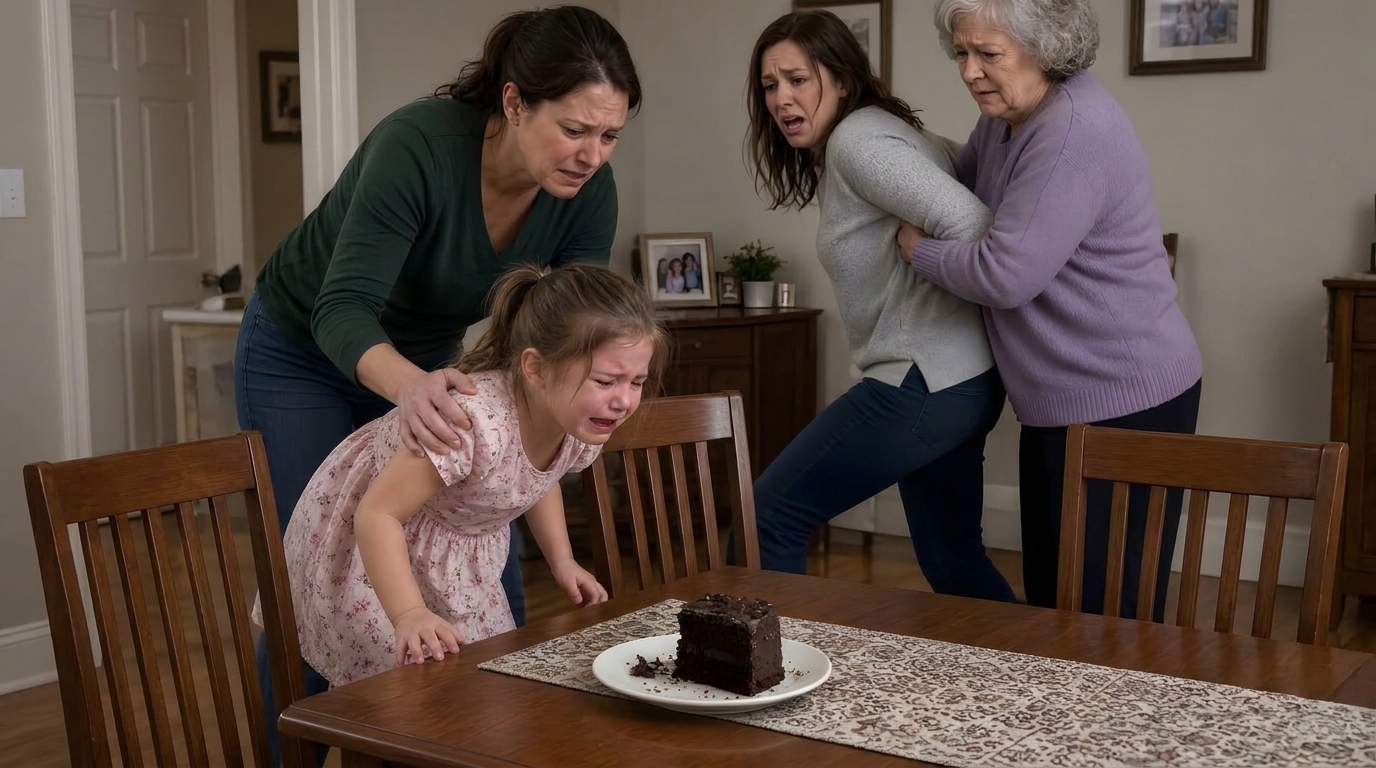
It had been an ordinary afternoon until my mother brought out the chocolate cake. She had placed it in the center of the table, and my daughter had watched with the intense concentration only a five-year-old can give to dessert. Chocolate frosting clung to the edge of the knife. The smell of cocoa and warm sugar filled the kitchen.
Vanessa had been sitting across from my daughter.
She had wanted the larger piece.
I remember that because she said so twice.
My daughter was given a piece first. She smiled and leaned over the plate, careful not to let the frosting touch her dress. She took one bite, then another.
Vanessa reached toward the cake.
My daughter, without thinking, moved her plate slightly closer to herself.
It was such a harmless little movement.
But Vanessa reacted as though my daughter had deliberately taken something from her.
“She got the bigger piece,” Vanessa said.
“She can have it,” I replied. “There's plenty.”
Vanessa frowned.
My mother told her there was another slice coming.
Then my daughter smiled and said something I barely remember now. She was talking about the frosting. There was a tiny smear of chocolate at the corner of her mouth.
Vanessa reached across the table.
I thought she was going to take the serving knife.
I was wrong.
Everything after that happened in a rush, but not so fast that I couldn't remember the details.
Vanessa stood.
My daughter leaned back.
There was a sharp movement of Vanessa's arm.
The chair scraped.
My daughter's shoulder struck the edge of the table.
Then her head followed.
The sound was dull.
Too dull.
It was the kind of sound that makes your body understand something is wrong before your mind catches up.
My daughter cried.
I moved toward her.
My mother grabbed my arms.
For one unbelievable moment, she held me back.
“Wait,” she said.
I stared at her.
“My child is hurt.”
“She needs a second.”
“A second for what?”
My daughter was crying harder.
Vanessa was staring at the fallen plate.
Not at my daughter.
At the cake.
That image had stayed with me all the way to the hospital.
Even now, sitting beside my daughter, I could see the frosting crushed against the floor tiles.
My mother had tried to tell me it was an accident.
I knew accidents happened.
What I could not understand was why, when my daughter needed an adult to rush to her, the adults around her had first worried about Vanessa.
My mother broke the silence.
“You're making her afraid of her own family.”
“No,” I said. “I'm listening to her.”
“She doesn't understand.”
“She understands that she was hurt.”
My daughter stared down at the blanket.
Vanessa swallowed.
“I never meant to hurt her.”
I believed that she might not have intended the injury.
But intention was not the whole story.
“You still did.”
Vanessa's eyes filled, and for the first time she looked directly at me.
“I said I didn't mean to.”
“And I heard you.”
My mother sighed.
“This is getting out of control.”
I looked at her.
“No. This is the first time I'm letting it be exactly what it is.”
She looked wounded.
That expression might once have worked on me.
It had worked on me for years.
I knew my mother's disappointment better than I knew my own anger. I knew when she was about to accuse me of being selfish, dramatic, ungrateful, or disloyal. I had learned to soften my words before she even asked me to.
But my daughter was lying in a hospital bed.
There was no room left for me to manage my mother's feelings first.
My daughter tugged gently on my sleeve.
I leaned closer.
“Mommy?”
“I'm here.”
“Can she go?”
I looked at Vanessa.
My mother answered before I could.
“Vanessa loves you.”
My daughter shook her head.
Then she said the words that silenced everyone.
“She hurt me.”
The room became completely still.
My mother looked at Vanessa.
Vanessa looked at the floor.
And I realized that the truth did not need to be dramatic to be devastating.
My daughter had not called Vanessa cruel.
She had not shouted.
She had not exaggerated what happened.
She had simply named it.
She was hurt.
And she was afraid.
I pulled the blanket a little higher over her legs.
“Vanessa needs to leave,” I said.
My mother stared at me.
“She is family.”
“So is my daughter.”
My mother took a slow breath.
For the first time, I saw the possibility that this argument would not end in that hospital room.
It was going to follow us home.
It was going to change things.
And as Vanessa quietly stepped toward the door, my mother gave me a look that told me she had already decided I was the one who had caused the problem.
Click Here to continue read next: PART2: My Mother Wanted Forgiveness Before My Daughter Could Even Stop Flinching Whenever the Door Opened
The Moment My Daughter Looked at Me and Asked Why Nobody Had Stopped Her Aunt
Part 1 of 8

