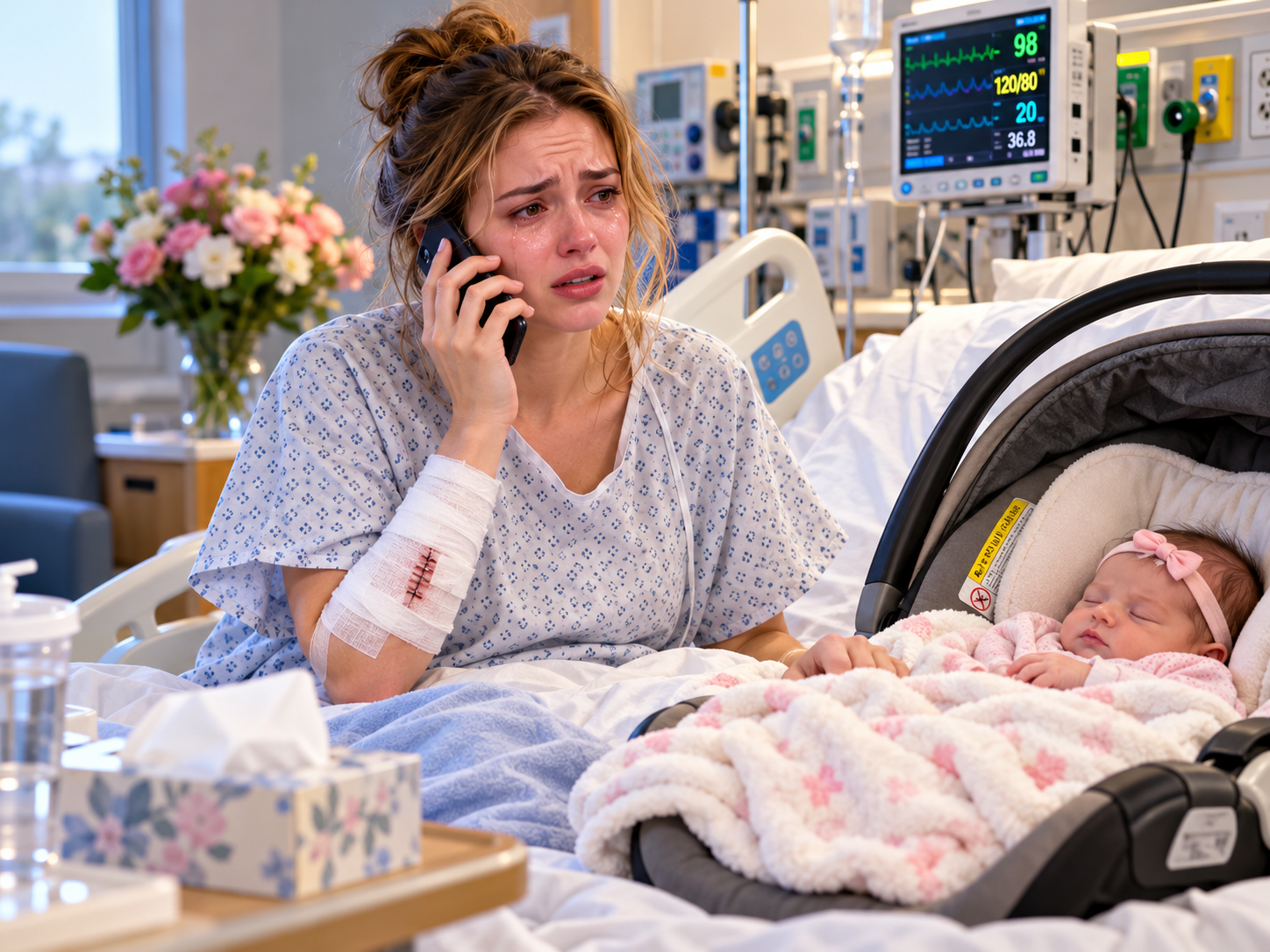
On the anniversary of the accident, I found myself looking at the faint scar along my left forearm while Ava played on the living room rug. The line had faded considerably, though it was still visible when the light caught it at an angle. I ran a finger lightly over the skin and remembered the hospital bed, the bandage, and the weight of my phone in my uninjured hand.
I had not planned to mark the date. It was Ethan who noticed it on the calendar and asked whether I wanted to do anything. At first, I said no. I did not want to turn an unpleasant memory into an annual family event. But later that afternoon, I thought about how much had changed since the day I had called my parents for help.
I messaged Sophie and asked if she wanted to meet for coffee the following weekend. She replied that she did, then asked whether I wanted to bring Ava or leave her with Ethan. I told her I would bring the baby because I wanted to show her the café where we had sat together after the first few months of repairing our relationship.
The café was not remarkable. It had small wooden tables, a chalkboard menu, and a wide front window overlooking the street. We chose a table near the glass and ordered drinks before settling Ava into her stroller. Sophie looked around and said she remembered the place, though she had not been there since our earlier lunch.
“I remember how nervous I was that day,” she said.
“Why?”
“I wasn't sure whether you wanted to talk about everything that happened or whether you were just trying to be polite.”
I smiled. “I was nervous too. I kept thinking I might say something that made you feel blamed.”
“Did you?”
“Probably at least once.”
She laughed. “Then I probably did the same.”
We sat quietly for a moment, watching people pass the window. A delivery driver hurried by with a bag tucked beneath his arm. Two women stopped to greet each other on the sidewalk. Inside the café, a machine hissed as the barista steamed milk.
“I keep thinking about that message,” Sophie said. “The one you sent from the hospital.”
“So do I.”
“It was such a simple question.”
“Is everything okay?”
She nodded. “If you hadn't asked me directly, I don't know when we would have figured it out.”
I thought about the hours before I sent it. I had nearly accepted Dad's explanation because I was exhausted and did not want another disagreement. I had been ready to wait for Ethan, struggle with the carrier, and tell myself that this was simply what being independent meant. The message had not been brave in any grand sense. It had been a question asked because something did not add up.
“I almost didn't send it,” I admitted.
“Why?”
“I thought it would sound passive-aggressive. I didn't want to start an argument.”
Sophie smiled sadly. “We spent a long time avoiding arguments that had already happened in our heads.”
The observation stayed with me. We had been so afraid of making each other uncomfortable that we had accepted secondhand explanations rather than risk asking a direct question. We had mistaken avoiding conflict for protecting the relationship, even as the silence weakened it.
Sophie reached across the table and touched my hand. “I'm glad you sent it.”
“Me too.”
When we returned home, Ethan was waiting with lunch prepared and Ava's toys spread across the living room. He asked how the coffee had gone, and I told him that Sophie and I had talked about the hospital night again. He listened, then said something that made me pause.
“You know, I think the biggest change is that you don't seem afraid to ask for help anymore.”
I looked at him. “I still don't like asking.”
“I know. But you ask.”
He was right. Before the accident, I had treated asking for help as an invitation to be disappointed. I had tried to anticipate what people would say, made my requests as small as possible, and often decided not to ask at all. I thought I was being considerate, but I was also protecting myself from the possibility of hearing no.
Now, I was learning that a request did not have to be a test of love. My parents could be unavailable without proving that they did not care. Sophie could be busy without abandoning me. I could need support without becoming a burden. And when someone's answer hurt, I could talk about it instead of quietly turning it into a permanent judgment.
That lesson became especially important when Ava developed a fever a few months later. It was late in the evening, and I was tired enough that every decision felt harder than it should have. Ethan was home, but he had an early shift the next morning. I called the pediatric advice line and followed the guidance we were given. After we had made sure Ava was safe and comfortable, I texted Sophie to let her know what was happening.
She replied immediately, asking whether I needed anything.
For a moment, I hesitated. I could manage the night, I told myself. Ethan was there. Ava was being monitored. I did not want to trouble Sophie.
Then I typed the truth: “I'm okay, but I'm anxious. Could you talk to me for a few minutes?”
She called at once. We talked while Ava slept beside me, and her familiar voice helped settle my thoughts. She did not pretend to know more than she did, and she did not tell me to stop worrying. She simply stayed on the phone until I felt calmer.
The next morning, when Ava was doing better, I thanked her.
“You don't have to thank me for answering,” Sophie said.
“I know. I still want to.”
We both laughed at the echo of our Christmas conversation. It had become a small family joke, but it also reminded me that we were learning to accept care without treating it as a debt.
Our parents continued to be part of our lives. Dad sometimes offered help before I asked, though he was still more comfortable with practical tasks than emotional conversations. Mom became more careful about speaking for us. When she was unsure whether Sophie wanted to attend something, she asked Sophie directly. When she wondered whether I needed space, she asked me.
She did not get it right every time. Once, she told Sophie that I had said I wanted a small birthday gathering, when I had actually said I was still deciding. Sophie checked with me, and I explained that I had not settled on a plan. Mom apologized for getting ahead of herself. We moved on without turning the mistake into evidence that nothing had changed.
That was how I knew our progress was real. We no longer expected perfection from one another, and we no longer treated every mistake as proof that the old pattern was returning. We corrected what we could, acknowledged what hurt, and tried again.
On Ava's first birthday, Sophie arrived early to help decorate. She had brought a banner, a bag of balloons, and a cake she had insisted on making herself. The frosting leaned slightly to one side, and the lettering was crooked, but Ava seemed more interested in the bright colors than in the design.
Mom arrived with a gift and asked where she could help. Instead of taking over the food or deciding who should sit where, she waited for me to answer. Dad carried a box of decorations inside and spent half an hour trying to attach a balloon to a chair without making it look ridiculous.
The house was noisy, crowded, and full of the ordinary confusion that comes with a child's birthday. Sophie held Ava while I lit the candles. Ethan gathered everyone close for a photograph, and Mom stood beside Dad, smiling as Ava leaned toward the cake with both hands.
After the guests had left and the living room was quiet again, Sophie and I sat on the floor surrounded by torn wrapping paper. Ava had fallen asleep, exhausted from the attention. Sophie picked up a small plastic spoon and turned it over in her fingers.
“Do you ever think about how different things might have been if you hadn't called me?” she asked.
“Sometimes.”
“Do you think we'd have figured it out eventually?”
I considered the question. Maybe we would have. Perhaps one of us would eventually have asked the right question, or a family gathering would have forced the contradictions into the open. But we might also have continued drifting, each believing the other had chosen the distance.
“I don't know,” I said. “I think we might have gone on believing what we were told.”
Sophie nodded. “That scares me a little.”
“Me too.”
She put the spoon down and leaned her shoulder against mine. We sat there without talking, listening to the quiet hum of the refrigerator and the distant sound of a car passing outside.
I thought about the girl Sophie had been when we shared a bedroom, the young woman I had assumed no longer needed me, and the sister who had hurried to the hospital because I had finally asked her directly. She had not changed from an uncaring person into a caring one. She had cared all along. We had simply lost the ability to recognize it through the stories we had accepted about each other.
I also thought about my parents. I still loved them. I could appreciate the ways they had helped me over the years while acknowledging that some of their choices had caused harm. Forgiveness did not require me to deny what happened, and honesty did not require me to stop loving them. It meant I could hold both truths at once.
The hospital night had begun with an ordinary need. I had been injured, my husband was far away, and I needed someone to help me get my newborn home safely. My father had refused, explaining that my sister needed our parents. I had nearly accepted the answer without question because I had spent years believing that Sophie always came first.
But the message I sent her changed the direction of that night. It showed me that our parents' explanations were not the same as our own voices, and that silence could not tell me what my sister felt. We had both been waiting for the other to reach out, each afraid of being unwanted.
Ava stirred in her sleep and made a small sound. Sophie rose to check on her, moving carefully through the dim room. I watched my sister bend over the crib and gently settle the blanket around my daughter. The scene was quiet and ordinary, yet it held the answer to the question I had once been too hurt to ask.
Sophie had wanted to be there.
She had wanted to meet Ava, to hold her, to know how I was doing, and to be part of our lives. I had wanted those things too. What separated us was not a lack of love but the assumption that the other person had already chosen to walk away.
I could not change the months we had lost or erase every misunderstanding that came before them. I could not make my parents respond perfectly, and I could not guarantee that Sophie and I would never hurt each other again. But I could ask rather than assume. I could listen rather than defend an old conclusion. I could tell my sister when I needed her and trust her to tell me when she needed me.
That was what we had recovered: not the exact relationship we had as children, but the chance to build an adult relationship on what we actually said and did, rather than on what someone else believed we meant.
The scar on my arm would probably remain, a thin reminder of the accident that sent me to the hospital. Whenever I noticed it, I would remember the pain, the fear, and the helplessness of that evening. But I would also remember the message I almost deleted, the sister who answered, and the moment I discovered that the person I thought had abandoned me had been waiting for me to reach out.
I had called my parents because I needed help carrying a baby and a car seat.
I ended up learning how to stop carrying years of assumptions by myself.
And the most important thing I gained that night was not an apology, an explanation, or even proof that I had been right to feel hurt.
It was the chance to know my sister again.
Click here to continue reading: PART 9: When My Father Finally Asked for Help, I Had to Decide Whether Our New Boundaries Applied to Him Too
Seven Stitches, a Sleeping Baby, and the Familiar Excuse That Made Me Question Everything
Part 8 of 20