I didn't sleep that night.
I drove around for nearly an hour before finally parking outside a twenty-four-hour café.
I sat in the corner with a cup of coffee I barely touched and stared at the table.
My phone kept vibrating.
Messages from my wife.
Please come home.
We need to talk.
I'm sorry.
Please.
I turned the phone face down.
Every message made me angrier.
Not because she was contacting me.
Because those words were arriving after the damage had already been done.
By morning, I had made one decision.
I needed the truth.
Not a partial confession.
Not three times.
Not I was bored.
Not I loved you but made a mistake.
I needed to understand how the woman I had married had reached the point where she could hide another relationship from me while coming home and sitting beside me at dinner.
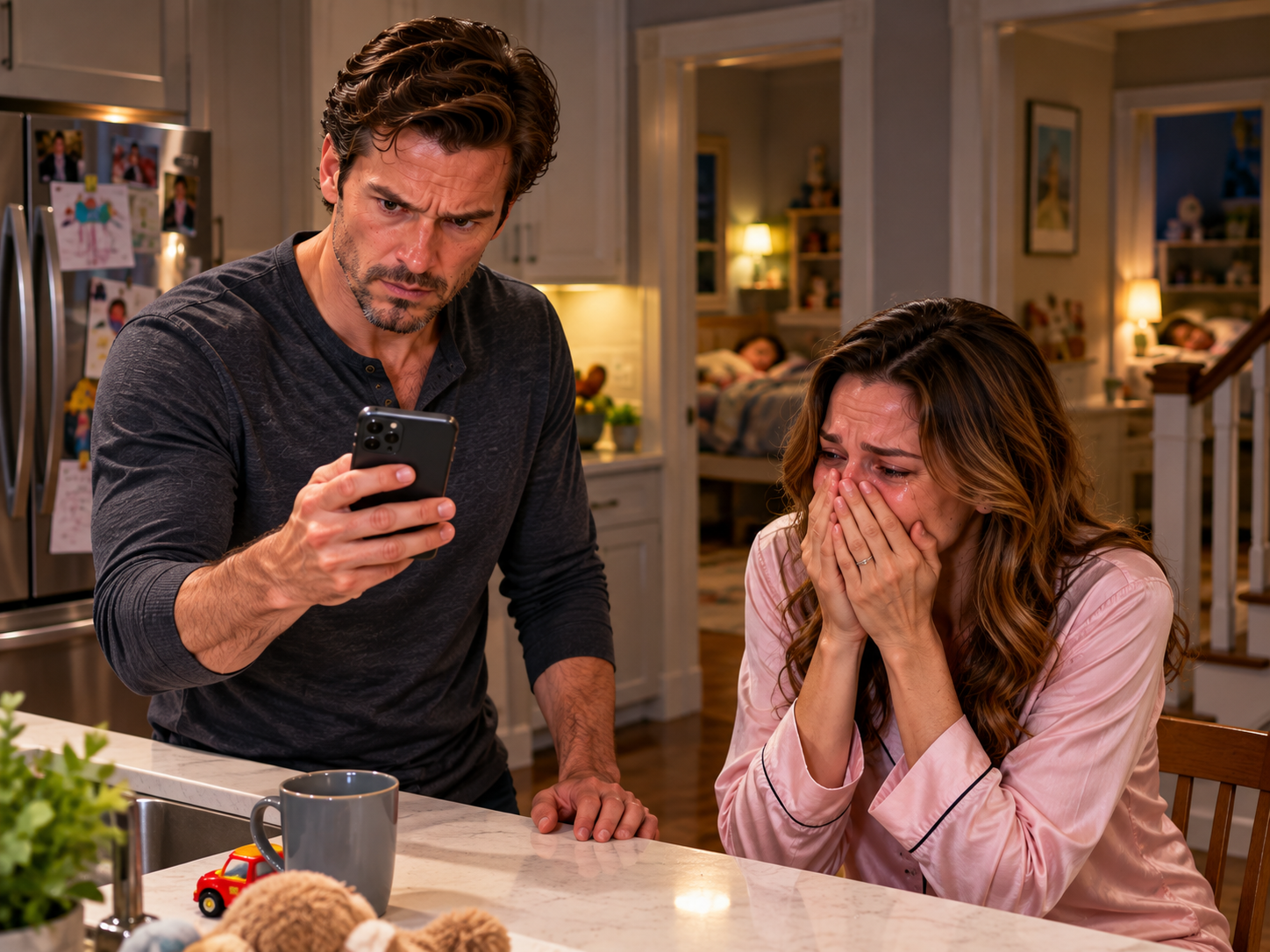
When I returned home, my wife was sitting at the kitchen table.
She hadn't slept either.
Our daughter was watching cartoons in the living room.
Our son was still asleep.
She looked at me.
“Can we talk?”
“Yes.”
She took a breath.
“I don't know where to begin.”
“Begin with the truth.”
She looked down.
“I was unhappy.”
“That isn't enough.”
“I felt bored.”
“You told me that already.”
“I liked the way he made me feel.”
I stared at her.
“What did he make you feel?”
“Wanted.”
The word stayed between us.
I sat down.
“Didn't I make you feel wanted?”
She didn't answer.
That silence told me more than I wanted to know.
“I thought you were happy.”
“I was.”
“That doesn't make sense.”
“I know.”
“You were happy and unhappy at the same time?”
“Yes.”
“How?”
She rubbed her hands together.
“I loved our family. I loved you. But I felt like I had become only a wife and a mother.”
I wanted to understand.
Part of me desperately wanted to find a reason that would make the affair logical.
But there was no explanation that turned betrayal into something unavoidable.
“You could have told me.”
“I should have.”
“You could have asked for help.”
“I should have.”
“You could have said you were unhappy.”
“I know.”
“You could have left.”
She looked at me.
“I didn't want to lose everything.”
I laughed bitterly.
“You mean you wanted to keep me and have him?”
“No.”
“But that's what you did.”
She began crying.
“I know.”
I stood and walked to the window.
Outside, our neighbor was loading groceries into a car.
Someone was walking a dog.
Children were waiting for a school bus.
Normal life.
It seemed offensive that the world could continue normally while mine had changed overnight.
My wife came closer.
“I was going to end it.”
“When?”
“I don't know.”
“Before or after I found out?”
“Before.”
I turned.
“Were you?”
“Yes.”
“Why?”
“Because I knew it was wrong.”
“When did you know?”
She hesitated.
“Almost immediately.”
That answer made my chest hurt.
Because it meant she had known.
She hadn't accidentally crossed one line and suddenly found herself trapped.
She had recognized the line and kept walking.
“How many messages were there?”
“I don't know.”
“Did you delete any?”
She looked away.
I knew.
“Did you?”
“Yes.”
“How many?”
“I don't know.”
I sat down again.
This was worse than I had expected.
Not because I wanted to know every detail.
Because every answer created another question.
She had told me she was bored.
She had told me she liked attention.
She had told me she loved me.
She had told me she planned to end it.
None of those statements could erase what she had chosen.
Our daughter came into the kitchen.
“Daddy?”
I looked at her.
“Yeah?”
“Are you staying home today?”
I swallowed.
“Yes.”
She climbed into my lap.
My wife stood nearby.
Our daughter didn't know.
She didn't know why her mother's eyes were red.
She didn't know why I looked exhausted.
She only knew that her father was sitting in the kitchen.
I hugged her.
That was when I realized the hardest part wasn't leaving my wife.
It was understanding what leaving would mean for the children.
I couldn't bear the idea of them asking why Daddy no longer lived at home.
I couldn't bear the thought of birthdays divided between houses.
I couldn't bear the idea of my daughter thinking she had done something wrong.
I couldn't bear losing ordinary mornings.
But I also couldn't imagine sleeping beside my wife and pretending trust still existed.
That afternoon, I called someone I trusted.
I told him what had happened.
He listened without interrupting.
Then he asked, “What do you want?”
I didn't know.
“I want my family.”
“That's not the same as wanting your marriage.”
I said nothing.
He was right.
But I wasn't ready to separate those two things.
That evening, my wife asked me to stay.
“I can fix this.”
“How?”
“I'll stop.”
“You already stopped?”
“Yes.”
“Because I found out?”
“No.”
I looked at her.
She looked directly at me.
“I was going to.”
“When?”
“I don't know.”
That answer wasn't enough.
“I need you to understand something,” I said. “I can't live with this hanging over us.”
“I know.”
“I can't wake up every morning wondering whether you're telling me the truth.”
“I'll prove it.”
“How?”
“I don't know.”
I shook my head.
“That's the problem.”
She reached for my hand.
I pulled it away.
She flinched.
I hated doing that.
But I was afraid that if I accepted comfort from her, I would confuse tenderness with trust.
Those were not the same thing anymore.
The next morning, I told her I needed space.
I packed a small bag.
Our daughter watched from the hallway.
“Are you going somewhere?”
“For a little while.”
“Why?”
I knelt beside her.
“Mom and Dad are having a grown-up problem.”
“Are you angry?”
I looked at my wife.
Then back at my daughter.
“Yes.”
“Is Mom angry too?”
“She is sad.”
“Are you coming back?”
The question almost broke me.
“I'll always come back to you.”
She hugged me.
I held her longer than usual.
Then I left.
I rented a small apartment about twenty minutes away.
It was nothing like our home.
One bedroom.
A narrow kitchen.
A couch that had clearly belonged to someone else.
The first night, I stood in the middle of the room and realized I had never felt so alone.
But the loneliness was easier than the pretending.
My wife continued calling.
She asked whether I would consider counseling.
Eventually, I agreed.
Not because I had decided to save the marriage.
Because I needed somewhere to speak without the children listening.
During the first session, she said she had been bored.
She said she liked the attention.
She said she regretted what she had done.
Then she looked at me.
“I still love you.”
The counselor asked me what I felt when I heard that.
I answered honestly.
“I don't know whether I believe her.”
My wife began crying.
The counselor didn't rush to comfort either of us.
Instead, she said something that stayed with me.
“Trust isn't rebuilt by asking the injured person to believe you. It's rebuilt by giving them enough consistent evidence that they no longer have to force themselves to believe.”
I looked at my wife.
She nodded.
For the first time, I realized that an apology was not a bridge.
It was only the first plank.
There would have to be many more.
And I had no idea whether either of us had the strength to build them.
Click here to continue reading: PART 3: I wanted to keep my children under one roof, but every attempt to rebuild the marriage forced me to confront a boundary I could no longer ignore
The message that appeared on my wife’s phone looked harmless at first, until I opened it and discovered months of choices I could never unknow
Part 2 of 28