Five years after Carter first announced that his family was moving into my house, we gathered at the lake for another Lake Day.
Five years.
The number surprised me.
It didn't feel that long.
Then again, so much had changed that the original night seemed almost like a different lifetime.
The house looked much the same.
The pool still caught the afternoon light.
The agave still lined the walkway.
The balcony still overlooked the water.
But the people were different.
Not completely.
Just enough.
My father was seventy-five.
My mother walked carefully after her earlier fall but refused to admit she was cautious.
Chloe had built a life of her own.
The children were older.
Sarah had become part of the family in a way none of us had planned.
Carter was no longer my husband.
But he was no longer a threat either.
That distinction mattered.
He arrived at the gate and texted.
“Here.”
I replied.
“Come in.”
He entered.
The children greeted him.
My father called him over to the grill.
My mother handed him a plate.
It was ordinary.
That was the miracle.
No one treated the house like contested territory.
No one checked whether they were allowed to sit in a certain chair.
Everyone simply knew the rules.
And because they knew them, nobody needed to discuss them constantly.
After lunch, my father asked everyone to gather.
“I have something to say.”
I smiled.
“Again?”
He laughed.
“This time, I'm prepared.”
We gathered near the pool.
He stood holding a glass.
“When I was younger, I thought being a parent meant having authority.”
He looked at me.
“I thought if I paid for something, helped with something, or loved someone, I earned a permanent right to their choices.”
Nobody interrupted.
“I was wrong.”
He looked around.
“I also thought family tradition meant nobody should ever be told no.”
My mother nodded.
“I believed that too.”
My father continued.
“I learned that when someone says no, the respectful response isn't to explain why they shouldn't have said it.”
He smiled faintly.
“It's to hear them.”
I looked down.
The children were listening.
That mattered.
My father raised his glass.
“I hope they learn that earlier than I did.”
Everyone applauded.
Then one of the younger children asked, “What happened?”
My father looked at me.
I smiled.
“Tell them.”
He laughed.
“Your grandparents once came to the lake house without permission.”
The child looked shocked.
“You did?”
My mother sighed.
“Yes.”
“Why?”
“We thought family meant we didn't need to ask.”
The child frowned.
“But she owned it?”
“Yes,” my father said.
“And she said no?”
“Yes.”
“What did you do?”
My father looked uncomfortable.
“We came anyway.”
The children gasped.
I laughed.
“Eventually the sheriff got involved.”
Their eyes widened.
“The sheriff?”
“Yes.”
“Because of a house?”
“Because people ignored an answer.”
The children looked at one another.
My father nodded.
“That was the lesson.”
He didn't hide it.
He didn't excuse himself.
He didn't make himself the hero.
He told the truth.
One of the children asked, “Were you embarrassed?”
My father laughed.
“Very.”
“Did you learn?”
“Eventually.”
The child thought about it.
“That's a long time.”
“It was.”
Everyone laughed.
Later, I walked toward the dock.
Carter followed.
“Can I sit?”
“Yes.”
We sat side by side.
He looked toward the family.
“Your dad handled that well.”
“He did.”
“He didn't make himself look good.”
“No.”
“That takes courage.”
I looked at him.
“It does.”
He was quiet.
Then he said, “I think I finally understand something.”
“What?”
“Forgiveness isn't the same as pretending nothing happened.”
“No.”
“It means you remember it without needing the other person to suffer forever.”
I nodded.
“That sounds right.”
He looked at the house.
“I don't expect anything from you.”
“I know.”
“I just wanted you to know that.”
I smiled.
“Thank you.”
He stood.
“I'll help your dad with the grill.”
“Go.”
He walked away.
I remained on the dock.
The lake moved gently beneath me.
I thought about the first night.
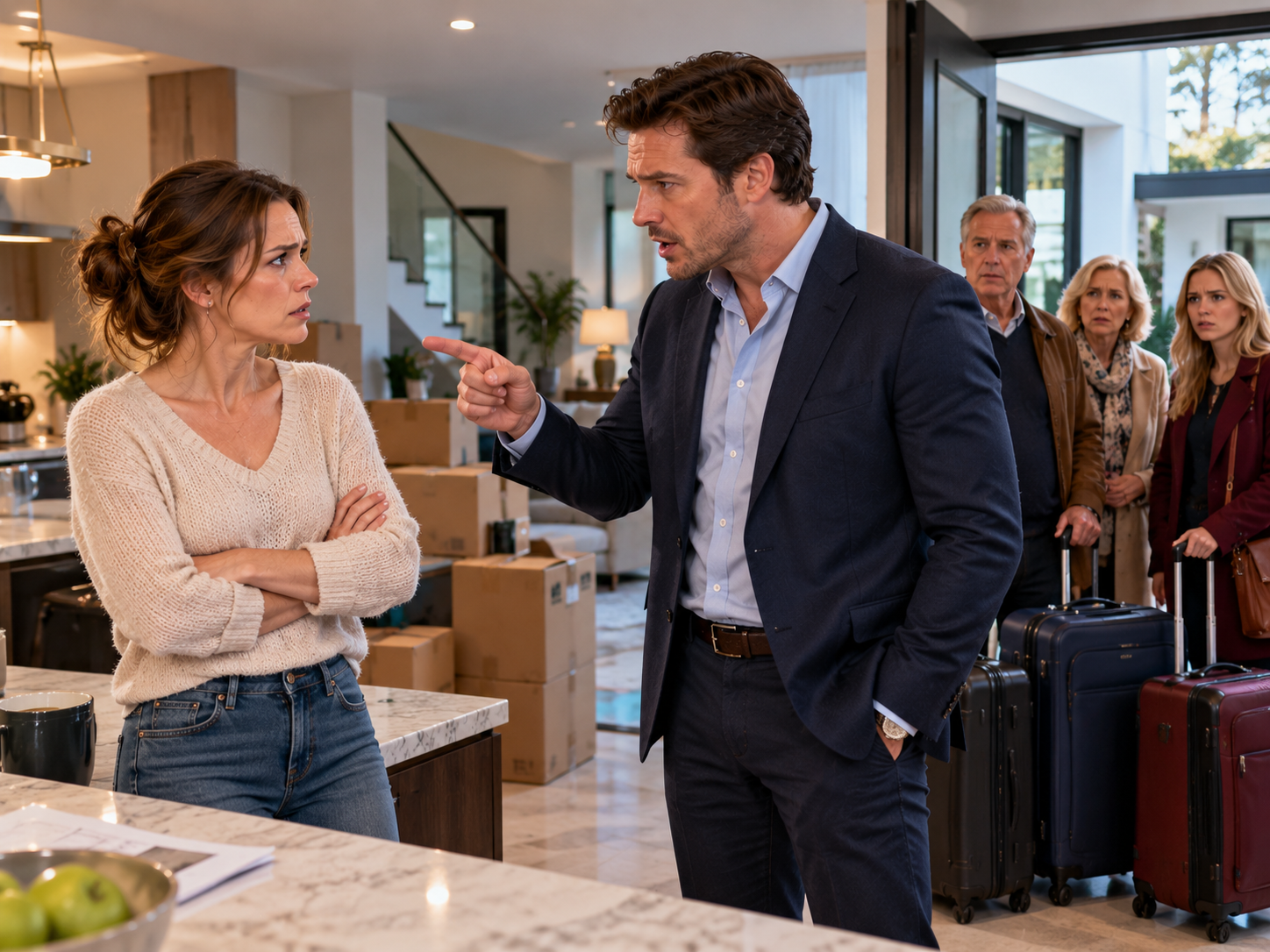
Carter standing in the kitchen.
The wet ring his bottle had left on the counter.
The words about his family arriving.
The floor plans.
The hidden business.
The pressure.
The fear.
For a long time, I thought that night had taken something from me.
It had.
But it had also forced me to learn something I might otherwise have avoided.
Ownership wasn't only about property.
It was about agency.
A person could love you deeply and still believe they were entitled to decide for you.
A family could mean well and still cross a line.
An apology could be sincere and still not restore the old relationship.
Trust could return without returning to its original form.
Those truths were harder than simple forgiveness.
They were also more useful.
That evening, everyone helped clean.
The children carried empty plates.
Chloe folded towels.
Sarah wiped the counters.
Carter took the trash outside.
My father checked the grill.
My mother gathered the cups.
Nobody waited for me to do everything.
I stood in the kitchen watching them.
The house was full.
Yet I felt completely in control.
Not because everyone was obeying me.
Because nobody was assuming anything.
That was the difference.
Before sunset, my mother came to me.
“Do you ever regret keeping control of the house?”
I looked toward the lake.
“No.”
“Not once?”
“No.”
She smiled.
“Good.”
“Why?”
“Because I don't think you should regret protecting yourself.”
I nodded.
Then she added, “But I'm glad you don't keep everyone out.”
I smiled.
“Neither am I.”
The last cars left around eight.
Carter was the final one.
He stood at the gate.
“Good night.”
“Good night.”
He paused.
“Thank you.”
“For what?”
“For letting me be here.”
“You asked.”
“I know.”
He smiled.
“That's still new to me.”
Then he left.
I closed the gate.
Walked back toward the house.
The windows glowed against the dark.
Inside, the kitchen was clean.
The pool lights were still on.
The old photograph from Chloe remained on the shelf.
The estate documents were secure.
The deed was secure.
Everything was where it belonged.
I walked to the front door and rested my hand on the handle.
For years, I had thought the door represented danger.
Then I thought it represented defense.
Now I understood.
It represented choice.
I could open it because I wanted to.
I could close it because I needed to.
I could welcome people without giving them ownership.
I could love my family without surrendering myself.
The house was still mine.
But it no longer felt like something I had to defend.
It felt like somewhere I was free to live.
And if someone knocked tomorrow, I would listen.
I would look through the glass.
I would decide.
Whatever answer I gave would be enough.
Click here to continue reading: PART 17: After the anniversary gathering, my father asked what would happen to the lake house when I was gone, and the answer changed how we saw its future
My husband thought three relatives could simply move into the house I had bought, but his confidence made me wonder what he believed he had already arranged
Part 16 of 20