Two years after the night on the porch, Stephen finally decided to sell the house.
The decision surprised even him.
He had originally thought he would stay there forever.
But the house carried too many memories, and he had begun thinking about moving somewhere smaller.
Somewhere with less maintenance.
Somewhere that did not require him to remember every room.
He hired a real-estate agent named Claire.
She walked through the property with a tablet, measuring rooms and making notes.
“This is a beautiful house,” she said.
Stephen smiled.
“It has history.”
Claire looked at the repaired porch.
“Good history?”
“Some of it.”
She didn't press.
The house went on the market.
Within a week, there was serious interest.
A couple named Daniel and Priya visited twice.
They loved the kitchen.
They liked the backyard.
They asked detailed questions about the roof, plumbing, electrical work, and neighborhood.
Everything seemed normal.
Then Claire called.
“There is a problem.”
Stephen was sitting at his desk.
“What kind?”
“The title company found an old filing.”
Stephen's stomach tightened.
“What filing?”
“A claim connected to an attempted property authorization.”
Stephen closed his eyes.
“From Dario?”
“Possibly.”
“But the police said it failed.”
“It did.”
“Then what is the problem?”
“The filing wasn't valid.”
She paused.
“But it wasn't properly withdrawn from one of the records systems.”
Stephen felt a familiar irritation rise.
“So someone could think there's still an issue?”
“Yes.”
“Can it be fixed?”
“Probably.”
That word did not reassure him.
He contacted his attorney.
The attorney reviewed the paperwork.
“The underlying document has no legal effect.”
“Then why is this happening?”
“Administrative residue.”
Stephen laughed.
“After everything, I'm being haunted by paperwork.”
His attorney smiled.
“Paperwork is very good at surviving people.”
They began the process of correcting the record.
It took weeks.
Stephen provided police reports.
Bank records.
Court documents.
Statements confirming that he had never authorized the property filing.
Eventually the title company cleared the issue.
The sale moved forward.
But the experience brought back something Stephen had thought he had finally buried.
He had spent two years believing the danger was behind him.
Now he realized that betrayal could leave fingerprints long after the person responsible had disappeared from your daily life.
Financial damage could be repaired.
A lock could be replaced.
A porch could be rebuilt.
But records remained.
Paper remained.
Consequences remained.
On the day before closing, Stephen received an unexpected call.
Melissa.
He nearly ignored it.
Then he answered.
“Hello?”
“Are you selling the house?”
“Yes.”
“I heard.”
“From whom?”
“Mom.”
Stephen hadn't spoken to his mother about the sale.
He frowned.
“What did she say?”
“She said you're moving.”
“I am.”
There was silence.
Then Melissa said, “I'm glad.”
Stephen sat back.
“Why?”
“Because maybe you'll finally stop living there.”
He understood what she meant.
“Maybe.”
“I want to see you before you go.”
Stephen hesitated.
“Why?”
“I want to say goodbye.”
He looked around the room.
Two years ago, he would have immediately agreed.
Now he considered what he needed.
Finally he said, “We can meet somewhere public.”
“That’s fair.”
They met at a small café.
Melissa looked different.
Not dramatically.
Just older.
Less defensive.
More tired.
She sat across from him.
“You look well.”
“So do you.”
She smiled faintly.
“Nico is doing well.”
“I'm glad.”
“He asked about you.”
Stephen looked down at his coffee.
“What did you tell him?”
“That you love him.”
“I do.”
“And that what happened wasn't his fault.”
Stephen looked at her.
“Good.”
Melissa folded her hands.
“I wanted to tell you something before you sell the house.”
“What?”
“Dario didn't know about every part of the plan.”
Stephen stared.
“What does that mean?”
“Some of the documents came from someone else.”
“Victor?”
“No.”
“Then who?”
Melissa hesitated.
“Raymond.”
Stephen remembered the photograph Victor had shown him.
“What about him?”
“He had access to information about property loans.”
Stephen waited.
“He was the person who encouraged Dario to think bigger.”
“Bigger than what?”
“Your house.”
Stephen's expression changed.
Melissa continued.
“Raymond told Dario that if your property couldn't be used, another person's could.”
Stephen realized something.
Dario had not invented the entire scheme.
But neither had he simply been manipulated.
He had chosen to participate.
“Did Raymond ever contact you?”
“No.”
“Did he threaten you?”
“No.”
“Then how do you know this?”
Melissa looked down.
“Dario told me after he was arrested.”
“Why?”
“He was angry.”
“Angry at whom?”
“Everyone.”
Stephen shook his head.
“So there was another person.”
“Yes.”
“What happened to him?”
Melissa looked toward the window.
“He disappeared.”
Stephen frowned.
“Disappeared?”
“He left the state.”
That was unsettling.
But the police had already known about Raymond.
His role had been documented.
The case had not depended entirely on locating him.
Still, Stephen found himself thinking about the old photograph.
The restaurant.
Dario.
Raymond.
The conversation that had happened before Melissa ever called him.
He wondered whether he had ever truly understood how deliberate the original plan had been.
Melissa reached across the table.
Stephen instinctively moved his hand away.
She stopped.
“I understand.”
He nodded.
“I don't hate you.”
She looked at him.
“That means more than you think.”
“But I don't trust you.”
“I know.”
“And I don't know if I ever will.”
She nodded.
“I know that too.”
There was no argument.
No attempt to make him feel guilty.
That was perhaps the biggest change of all.
They finished their coffee.
Before leaving, Melissa said, “Can I ask one thing?”
“What?”
“Are you happy?”
Stephen thought about it.
“Yes.”
The answer came easily.
Melissa smiled.
“Good.”
They stood.
Neither hugged.
Neither pretended the past had disappeared.
They simply said goodbye.
The next morning, Stephen signed the final papers.
The house belonged to someone else.
He sat in his car outside for several minutes.
He expected sadness.
Instead, he felt light.
He looked at the porch one final time.
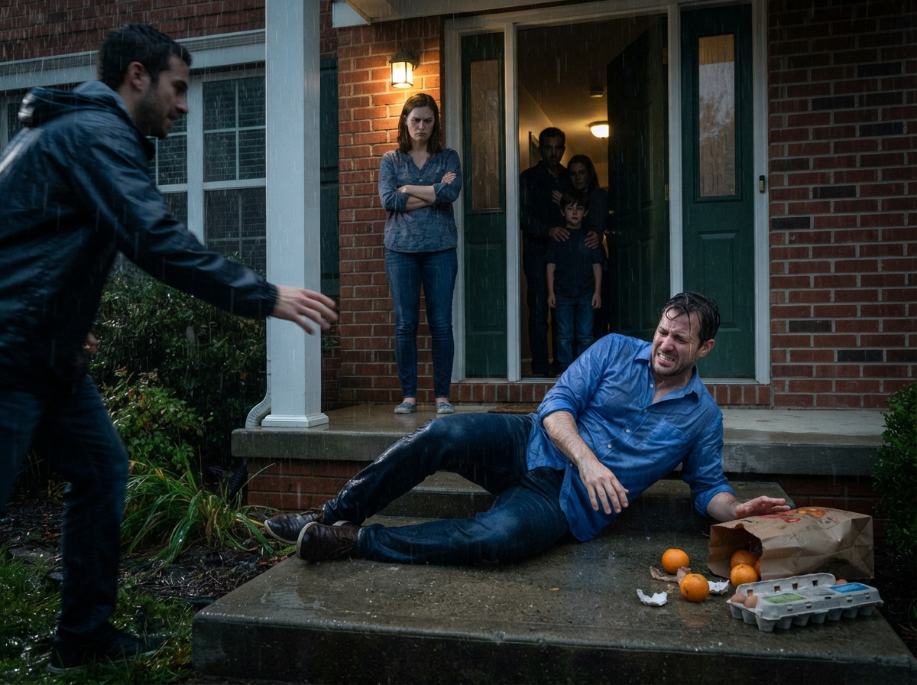
He remembered the rain.
The broken ankle.
The groceries.
Melissa's words.
Marcus helping him.
The police.
The blue folder.
The photographs.
The years afterward.
Then he started the engine.
His new home was smaller.
It had fewer rooms.
A smaller yard.
A shorter driveway.
But when Stephen walked through the front door that evening, he didn't feel as though he had lost something.
He felt as though he had made room for something new.
He unpacked slowly.
He placed the old photograph of himself and Melissa in a drawer.
Not on display.
Not hidden.
Simply kept.
Some memories deserved neither worship nor destruction.
They could simply exist.
A week later, the title company called.
Everything had been finalized.
No outstanding claims.
No liens.
No unresolved property issues.
The last shadow had finally been removed.
Stephen thanked the representative.
After hanging up, he stood by the window.
The new house was quiet.
But this time, quiet meant possibility.
His phone buzzed.
A message from Marcus.
Dinner tonight?
Stephen smiled.
Absolutely.
He put on his jacket.
Before leaving, he checked the door.
Locked.
Then he smiled at himself.
He wasn't checking because he was afraid.
He was checking because habits remained.
Some habits came from fear.
Others came from wisdom.
He was learning the difference.
Click Here to continue read next: PART8: When Stephen Finally Closed the Last File, He Discovered That Moving Forward Did Not Require Forgetting What Had Happened
The Five Minutes Began With a Broken Ankle, a Doorway Full of Silence, and the Family I Thought I Could Still Trust
Part 7 of 16