Christmas came again.
I almost laughed when I saw the first decorations appear in the stores.
For months, the word itself had carried too much weight.
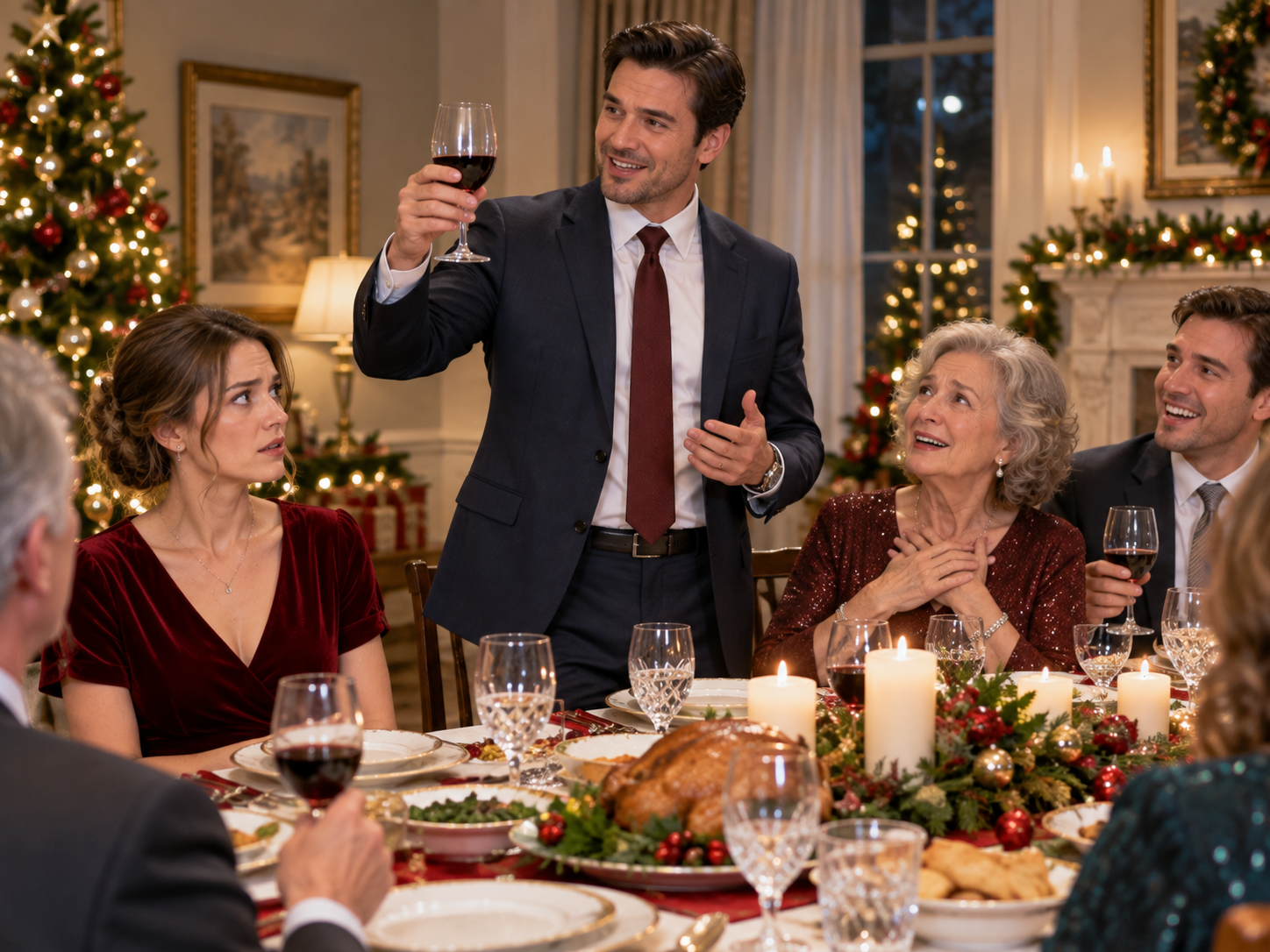
Christmas had become the night of the toast.
The night of the roof.
The night Cal had said “we.”
The night everything began to fall apart.
But a year had passed.
Time had changed the edges.
Not the facts.
Not the consequences.
The edges.
I bought a small tree.
Not the large one Cal and I had used.
A simple one.
I decorated it alone.
There was something comforting about choosing every ornament myself.
No family expectations.
No hidden meaning.
No one else's plans.
Just mine.
I made dinner for two.
The second place was not for a date.
It was for my sister, who had spent the year checking on me without asking intrusive questions.
She arrived carrying wine.
“You look happy.”
I smiled.
“I am.”
She hugged me.
We sat down.
For a while, we talked about ordinary things.
Work.
Travel.
Books.
A neighbor's ridiculous dog.
I realized halfway through dinner that I had gone nearly an hour without thinking about Cal.
That felt like a milestone.
Not because I wanted to forget.
Because I no longer needed to remember.
After dessert, my sister raised her glass.
“To your new year.”
I laughed.
“To mine.”
The glasses touched.
No fear.
No tension.
No secret.
Just a toast.
Later, after she left, I sat beside the tree.
The lights reflected in the window.
My phone was silent.
The house was silent.
I opened the folder containing the final legal documents.
There was the closure notice for the fraudulent account.
There were the credit corrections.
The settlement records.
The court documents.
The final report.
I read the last page again.
The financial investigation had established the chain of accounts.
Cal's responsibility had been documented.
Adrian's role had been separately addressed.
Derek had cooperated.
Margaret had testified.
Eric had given evidence.
The questions surrounding Marcus's death had been resolved as far as the evidence allowed.
Cal had not been convicted of intentionally killing Marcus.
But his vehicle had struck Marcus's car.
He had left the scene.
He had concealed what happened.
He had spent years hiding the truth.
That was enough.
I closed the folder.
There was no more mystery I needed to solve.
That was the strange part.
For months, I had thought the final answer would make me feel whole again.
It didn't.
It simply made the uncertainty stop.
Wholeness came from elsewhere.
From mornings when I woke without checking whether money had moved.
From signing my name without wondering where it might appear.
From receiving mail without fear.
From choosing where to live.
From deciding whom to trust.
From learning that independence wasn't loneliness.
It was ownership of my own choices.
A few days before Christmas, I received a letter from Margaret.
I almost didn't open it.
Inside was a short note.
She said she was sorry.
She said she had finally understood how badly fear had distorted her decisions.
She said she hoped I would someday remember her without only remembering the lies.
I folded the letter.
I didn't know whether I would.
But I didn't need to decide that day.
I placed it in the drawer.
The next letter came from Eric.
He had finished repaying the money.
He included a note saying he had opened a separate savings account for his daughter.
He wrote:
“I want her to grow up understanding that needing help doesn't mean you stop asking questions.”
I smiled.
That was something.
Not redemption.
But change.
Stephanie never wrote again.
I hoped she was safe.
I didn't need to know more.
Derek's name disappeared from my life.
Adrian's legal proceedings continued without me.
Cal remained in custody.
I did not visit.
I had once believed visiting him would give me closure.
It wouldn't.
I had already said everything I needed to say.
The last time I saw him was in the courthouse.
He had looked at me.
I had looked back.
That was enough.
On Christmas Eve, I took a walk.
The streets were bright with decorations.
Families carried groceries.
Children ran ahead of parents.
Cars lined the roads.
Ordinary life.
I liked it.
I liked how ordinary it was.
At a small coffee shop, I stopped for a drink.
The woman behind the counter asked:
“Holiday plans?”
I smiled.
“Dinner with family.”
“Big gathering?”
“No.”
She smiled.
“Sometimes small is better.”
I nodded.
Sometimes it was.
I walked home carrying the coffee.
When I reached my house, I saw the tree through the window.
The lights were still on.
I unlocked the door.
For a moment, I stood in the hallway.
This was my home.
Not ours.
Mine.
The distinction still mattered.
I went to the kitchen.
On the counter was the old bank statement.
I had kept it as a reminder.
The account ending in 6619.
The account that had carried my name without my permission.
The account that had moved nearly nine hundred thousand dollars through a network I never knew existed.
I looked at the number.
Then I tore the statement in half.
Not because I wanted to erase the past.
Because I didn't need the paper anymore.
The evidence belonged in the legal files.
The lesson belonged with me.
I threw the pieces away.
Then I made tea.
I sat beside the window.
The first snow began falling.
It wasn't dramatic.
Just small flakes disappearing against the glass.
I thought about the woman I had been a year earlier.
She had sat at a Christmas table and believed her husband was making an announcement about a bonus.
She had smiled because everyone else smiled.
She had raised her glass because everyone else raised theirs.
She had believed the word “we.”
I felt compassion for her now.
She had trusted someone.
That was not a crime.
She had believed a marriage meant honesty.
That was not foolish.
She had failed to question things she should have questioned.
That was human.
What mattered was what she did once she knew.
She looked.
She asked.
She protected herself.
She told the truth.
She stopped accepting explanations simply because they were convenient.
She left.
I had once thought strength meant never being deceived.
Now I knew better.
Strength was what happened after deception.
It was the decision to look at the truth without bargaining with it.
It was accepting that someone could love you and still hurt you.
It was accepting that an apology could be sincere and still not be enough.
It was accepting that forgiveness did not require reconciliation.
And it was understanding that leaving did not mean the years had been meaningless.
My marriage had contained happiness.
It had also contained fraud.
Both were real.
One did not erase the other.
But the fraud no longer controlled the meaning of my life.
That belonged to me.
At midnight, fireworks began somewhere across the city.
I stood by the window and listened.
My phone buzzed once.
A message from my sister.
Merry Christmas. Proud of you.
I smiled.
I typed back:
Merry Christmas. Love you.
Then I put the phone down.
There was no message from Cal.
I was grateful.
The next morning, I woke early.
I made coffee.
I opened the curtains.
Sunlight filled the kitchen.
For a moment, I stood still.
No investigators.
No statements.
No forged signatures.
No hidden accounts.
No questions waiting in an envelope.
Just morning.
I took out my notebook.
On the first page, I had written:
I am allowed to know my own life.
Underneath it, I added another sentence.
I am allowed to choose what comes next.
Then I closed the notebook.
The story had begun with money.
It had moved through marriage, family, fear, fraud, and loss.
It had crossed years before I knew it existed.
It had reached backward into the beginning of my relationship and forward into the life I had to rebuild.
But the ending was not the punishment of Cal.
It was not the exposure of Adrian.
It was not the recovery of the money.
Those things mattered.
They had consequences.
But they were not my ending.
My ending was simpler.
I knew my name.
I knew my accounts.
I knew my choices.
And I no longer needed anyone else to tell me what “we” meant.
A year earlier, Cal had raised his glass and told his family that “we” had gotten a bonus.
He had used my money to create an image of generosity.
He had believed the word belonged to him.
Now, when I thought of that night, I no longer remembered the applause first.
I remembered the moment I looked across the table and saw him avoid my eyes.
That had been the beginning.
Not because I knew everything.
Because something inside me recognized that the story I was being told was incomplete.
I had followed that feeling.
It had led me through bank statements and hidden accounts.
Through Stephanie.
Through Margaret.
Through Eric.
Through Derek.
Through Adrian.
Through Marcus's final evidence.
Through the ledger beneath the house.
Through the courthouse.
Through the end of my marriage.
And finally back to myself.
That was where the story really ended.
Not at the courthouse.
Not at the memorial.
Not when the last account closed.
Here.
At my own kitchen table.
With my own coffee.
My own money.
My own name.
My own life.
I lifted my mug.
There was no audience.
No family watching.
No husband beside me.
No performance.
I whispered the toast anyway.
“To me.”
And for the first time, that was enough.
The End
Read more original stories on Feel Every Story.
The Christmas Toast That Made Me Realize My Husband Had Been Spending More Than Money
Part 16 of 16