
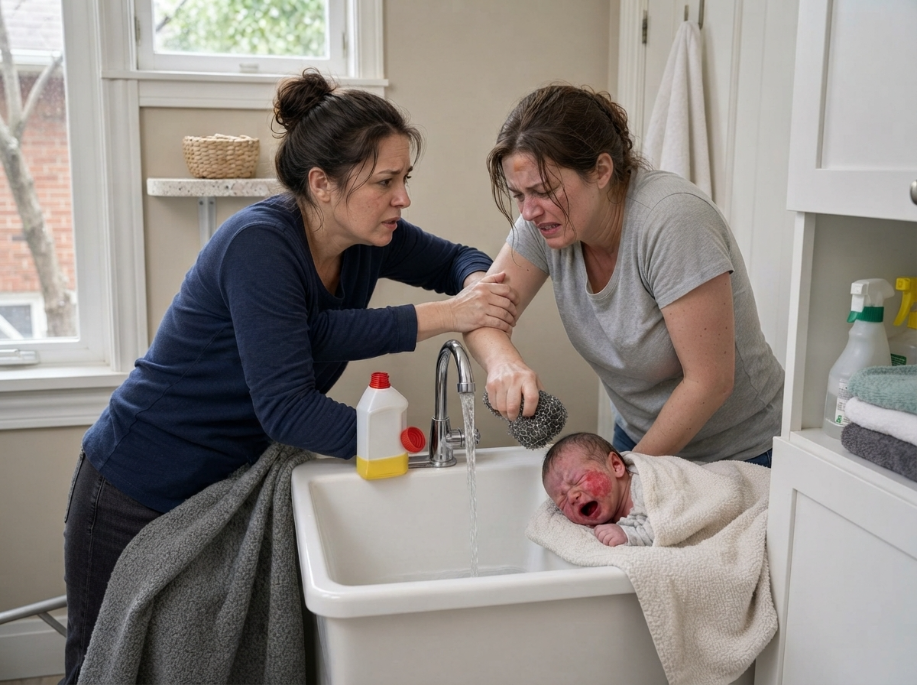
The final recording began with the sound of a kettle being placed on the counter.
My mother was breathing heavily.
Linda stood beside her.
"Maybe we should stop," Linda said.
My mother answered, "It's too late."
"The baby is here."
"That's the point."
I felt my stomach twist.
The detective stopped the recording.
I asked her to continue.
My mother spoke again.
"She won't listen unless she sees him lose control."
Linda asked, "And if he doesn't?"
"He will."
The confidence in my mother's voice was chilling.
She knew my husband.
She knew what he would do if our baby were threatened.
She had mistaken his willingness to protect his child for evidence that he was dangerous.
Then came the sentence that ended every remaining doubt.
"Once the police arrive, I'll tell them exactly what happened."
Linda asked, "What about the recording?"
My mother answered, "It will show him attacking me."
I closed my eyes.
She had planned the narrative before the event occurred.
She had decided who would be the victim before anyone was hurt.
The detective turned off the recording.
"We have enough to establish a clear sequence."
I nodded.
But I didn't feel relieved.
The evidence had given me answers.
It had not given me back the mother I thought I had.
My daughter remained hospitalized for several more days.
Her condition improved steadily.
The doctors told us the injuries would heal, though they would continue monitoring her skin.
I asked whether she would remember what happened.
They told me she was too young to form a conscious memory of the event.
I was grateful for that.
But I knew I would remember every second.
The basin.
The kettle.
The cloth.
The scream.
My husband's arms turning red.
My mother looking toward the phone before looking at me.
Those moments would stay with me.
My husband also struggled.
He kept replaying the moment he struck my mother.
One evening, he said, "I don't know whether I should have done something different."
I sat beside him.
"You saw our daughter in danger."
"I know."
"You acted."
"I hurt your mother."
"Both things are true."
He looked at me.
"I won't lie about what I did."
"Neither will I."
That became our agreement.
No rewriting.
No convenient version.
No protecting ourselves by pretending difficult facts didn't exist.
We would tell the truth and let the evidence speak.
The police investigation continued.
My mother's phone contained recordings.
The hidden cameras provided additional footage.
Messages connected her to Linda.
Medical records documented the baby's injuries.
My statement described the incident.
My husband's statement described his intervention.
Linda eventually gave investigators a fuller account.
She admitted that my mother had spent months telling her my husband was abusive.
She said she had believed the story because my mother seemed convinced.
But when my mother proposed creating an incident that would force my husband to react, Linda became frightened.
She claimed she did not understand that the baby would be placed in danger.
The evidence suggested otherwise.
She had heard my mother discuss the plan.
She had questioned what would happen to the baby.
She had stayed.
The prosecutor considered all of those facts.
I was careful not to decide the legal outcome myself.
That was for the authorities and the court.
What mattered to me was something simpler.
My daughter needed to be safe.
My husband and I changed the locks.
We replaced the security system.
We checked every room for recording devices.
We stopped giving anyone unrestricted access to our home.
The nursery became the safest room in the house.
Not because we were afraid of everything.
Because we had learned that boundaries were not cruelty.
They were protection.
My mother was eventually released from the hospital under conditions connected to the investigation.
She was not permitted to contact us directly.
She still tried.
Messages arrived through relatives.
Some said she was sorry.
Others said she had been misunderstood.
A few accused my husband of destroying the family.
I did not respond.
The detective had warned me that indirect communication could complicate the case.
More importantly, I had nothing left to prove.
My mother had spent years teaching me that a good daughter forgave quickly.
I had learned something different.
Forgiveness did not mean reopening the door.
The court proceedings were difficult.
My husband faced questions about striking my mother.
He answered them honestly.
He explained that he had seen our daughter being handled in dangerously hot water and believed she was in immediate danger.
The evidence supported the emergency context.
The authorities also considered the fact that he stopped immediately after getting the baby away from the basin.
He had not continued attacking my mother.
He had called for emergency assistance.
He had remained with the baby.
Those details mattered.
My mother, meanwhile, faced charges related to what she had done to our daughter and the steps she had taken to create a false account of the incident.
The recordings were central.
There was no dramatic confession in court.
There didn't need to be.
The truth was already sitting in the evidence.
The prosecutor played the preparation footage.
The kettle.
The basin.
The phone.
The conversation.
The plan.
Then the final recording.
My mother sat quietly as her own voice filled the courtroom.
I did not look at her.
I looked at my husband.
Then I looked at our daughter, who was safely at home with a trusted relative.
For the first time since the incident, I felt that the future belonged to us again.
My mother eventually accepted responsibility for the conduct she had been charged with.
The court imposed legal consequences and restrictions preventing her from contacting our child.
Linda also faced consequences for her involvement.
The details were handled through the legal process.
I did not celebrate.
There was nothing to celebrate.
A child had been hurt.
A family had been broken.
And the people involved would have to live with those facts.
Months passed.
Our daughter healed.
The redness disappeared.
She began smiling at us.
Then laughing.
The first time she laughed after the incident, my husband and I both froze.
We had been so accustomed to listening for cries that we didn't know how to react to happiness.
I started crying.
He laughed.
Then we both laughed.
Our daughter stared at us as if we were the strangest people she had ever seen.
That moment mattered more than any courtroom victory.
It reminded me that the story of our family would not end with what my mother had done.
We would decide what came next.
One afternoon, I found the old letter from my mother in a box.
The one she had written when I was sixteen.
I read it again.
For years, I had believed it was a warning.
Now I understood it differently.
My mother had written about losing me before I had even met the man she would eventually blame.
She had been afraid of being left.
Instead of confronting that fear, she had tried to prevent anyone from becoming more important to me than she was.
She had called that love.
It wasn't.
Love could warn.
Love could disagree.
Love could even be afraid.
But love could not require control.
I tore the letter in half.
Then I stopped.
I almost threw it away.
Instead, I placed it in the evidence box with the old photographs.
I wanted to remember.
Not the fear.
The lesson.
My husband found me there.
"Are you okay?"
I nodded.
"I think so."
He looked at the box.
"Want me to get rid of it?"
"No."
"Why keep it?"
"Because I don't want to forget how easily I believed her."
He sat beside me.
"You don't have to blame yourself."
"I'm not."
I closed the box.
"I'm reminding myself that trust should have boundaries."
He smiled.
Our daughter began crying from the nursery.
We both stood.
For a moment, we looked at each other.
Then we walked toward her together.
The house was quiet.
The doors were locked.
The cameras were gone.
There was no kettle beside the basin.
No hidden phone.
No one waiting to turn an ordinary moment into evidence.
Our daughter reached for us.
I lifted her.
She rested her head against my shoulder.
I looked at my husband.
He touched her tiny hand.
And I understood something I had not understood before.
My mother had spent years telling me that the family could fall apart if I stopped listening to her.
She had been wrong.
The family survived because, finally, I stopped listening to fear.
I did not need to choose between my mother and my husband.
I needed to choose between truth and manipulation.
The truth was painful.
It had cost us trust, security, and a relationship I once thought would last forever.
But it had also protected my daughter.
And that was enough.
The recording my mother thought would destroy my husband had done something she never expected.
It had revealed the truth.
Not just about that terrible morning.
About the pattern that had existed long before the kettle was filled.
About the cameras.
The messages.
The edited recordings.
The warnings.
The need to control every person who came close to me.
And most importantly, it had revealed that my mother had never been trying to save me from losing my family.
She had been trying to make sure I could never build one without her.
I would never forget what happened.
But I would not let it define my daughter.
She deserved to grow up knowing that family meant safety, honesty, and love without conditions.
So I held her closer.
My husband stood beside me.
And for the first time in months, the silence in our home felt peaceful instead of threatening.
STORY TITLE: The Recording My Mother Never Meant Me to See
Click Here to continue read next: PART5: After the Courtroom Went Quiet, the Evidence Left Behind Forced Me to Discover How Deeply My Mother Had Entered Our Lives
The Bath That Turned Into a Crime Scene Revealed a Secret My Family Had Been Hiding in Plain Sight
Part 4 of 8

