
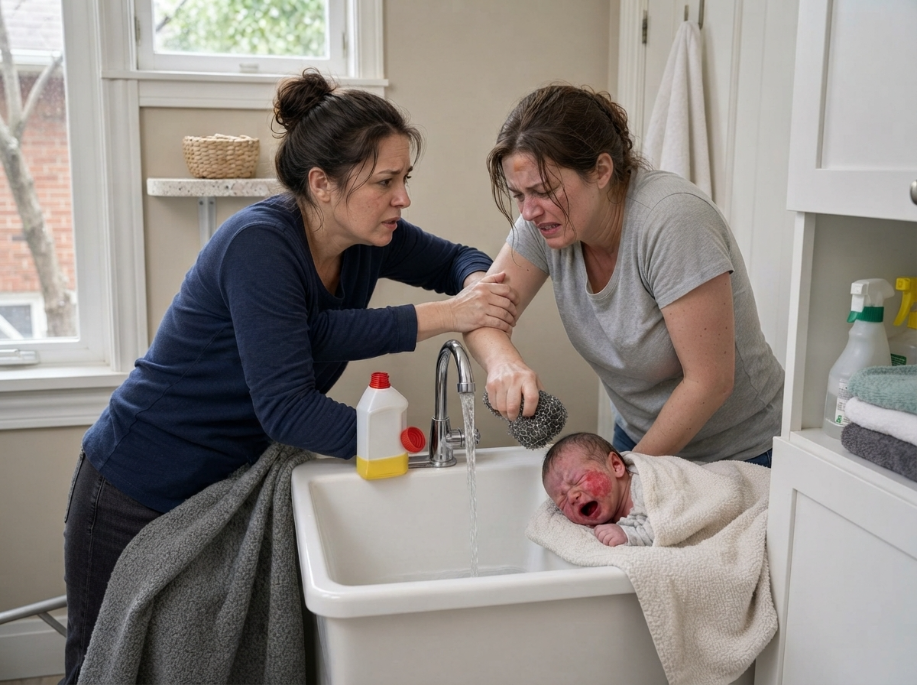
NOTE: This part focuses on the aftermath of the investigation, the emotional consequences for the family, and the discovery that some unanswered questions remained even after the case appeared settled.
The first morning after the restrictions were issued, I woke before sunrise and listened to the house.
There was no shouting.
No footsteps outside the nursery.
No unfamiliar voice coming through my mother's phone.
Only the soft hum of the refrigerator and the occasional sound of my daughter breathing through the baby monitor.
For months, silence had frightened me.
That morning, it felt different.
It felt earned.
I walked into the nursery and found my daughter awake, staring at the ceiling with the solemn expression she had begun making whenever she was deciding whether to cry or smile.
"Good morning," I whispered.
Her mouth opened.
Then she smiled.
I lifted her from the crib and held her against my chest.
For a moment, I allowed myself to forget everything.
Then I noticed the small scar on my husband's forearm where the hot water had injured him.
It was healing.
So was our daughter's skin.
But neither injury had disappeared completely.
Some things simply needed time.
My husband entered the room carrying two cups of coffee.
"She's awake?"
"She's been waiting for you."
He smiled.
"Clearly."
He leaned over and kissed our daughter's forehead.
Then he looked at me.
"You slept."
"A little."
"That's progress."
I nodded.
There had been a time when I would have laughed at such a small statement.
Now sleep felt like evidence that our lives were becoming ordinary again.
But ordinary was not what awaited us.
A week later, the detective called.
She asked whether we had noticed anything missing from the house.
I immediately thought about valuables.
Jewelry.
Documents.
Money.
"Nothing obvious."
"Check the nursery."
I froze.
"Why?"
"We're reviewing the evidence again."
She explained that investigators had discovered inconsistencies in the timestamps from one of the recording devices.
Not enough to change the case.
Not enough to invalidate the recordings.
But enough to raise another question.
Someone had accessed one of the cameras after my mother installed it.
"Who?"
"We're still determining that."
My husband heard the conversation.
"What happened?"
I told him.
His expression hardened.
We waited until our daughter was asleep before searching the nursery.
The room looked untouched.
The crib.
The rocking chair.
The shelves.
The books.
The little basket of blankets.
Then my husband noticed something behind the dresser.
A narrow envelope.
It had been pushed so far into the gap that we would never have found it during ordinary cleaning.
There was no name on the front.
Only a date.
The date was from three months before our daughter was born.
My hands began to shake.
"Don't open it yet," my husband said.
I stopped.
We called the detective.
An officer collected the envelope as evidence.
The following afternoon, she told us what it contained.
Copies of medical records.
Not our daughter's.
Mine.
Prenatal records.
Appointment dates.
Notes about my pregnancy.
And one handwritten page.
My mother's handwriting.
I read the first line.
"She doesn't know what I know."
I looked at the detective.
"What did she know?"
"We're trying to determine that."
The document was not proof of a crime by itself.
But it revealed that my mother had been collecting information about my pregnancy without my permission.
The detective asked whether my mother had ever accompanied me to medical appointments.
"Only once."
"Was she alone with the paperwork?"
"I don't remember."
That was the problem.
There were too many moments I could no longer remember clearly.
Not because they had been dramatic.
Because they had been ordinary.
A mother offering help.
A grandmother organizing paperwork.
A friend carrying a bag.
A relative asking a harmless question.
My mother's greatest advantage had been that she never needed to break into our lives.
We had opened the door for her.
That night, I told my husband that I felt foolish.
He shook his head.
"You trusted your mother."
"I should have seen it."
"Most people don't look for danger in someone they've loved their entire life."
I looked at him.
"Did you?"
He was quiet.
"Sometimes."
"How long?"
"Longer than I admitted."
I waited.
He finally told me that the nursery camera had not been the first strange thing he had found.
Months earlier, he had noticed our mail had been opened.
At first he assumed it was a delivery mistake.
Then he found a bank statement that had been removed from an envelope.
He had asked my mother whether she knew anything.
She had laughed and told him he was being paranoid.
He had believed her.
Until it happened again.
"Why didn't you tell me?"
"Because every time I raised concerns, you defended her."
His honesty hurt.
But it was necessary.
"I was afraid that if I made you choose, I'd lose you."
I looked down.
"I made you feel that way."
"Yes."
Neither of us tried to soften it.
Our marriage had survived, but survival did not mean pretending there had been no damage.
We began counseling.
The counselor asked us not to focus only on my mother.
She asked what had happened between us.
We discovered that fear had changed our communication.
My husband had started withholding concerns because he did not want to upset me.
I had started dismissing concerns because I did not want another conflict with my mother.
Both habits had allowed problems to grow.
The counselor said rebuilding trust required more than agreeing that my mother had been wrong.
It required learning to speak before resentment became silence.
We tried.
Some days were difficult.
Others were surprisingly easy.
Our daughter gave us a reason to keep choosing each other.
She would wake from a nap and reach for both of us.
She did not know about court.
She did not know about recordings.
She only knew that two people came when she cried.
That was enough.
Then the detective called again.
She had reviewed the old evidence from my mother's first marriage.
The records concerning Daniel contained something investigators had overlooked.
A financial account had been opened in my mother's name shortly before he left.
The account later received money connected to a property sale.
My mother had always told me Daniel left with everything.
The records suggested otherwise.
Again, the detective emphasized that the old matter did not prove my mother had committed a crime.
But it revealed that her story about the marriage was incomplete.
I asked whether Daniel was still alive.
"Yes."
The answer stunned me.
I had spent years imagining a man who had vanished.
He had not vanished.
He had simply left.
The detective asked whether I wanted to speak with him.
I wasn't sure.
My entire understanding of my childhood was already unstable.
I didn't know if I wanted another version.
But eventually, I agreed.
Daniel lived several hours away.
We met in a quiet café.
He looked older than the photograph, of course.
But there was something familiar about him.
Not his face.
His caution.
He listened before speaking.
"I never wanted to hurt your mother," he said.
"Why did you leave?"
"Because I realized we couldn't have a normal marriage."
I asked whether he had abandoned us.
He shook his head.
"Your mother told you that?"
"Yes."
"I tried to stay in contact with you."
My throat tightened.
"She told me you didn't want to see me."
Daniel looked down.
"She told me you didn't want to see me."
I felt as though the room tilted.
Two people had been told opposite versions of the same lie.
Neither had known.
Daniel had written letters.
My mother had kept them.
He had sent birthday cards.
She had returned them.
She had convinced each of us that the other had chosen distance.
I asked why.
He gave the simplest answer.
"Control."
That word followed me home.
My mother had not merely tried to control my marriage.
She had controlled the information between people.
She had decided who spoke to whom.
Who trusted whom.
Who belonged to whom.
And she had been doing it for decades.
When I told my husband, he said nothing for several minutes.
Then he asked, "Did you keep the letters?"
I had not.
Daniel had copies.
He gave them to me.
I read them at our kitchen table.
Some contained nothing more than ordinary birthday wishes.
Others apologized for not being there.
One said, "I hope someday you'll know I never stopped thinking about you."
I cried so hard that my husband had to take the pages from my hands.
Our daughter crawled across the rug and grabbed one of them.
I laughed through my tears.
"She doesn't care about family history."
"She's smarter than all of us."
We laughed together.
It was the first time the past had not felt entirely powerful.
A month later, my mother requested a formal review of the contact restrictions.
She wanted permission to send our daughter birthday gifts.
We declined.
Not because gifts were dangerous.
Because accepting them would create a connection we were not ready to reopen.
The judge maintained the restrictions.
My mother sent one final message through an attorney.
"I want her to know I loved her."
I stared at the sentence.
I believed she believed it.
That was perhaps the hardest part.
People can love someone and still harm them.
Love does not automatically make behavior safe.
I wrote nothing back.
That evening, I took our daughter outside.
The sun was setting.
My husband sat on the porch steps.
She crawled through the grass, fascinated by everything.
A leaf.
A pebble.
A bird.
The world had not become smaller because of what happened.
If anything, it had become more precious.
I watched her explore and realized I no longer wanted my life organized around my mother's choices.
I wanted it organized around ours.
But there was still one unanswered question.
Who had accessed the recording system after my mother installed it?
The detective called again two weeks later.
"We found the answer."
My stomach tightened.
"Who?"
She paused.
"It wasn't your mother."
Click Here to continue read next: PART6: The Person Who Accessed the Cameras Was Not Who We Expected, and the Discovery Forced Us to Reconsider One Final Unanswered Piece
The Bath That Turned Into a Crime Scene Revealed a Secret My Family Had Been Hiding in Plain Sight
Part 5 of 8

