
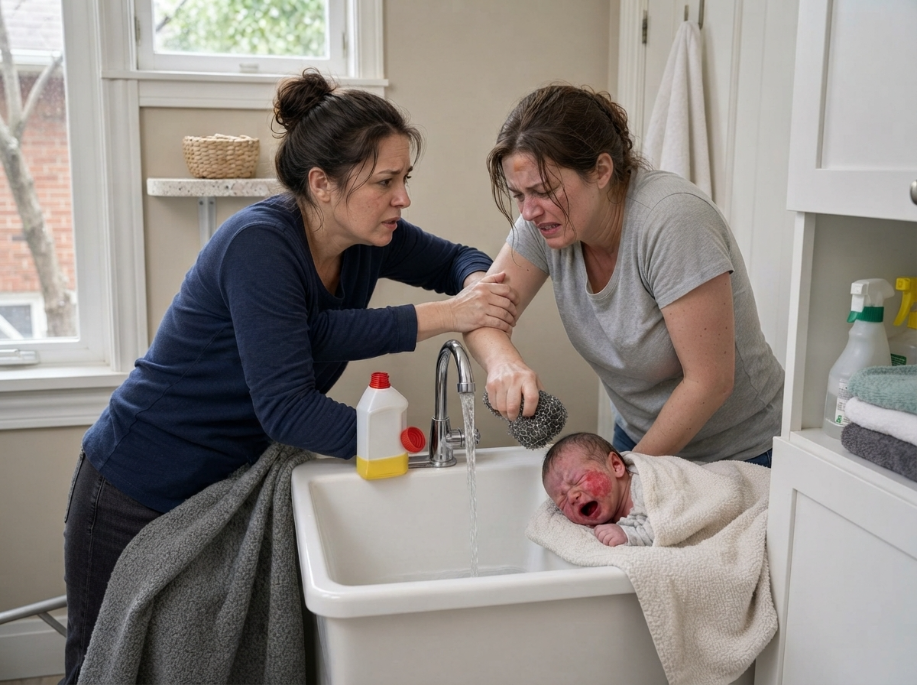
NOTE: This part uncovers the remaining technical and personal mystery surrounding the recordings while showing how the family begins separating facts from old assumptions.
The detective arrived at our house the next morning.
She brought two officers and a file.
I knew immediately that whatever they had discovered was important.
My husband invited them inside.
Our daughter was with a sitter in another room.
The detective placed the file on the dining table.
"The person who accessed the camera system was someone connected to the installer."
I frowned.
"The installer?"
"We traced the equipment."
She explained that the hidden camera had been purchased through an account belonging to a small security business.
The business owner had previously worked with the man connected to my mother's old case.
That connection alone meant little.
But payment records showed that the equipment had been ordered under a name that was not my mother's.
I asked whose name it was.
The detective gave us the answer.
Linda.
I sat down.
"So Linda bought the cameras."
"Yes."
"She lied."
"She did."
My husband looked at me.
"Does that mean she knew everything?"
"Not necessarily," the detective said.
That distinction again.
The evidence could establish actions.
It could not automatically establish every intention.
Linda had admitted buying the equipment.
She had admitted giving it to my mother.
She had admitted discussing my husband.
But she still denied knowing my mother intended to put our baby in danger.
The detective had recovered messages between them.
Most were ordinary.
Some were not.
One message from Linda read:
"Are you sure this is enough?"
My mother replied:
"Once she sees the recording, she'll understand."
Another message said:
"Don't involve the baby."
My mother answered:
"I know what I'm doing."
That message changed the investigators' interpretation of Linda's role.
She had known there was a plan.
She had expressed concern.
She had still provided equipment.
Whether that made her legally responsible was a matter for the authorities.
But for me, the personal truth was enough.
Linda had chosen to participate.
She had not merely listened to my mother.
She had helped create the machinery that allowed my mother to watch us.
I remembered every birthday she attended.
Every meal.
Every time she held my daughter.
The memories had changed.
Not because every moment had been fake.
Because now I knew what had existed behind them.
The detective then explained why another person had accessed the camera.
A technician from the security company had remotely tested the system after installation.
He had not known who owned the house.
He had not known what my mother intended.
He had simply checked whether the device was working.
The technician's access had created the confusing timestamp.
He had done nothing wrong.
I felt almost relieved.
For once, the explanation was ordinary.
Not every strange detail was another betrayal.
That mattered.
After the officers left, I sat quietly.
My husband made coffee.
"You're thinking."
"I keep expecting every ordinary thing to have a hidden meaning."
He placed the mug in front of me.
"That's because you lived through something where ordinary things were used against you."
I nodded.
"How do I stop?"
"Slowly."
He sat beside me.
"We check facts. We don't invent them."
That became our rule.
When something frightened us, we asked what we actually knew.
Not what we feared.
Not what someone suggested.
What we knew.
It helped.
Months passed.
Our daughter began walking.
Her first steps happened in the living room.
She grabbed the edge of the sofa, pushed herself upright, and took three uncertain steps toward me.
I cried.
My husband cheered.
She sat down hard and looked offended.
We laughed until she started laughing too.
That afternoon, I realized something.
For the first time since the incident, I had gone an entire day without thinking about my mother.
It felt strange.
Then it felt wonderful.
The court case had ended.
The restrictions remained.
Linda had moved away.
Daniel occasionally sent photographs and letters.
My father, who had been largely absent from my mother's stories, contacted me after learning the truth.
That conversation was complicated.
He apologized for not questioning her version of events.
I told him he had trusted what he was told.
He said that wasn't enough.
Perhaps he was right.
Families are built from choices, but they are also shaped by silence.
We all had our part in that.
Not equal parts.
Not the same responsibility.
But we each had things we needed to understand.
I began keeping a journal.
Not to document my mother.
To document myself.
I wrote about decisions I had made.
Things I believed.
Things I feared.
Things I wanted for my daughter.
One entry said:
"I want her to know she can tell me the truth without being afraid that I'll stop loving her."
I read that sentence several times.
That was the opposite of how I had been raised.
My mother had made love conditional on obedience.
I wanted to make love safe enough for disagreement.
One evening, an envelope arrived.
There was no return address.
Inside was a photograph of my mother holding my daughter shortly after her birth.
On the back, my mother had written:
"She will understand me someday."
I threw the photograph away.
Then I regretted it.
Not because I wanted the photograph.
Because I hated that she still had the power to make me angry.
My husband found me staring at the trash.
"Do you want it back?"
"No."
"Then let it go."
I nodded.
That became another lesson.
Healing did not mean never being angry.
It meant anger no longer decided what I did next.
A few weeks later, the detective called one last time.
She told me investigators had finished reviewing the entire digital archive.
There was nothing else that changed the case.
No hidden accomplice.
No additional injury.
No secret plan involving another child.
No dramatic final revelation.
The evidence had reached its natural limit.
That was strangely comforting.
I had spent months expecting another door to open.
It didn't.
The truth was not an endless maze.
It was what had already been established.
My mother had planned to create evidence against my husband.
She had involved Linda.
She had used hidden recording devices.
She had endangered our daughter.
My husband had reacted to an immediate threat.
I had finally stopped protecting my mother from the consequences of her own choices.
That was enough.
The detective asked whether I needed anything else.
"No."
Then I thanked her.
After we hung up, I went to the nursery.
Our daughter was asleep.
The room was bright with afternoon sunlight.
I sat beside her.
There were no cameras.
No hidden devices.
No notes.
Just a child sleeping peacefully.
I thought about the woman I had been before becoming a mother.
She had believed that keeping a family together was always more important than confronting what was wrong.
Now I understood that sometimes confronting what is wrong is how you keep a family safe.
My husband entered the room.
"She's out."
"She's been asleep for an hour."
"Good."
He sat beside me.
We watched her together.
"Do you ever wish you could go back?" he asked.
I thought about it.
"Sometimes."
"To change things?"
"No."
I surprised myself with the answer.
"To tell myself sooner that I was allowed to say no."
He took my hand.
"You know that now."
"Yes."
Our daughter stirred.
We both leaned forward.
She opened her eyes.
Then she reached toward me.
I picked her up.
She pressed her face against my shoulder.
I kissed her hair.
There was no courtroom.
No detective.
No evidence bag.
No phone recording us.
Only us.
That was what my mother had never understood.
A family did not need to be controlled to remain together.
It needed honesty.
It needed boundaries.
It needed people who could hear difficult truths without immediately turning against one another.
I had spent years believing that my mother's greatest gift was her certainty.
She always seemed to know who was right.
Who was wrong.
Who was dangerous.
Who could be trusted.
Who could not.
Now I understood that certainty had often been a weapon.
Real life was more complicated.
Sometimes we had to say, "I don't know."
Sometimes we had to wait for evidence.
Sometimes we had to admit we had been wrong.
That humility saved us.
The final legal documents arrived several months later.
My mother's restrictions remained.
Her sentence required compliance with conditions and continued separation from our daughter.
Linda accepted consequences for her involvement.
Daniel remained in contact.
My father and I slowly began rebuilding our relationship.
None of it restored the family I once imagined.
But it created something more honest.
One evening, my husband asked whether I wanted to move.
I looked around the house.
"No."
"Are you sure?"
"Yes."
This house had been the place where everything happened.
But it was also the place where our daughter had taken her first steps.
Where my husband had held her through sleepless nights.
Where we had rebuilt our marriage.
I didn't want my mother to own the memory of it.
So we stayed.
We changed what needed changing.
We painted the kitchen.
We replaced the sink.
We moved the dining table.
The oak chair was gone.
The basin was gone.
The old security equipment was gone.
The house became ours again.
One night, I stood at the kitchen sink washing a bottle.
Steam rose from the water.
For half a second, my body remembered.
Then I looked toward the nursery.
My daughter laughed.
The fear passed.
I turned off the tap.
I smiled.
The past had not disappeared.
But it had stopped controlling the present.
And I thought that was what freedom felt like.
Click Here to continue read next: PART7: Years of Manipulation Could Not Be Undone, but One Conversation Finally Showed Me What My Mother Had Been Trying to Protect
The Bath That Turned Into a Crime Scene Revealed a Secret My Family Had Been Hiding in Plain Sight
Part 6 of 8

