
I read the message three times before showing it to my husband.
He looked at the number.
"Do you recognize it?"
"No."
The detective took a photograph of the screen and asked me not to respond.
That was becoming the rule of my new life: do not answer, do not delete, do not assume, and do not trust anything until someone has checked the evidence.
The hardest part was that I had spent my entire life doing the opposite with my mother.
If she said something, I believed it.
If she warned me about someone, I became suspicious of that person.
If she told me I was making a mistake, I reconsidered.
I had mistaken obedience for trust.
Now I was beginning to wonder how many of my decisions had actually been mine.
The next morning, the detective brought my husband's hidden camera to the hospital.
It was small enough to fit in her palm.
She placed it on the table.
"This was found in the nursery?"
My husband nodded.
"Behind a shelf."
"Did you install it?"
"No."
"Did you ever give your mother permission to install recording equipment in your house?"
"No."
The detective looked at me.
I shook my head.
"No."
She examined the device.
"It may contain stored footage."
My husband asked whether it could be traced.
"Possibly."
That word became the center of everything.
Possibly.
Possibly my mother installed it.
Possibly someone else did.
Possibly the recordings showed something important.
Possibly the incident had been planned.
Possibly we had misunderstood her motives.
I hated the uncertainty.
I wanted someone to tell me exactly what had happened.
Instead, the evidence kept opening more doors.
The detective asked me about the weeks after our daughter's birth.
I told her my mother had become unusually involved.
She came over almost every day.
She insisted on helping with baths.
She reorganized the nursery.
She criticized the way I sterilized bottles.
She said my husband was too cautious.
At the time, I thought she was simply being an overbearing grandmother.
Then the detective asked whether my mother had ever objected to my husband's involvement.
I remembered one evening when my mother had stood in our kitchen and said, "A baby doesn't need two people arguing over every little thing."
My husband had laughed.
I had dismissed it.
Now I remembered the expression on her face.
She had not been joking.
The detective asked whether my mother had ever told me that my husband wanted to separate me from my family.
"Yes."
"When?"
"Several times."
"What did you say?"
"I told her she was wrong."
The detective nodded.
"How did she respond?"
"She said I'd understand eventually."
That phrase appeared again.
Understand eventually.
It had been one of my mother's favorite expressions.
The detective told me investigators had found similar language in the notes recovered from her house.
My mother had written about me repeatedly.
There were dates.
Descriptions.
Opinions about my marriage.
Notes about arguments my husband and I had forgotten.
One entry described a disagreement about money.
Another mentioned that I had stopped answering my mother's calls immediately.
Another said I was "becoming loyal to him instead of the family."
I stared at the pages.
She had been keeping records of my life.
Not memories.
Records.
The distinction frightened me.
The detective then showed me a photograph.
It was an old picture of my mother with a man I had never seen before.
"Do you know him?"
I shook my head.
"He is Daniel."
The name meant nothing.
"He was your mother's first husband."
I looked closer.
My mother had rarely spoken about him.
She had always said her first marriage had ended because Daniel abandoned her.
The detective explained that the historical records were incomplete, but there had been an investigation years earlier involving financial disputes and accusations of fabricated evidence.
My mother had not been convicted of a crime in that matter.
The detective emphasized that.
"But she was questioned?"
"Yes."
"Why?"
"Because several documents appeared to have been created after the fact."
I felt sick.
"Did Daniel disappear?"
"He left the area."
"Did my mother cause that?"
"We don't know."
The detective did not speculate.
That restraint somehow frightened me more.
She wasn't trying to make my mother look guilty.
She was showing me why the investigators were asking questions.
That meant there were facts they still couldn't explain.
That afternoon, I finally entered my daughter's room.
She was sleeping.
A nurse told me her condition was improving.
I touched her forehead.
"I'm here."
My voice broke.
My husband stood beside me.
"I keep thinking I should have known."
He shook his head.
"Nobody expects their mother to do something like this."
I looked at him.
"But you suspected something."
"I suspected a camera."
"That's different."
"Not completely."
He hesitated.
"I should have told you."
I squeezed his hand.
"I should have listened."
We sat together in silence.
Neither of us knew how much of our life had already been affected.
That evening, the detective returned with another recording.
This one had been recovered from the hidden kitchen camera.
My mother entered the kitchen the night before the incident.
She carried the kettle.
She placed it beside the basin.
Then she called someone.
The detective increased the volume.
A man's voice answered.
"Are you certain?"
My mother said, "Tomorrow."
"She might stop you."
"She won't."
"What about the baby?"
My mother paused.
"Nothing will happen."
I felt a chill.
The detective stopped the video.
"Do you recognize the man's voice?"
I listened again.
Something about it seemed familiar.
Not someone I knew well.
Someone I had heard before.
The detective asked me to think.
I closed my eyes.
Then I remembered my mother's friend.
Linda.
She was the person my mother called whenever there was a family disagreement.
Linda had been around for years.
She had attended my wedding.
She had visited after my daughter's birth.
She had brought food when I was exhausted.
She had always seemed kind.
But there was something else.
Linda had recently asked whether my husband was "still working late."
I had wondered why she cared.
Now the question felt different.
The detective asked whether Linda had access to our house.
"Not directly."
"Did she ever have a key?"
"I don't think so."
"Did she ever visit while you weren't home?"
"Maybe."
The detective wrote down her name.
Then she asked me to check something.
"Does Linda know your security code?"
I thought about it.
My mother had once asked me to share it.
I had refused.
But Linda had visited with my mother many times.
I couldn't remember whether she had ever seen me enter it.
The next morning, investigators interviewed Linda.
She denied knowing about the plan.
She admitted speaking with my mother.
She admitted discussing my husband.
But she said my mother had convinced her that he was emotionally abusive.
"Did you ever see him hurt your daughter?" the detective asked.
"No."
"Did you ever see him threaten her?"
"No."
"Then why did you believe it?"
Linda cried.
"Because she showed me recordings."
The recordings were edited.
My mother had taken ordinary arguments and removed the surrounding context.
In one clip, my husband said, "You can't keep doing this."
The clip made him sound threatening.
The full conversation revealed he was talking about my mother's constant interference with our finances.
Another clip showed him shouting.
The complete recording revealed that our daughter had just begun crying and he was calling for help because he thought she might be choking.
My mother had transformed fragments of ordinary life into a story of abuse.
The detective asked Linda whether she knew what my mother intended to do with the baby.
Linda said no.
But then she admitted something else.
My mother had told her to "watch the news" the night before the incident.
I stared at the detective.
"What did that mean?"
"We don't know."
Then she placed another document on the table.
It was a message from my mother to Linda.
"Tomorrow she will finally see who he is."
The words were dated the day before the incident.
My hands began shaking.
The plan had not been spontaneous.
Whatever my mother intended, she had been preparing for it.
The detective asked me to think about one more thing.
"Has your mother ever told you that you would eventually come back to her?"
I nodded.
"Many times."
"Why?"
"I thought she meant our relationship."
The detective looked at me.
"Maybe she meant something else."
I stared at the message.
Suddenly I understood the danger of the recordings.
My mother had not simply wanted to hurt my husband.
She wanted to control what I believed.
She wanted to create evidence that would force me to choose her.
And she had been building that evidence for weeks.
Then the detective received a call.
She listened.
Her expression changed.
"What happened?"
She covered the phone.
"We recovered another file."
"From my mother's phone?"
"Yes."
"What does it show?"
The detective looked directly at me.
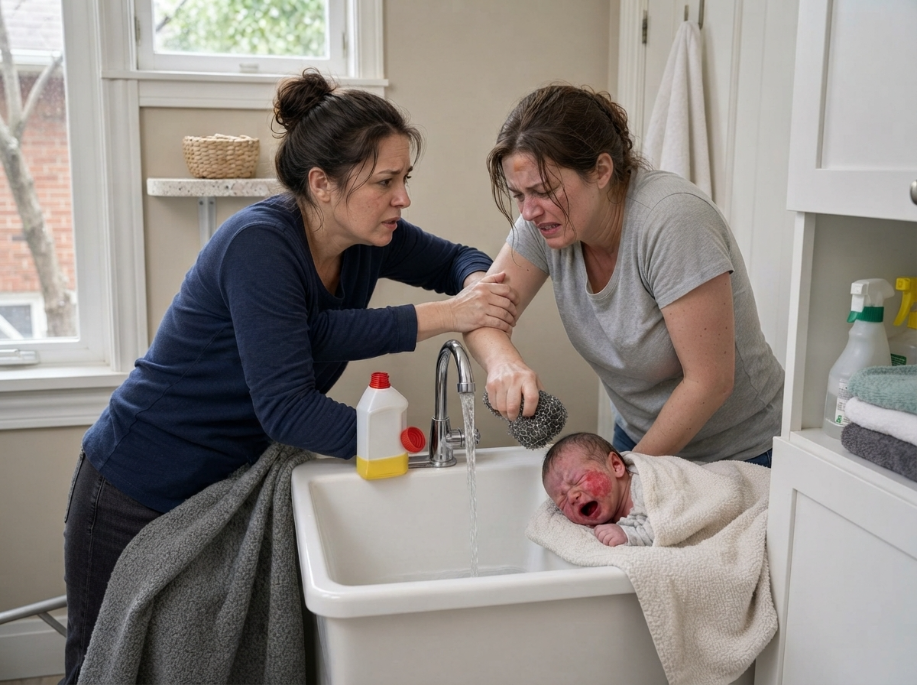
"It shows your mother preparing the basin."
She paused.
"But there is someone else in the room."
Click Here to continue read next: PART3: The Person Standing Beside My Mother Before the Incident Was Someone I Trusted, and Their Conversation Changed What I Thought the Evidence Meant
The Bath That Turned Into a Crime Scene Revealed a Secret My Family Had Been Hiding in Plain Sight
Part 2 of 8

