
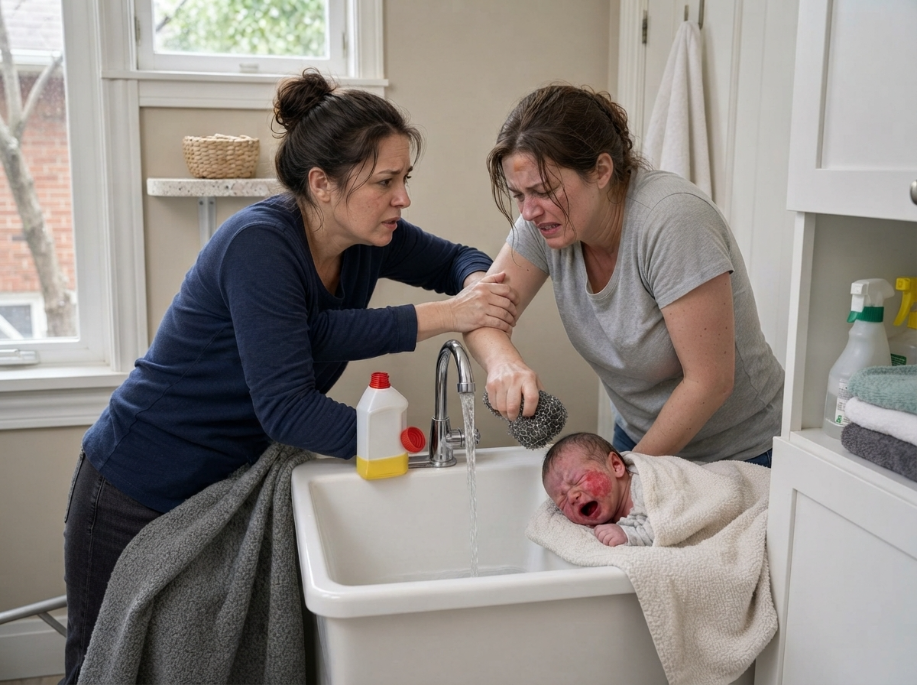
The video was dark, but the second person was unmistakably there.
My mother stood beside the sink.
Linda stood near the doorway.
Neither woman looked toward the camera.
They were speaking quietly.
My mother held the kettle.
Linda looked nervous.
"Are you sure this won't go too far?" Linda asked.
"It won't."
"And the baby?"
My mother lowered her voice.
"She'll cry. That's all."
I covered my mouth.
The detective paused the video.
My entire body felt cold.
"What does 'that's all' mean?"
"We don't know."
"But she knew."
The detective nodded carefully.
"It appears she knew something was planned."
That was enough for me.
I asked whether Linda had been arrested.
"Not at this point."
"Why?"
"Because being present and knowing about one part of a plan are not automatically the same as participating in the entire offense."
The detective was right.
But emotionally, the distinction was difficult.
Linda had stood there.
She had heard my mother.
She had asked about the baby.
And she had stayed.
I couldn't stop thinking about that.
The next recording showed my mother placing the phone near the fruit bowl.
She checked the angle.
Then she looked at Linda.
"If she sees him lose control, she'll believe us."
Linda whispered, "What if he doesn't?"
My mother smiled.
"He will."
That sentence frightened me more than anything else.
My mother had predicted my husband's reaction.
She knew that if he saw our baby in danger, he would act.
She was counting on it.
The chair.
The confrontation.
The police.
Everything had been part of the scenario she expected.
The one thing she had not planned for was the camera capturing her preparation.
The detective told me investigators were comparing timestamps.
They wanted to establish exactly what happened and when.
The medical records would also be important.
The doctors had documented the baby's injuries.
The marks were consistent with exposure to excessively hot water and harsh handling.
My mother's claim that the bath had been accidental was becoming harder to reconcile with the evidence.
But my husband's actions still had to be examined.
He had struck her with a chair.
No recording could erase that.
I told the detective I understood.
"I don't want anyone changing the truth to help us."
She looked at me.
"That's exactly why your statement matters."
I gave it again.
Every detail.
Where my mother stood.
What she held.
What my husband did.
What I saw before and after.
I did not exaggerate.
I did not minimize.
For the first time, I realized that telling the truth meant allowing it to remain complicated.
My husband had used force.
My mother had endangered the baby.
Both things could be true.
That afternoon, I visited my mother at the hospital.
I almost turned around before entering.
She looked smaller than I remembered.
Her side was heavily bandaged.
She had bruising across her shoulder.
When she saw me, she started crying.
"My own daughter."
I remained near the door.
"You hurt my baby."
"I didn't."
"I saw you."
"It was an accident."
"You prepared the water."
"I was trying to help."
"You recorded it."
She looked away.
"I wanted evidence."
"Evidence of what?"
"Your husband."
I stared at her.
"He wasn't hurting anyone."
"You don't know what he does when you're not looking."
"Then why did you need to manufacture something?"
Her face tightened.
"I didn't manufacture anything."
I placed the detective's photograph on the table.
It showed the hidden camera.
My mother looked at it.
Then she looked at me.
"Who told you about that?"
"The police."
She said nothing.
I understood then.
She had known about the camera.
Perhaps she had thought it was hers.
Perhaps she had never realized another camera existed.
Either way, the expression on her face told me that the evidence had surprised her.
"You were recording us," I said.
"I was protecting you."
"You were watching me."
"I was watching him."
"You were watching my daughter."
She started crying.
"Because someone had to."
I shook my head.
"No. You wanted me to believe I couldn't protect my own family."
She looked at me.
"You've changed."
"I became a mother."
The words silenced her.
For most of my life, she had been the center of every decision.
Now there was someone smaller than both of us who depended on me to make the right ones.
I left before she could turn the conversation into another argument.
Outside, I called the detective.
"I need to tell you something."
"What?"
"My mother has always done this."
"Done what?"
"Made me afraid of people."
The detective listened.
I told her about childhood.
About friends my mother disliked.
About relatives she said were dangerous.
About how she had told me my father could not be trusted.
About how she had warned me that every relationship would eventually end in betrayal.
The detective asked whether I had evidence.
"No."
"Then treat those memories as background, not proof."
I appreciated that.
She wasn't turning my pain into evidence.
She was teaching me to separate memory from fact.
That distinction became important when investigators found an old letter from my mother.
It had been written years earlier.
The letter was addressed to me when I was sixteen.
My mother wrote that someday I would leave her.
She said people would try to separate us.
She warned that any husband I chose would eventually "take me away."
The strangest part was the date.
It had been written before I had met my husband.
My hands trembled.
She had been anticipating the conflict long before he existed in our lives.
The detective told me that did not prove criminal intent.
But it showed a longstanding pattern in how my mother viewed relationships.
Anyone who became important to me was a potential rival.
My husband had simply become the most important one.
Then we found something even more troubling.
A folder containing photographs.
My pregnancy.
My husband at work.
Me asleep in the nursery.
Our daughter in her crib.
Some pictures had been taken from inside our house.
I recognized the angles.
The camera had been hidden.
The detective asked whether my mother had ever been alone in the house.
"Many times."
She nodded.
"That explains access."
But one photograph confused everyone.
It showed Linda standing in our hallway.
The timestamp was from a day when I had been at the hospital for a prenatal appointment.
My husband had been at work.
Linda had no reason to be there.
I called her.
She denied visiting.
The detective confronted her with the photograph.
Linda finally admitted she had gone there with my mother.
"Why?"
She cried.
"She told me you were in danger."
"Did you believe her?"
"Yes."
"Did you see anything?"
"No."
"Did you install a camera?"
"No."
"Did you know about the kettle?"
Linda hesitated.
"She told me she wanted to make your husband look dangerous."
The room went silent.
That was the first direct admission connecting Linda to the plan.
But Linda insisted she never believed my mother would actually hurt the baby.
"I thought she was going to stage an argument."
The detective asked what she expected my husband to do.
Linda said, "Get angry."
That was enough to make the pattern clear.
My mother had been trying to create a situation in which my husband reacted.
She had wanted the reaction recorded.
Then she could present it as proof of abuse.
But the plan had crossed a line when she used the baby as the trigger.
The prosecutor reviewed the evidence.
The case moved forward.
My husband's lawyer advised him not to discuss the investigation publicly.
He agreed.
My mother continued to insist she was the victim.
Then she made one mistake.
She sent me a message.
"You'll regret choosing him."
I stared at the screen.
For the first time, I didn't feel fear.
I felt clarity.
I forwarded it to the detective.
Then I blocked the number.
That night, my daughter slept peacefully.
I watched her for nearly an hour.
My husband stood beside me.
"What are you thinking?"
"That she wanted me to choose."
"Your mother?"
I nodded.
"And she thought I had to choose between her and you."
He looked at our daughter.
"You chose her."
I shook my head.
"No."
I touched the baby's blanket.
"I chose the truth."
The next morning, the detective called.
They had recovered the final deleted recording.
She said it contained a conversation between my mother and Linda immediately before the incident.
"There is something you need to hear."
Click Here to continue read next: PART4: The Final Recording Forced My Mother to Confront the Consequences of Her Own Plan, While I Finally Refused to Let Fear Decide My Family’s Future
The Bath That Turned Into a Crime Scene Revealed a Secret My Family Had Been Hiding in Plain Sight
Part 3 of 8

