
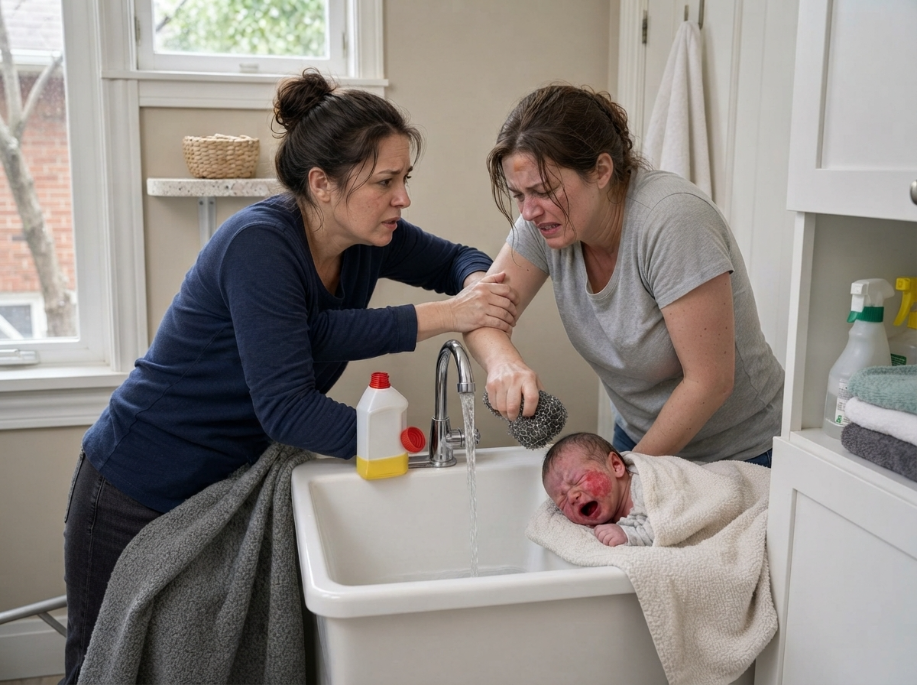
NOTE: This final part resolves the central conflict by showing the lasting consequences of the incident, the legal and emotional closure, and the new family life built without manipulation.
Five years after the morning that changed everything, our daughter asked me why I always checked the bathwater twice.
I smiled.
"Because I like it comfortable."
She dipped her fingers into the water.
"Feels fine."
"I know."
She looked at me suspiciously.
"You checked it three times."
My husband laughed from the doorway.
"Your mother checks everything three times."
"Not everything," I said.
He raised an eyebrow.
"Almost everything."
Our daughter giggled.
The sound filled the bathroom.
There was no basin on the counter anymore.
No kettle.
No rough cloth.
No hidden phone.
Only a little girl sitting safely beside her parents, splashing water against the sides of the tub.
Sometimes healing looked dramatic.
Sometimes it looked like this.
An ordinary bath.
A joke.
A laugh.
A mother checking water that was perfectly safe because once upon a time it had not been.
My mother never returned to our home.
The court restrictions eventually changed as the years passed, but the boundaries we had created remained.
There were no secret visits.
No surprise appearances.
No unsupervised contact.
My daughter knew that she had a grandmother.
She knew there were complicated reasons they did not spend time together.
As she grew older, we answered her questions honestly but carefully.
We never turned her against my mother.
We never invented stories.
We simply told her that some adults make choices that create consequences.
When she was old enough to understand, she would learn more.
Not before.
My husband and I kept the promise we had made on the worst day of our lives.
We never changed the truth to make ourselves look perfect.
He never denied striking my mother.
I never denied what my mother had done.
The investigators had preserved the recordings.
The medical records documented our daughter's injuries.
The court had reviewed the evidence.
The legal process had ended.
But our private healing had taken much longer.
My husband still carried a faint scar on his forearm.
Our daughter had almost no visible reminder of what happened.
I carried the most.
Not physically.
Emotionally.
I had lost a mother long before she stopped being part of my life.
I had lost the certainty that childhood memories were reliable.
I had lost the belief that family automatically meant safety.
But I had gained something too.
A voice of my own.
I no longer asked whether my decisions would make my mother angry.
I asked whether they were right for my family.
That difference transformed everything.
Years after the incident, Daniel remained part of our lives in a quiet way.
He never tried to replace anyone.
He never demanded anything.
He simply stayed available.
My daughter called him Daniel.
She knew he was connected to my family history.
One afternoon, she asked why he had so many old photographs.
He smiled.
"Because memories matter."
She asked whether memories could be wrong.
He looked at me.
Then he said, "Sometimes people remember things differently."
That was true.
But I knew there was another danger.
Sometimes people deliberately make others remember things differently.
That was what my mother had done.
She had created stories and repeated them until they became reality inside other people's minds.
The recordings had broken that spell.
The camera had been meant to support her story.
Instead, it exposed the person creating it.
That irony stayed with me.
My mother had believed evidence would make everyone believe her.
Evidence ultimately made the opposite possible.
The truth did not come from one perfect recording.
It came from many pieces.
The phone.
The hidden camera.
The messages.
The timestamps.
The medical records.
The photographs.
The old letters.
The statements.
Each piece mattered because none of them had to stand alone.
That was something I had learned during the investigation.
Truth is often less dramatic than lies.
Lies can be simple.
"They attacked me."
"She misunderstood."
"It was an accident."
Truth is usually more complicated.
"I saw this."
"I don't know about that."
"I did this."
"I was wrong."
"I need evidence."
Those sentences had saved us.
My mother eventually accepted responsibility for what she had done.
Her later years were largely private.
I heard occasional updates through relatives.
She had become quieter.
She had apologized to some people.
Whether she truly changed, I could not know.
And I no longer needed to know.
That was another kind of freedom.
I did not have to monitor her.
I did not have to understand every motive.
I did not have to wait for the perfect apology.
Her choices belonged to her.
Mine belonged to me.
My daughter eventually learned the full story.
She was a teenager when we told her.
We did not show her the most disturbing footage.
We explained what had happened in language she could understand.
She sat quietly.
Then she asked the question I had been afraid of.
"Did Grandma love you?"
I took a breath.
"Yes."
"Then why did she do it?"
"I don't know exactly."
She frowned.
"That's weird."
"It is."
"Did you forgive her?"
I thought for a moment.
"I forgave myself first."
She looked confused.
"For what?"
"For believing her for so long."
"You didn't know."
"I didn't."
"Then why forgive yourself?"
"Because sometimes people carry guilt for things they couldn't have known."
She nodded slowly.
Then she asked whether I hated my mother.
"No."
"Do you love her?"
I looked out the window.
"Love can remain even when trust doesn't."
She thought about that.
Then she said, "I think I understand."
I hoped she did.
Not because I wanted her to understand my pain.
Because I wanted her to understand boundaries.
That night, I found the evidence box again.
The phone was still inside.
The screen no longer worked.
The recordings had been copied and preserved.
The device itself was just an object now.
I held it in my hand.
Once, I had believed that phone represented the worst thing my mother had done.
Now I understood that it represented the moment the truth became impossible to control.
I put it back.
My husband came into the attic.
"Still keeping that?"
"Yes."
"Why?"
I smiled.
"Because I don't want to forget."
He sat beside me.
"What don't you want to forget?"
I looked at the box.
"That people can tell you a story so often that you stop asking questions."
He nodded.
"And?"
"And that asking questions doesn't mean you don't love someone."
We closed the box.
Downstairs, our daughter called us.
Dinner was ready.
We went down together.
The house was warm.
The kitchen smelled like food.
There were photographs on the walls.
Our daughter at school.
Our family on vacation.
My husband holding a birthday cake.
Me laughing beside a lake.
Nothing in those pictures looked like the family my mother had once tried to construct.
And that was the point.
Our family was not built from control.
It was built from choices.
Every day, we chose honesty.
Every day, we chose communication.
Every day, we chose boundaries.
And every day, we chose to protect our daughter without teaching her to fear the world.
Sometimes I still dreamed about that morning.
The kettle.
The steam.
The scream.
I would wake up with my heart racing.
Then I would hear my daughter's voice from the next room.
"Mom?"
I would answer.
"I'm here."
And she would say, "Good."
That one word was enough.
I was here.
My husband was here.
She was safe.
The recording had ended years ago.
The investigation had ended.
The court case had ended.
My mother's story had ended too.
But ours continued.
That was the real outcome.
Not revenge.
Not triumph.
Not a perfect reconciliation.
A life rebuilt around truth.
A child growing up without inheriting the fear that had controlled generations before her.
A marriage strengthened by the decision never to hide difficult facts from each other again.
And a daughter who would eventually learn that she could love people without surrendering her judgment.
The morning after the incident, I had believed my family was ending.
I was wrong.
One family ended.
Another began.
The family my mother tried to control disappeared.
The family my husband and I chose to build survived.
And the recording she believed would prove her story became the evidence that finally allowed us to write our own.
The End
Read more original stories on Feel Every Story.
The Bath That Turned Into a Crime Scene Revealed a Secret My Family Had Been Hiding in Plain Sight
Part 8 of 8

