
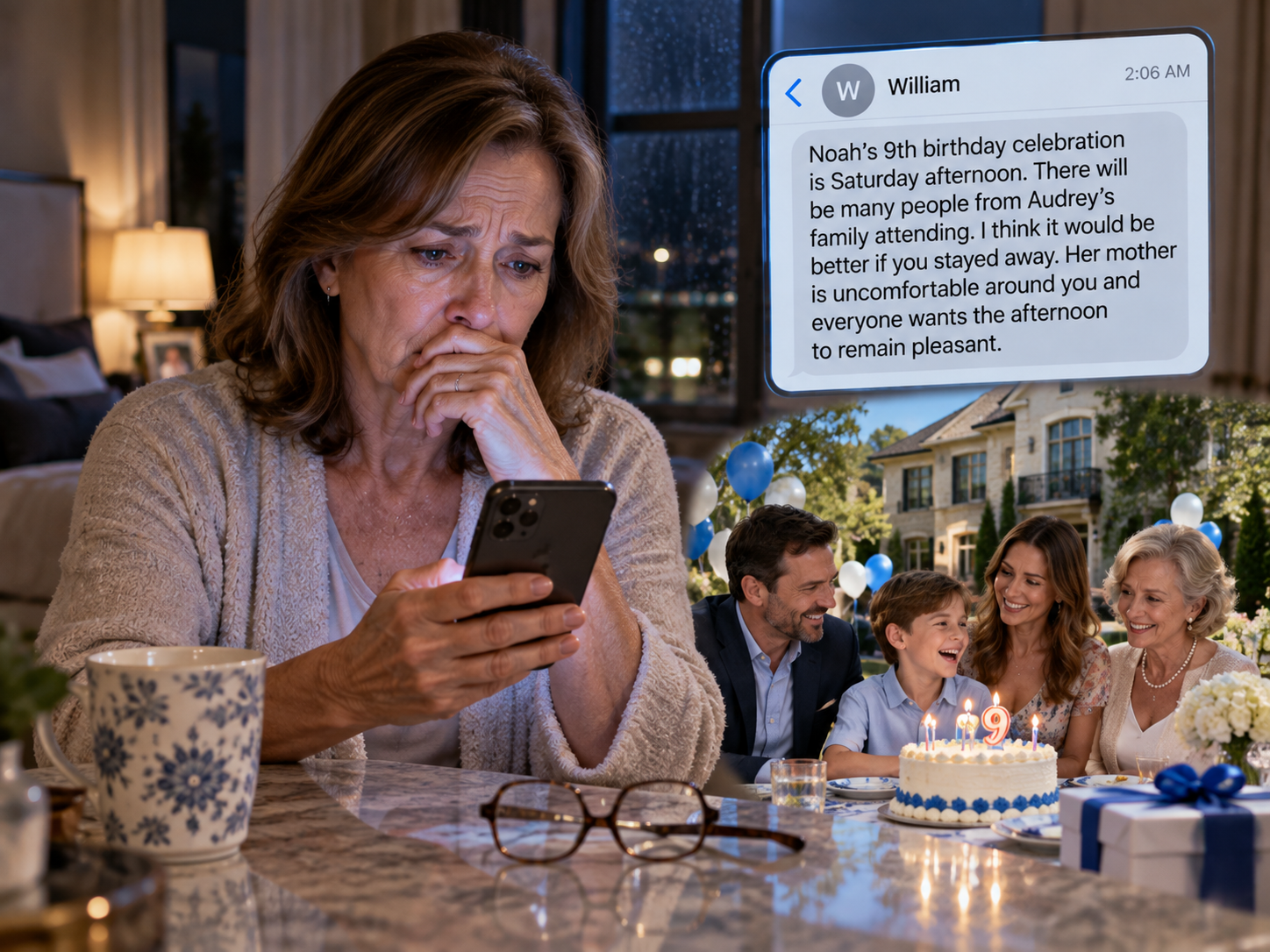
Seven years passed before Noah learned the full story.
By then, he was sixteen.
William's career had recovered, though not to the level it had reached before the collapse. He had become more careful with money. Audrey had rebuilt her professional life as well. Their marriage had survived, but it was not the same marriage.
They no longer pretended trust meant never asking questions.
They checked documents.
They discussed money.
They disagreed openly.
And when they disagreed, they did not call Beatrice to settle it.
That change had taken years.
I saw Noah almost every weekend.
He had grown tall enough to make the old family photographs look strange. His voice had deepened. The crooked model airplane from his ninth birthday sat on a shelf in my study because he had insisted I keep it.
One summer afternoon, he found the trust papers.
He was looking for a document concerning a school project on property law. Richard had sent me an updated copy of the trust, and I had left the folder on my desk.
Noah picked it up.
“Grandma?”
I looked up.
“Yes?”
“What is this?”
I knew immediately.
“The trust.”
“Is this about the house?”
“Yes.”
He began reading.
His eyebrows drew together.
“Why does my name appear here?”
I put down my pen.
“Because the trust includes a future provision for you.”
He looked at me.
“What does that mean?”
“It means the house may eventually become your responsibility.”
“May?”
“Yes.”
“Why not definitely?”
“Because I don't want you to receive something simply because you were born into the family.”
He sat down.
“What happened?”
I could have given him a softened version.
Instead, I decided he was old enough for the truth.
“Your father made mistakes.”
“About the house?”
“Yes.”
“Mom too?”
“Yes.”
He was quiet.
“And you kicked them out?”
“They moved out.”
“Because they tried to sell it?”
I nodded.
“Did Dad steal money?”
“No.”
“Mom?”
“She took money she should not have taken.”
“What about Grandma Beatrice?”
I looked at him.
“She was deeply involved.”
He absorbed that.
“Why didn't you tell me?”
“Because you were nine.”
“I would have understood.”
“No. You would have understood that adults were angry. You would not have understood what it meant to carry that knowledge.”
He looked down at the papers.
“So the house was almost sold?”
“Yes.”
“And I almost lost it?”
“You never owned it.”
“But it could have disappeared.”
“Yes.”
He leaned back.
“Why did you save it?”
I smiled.
“Because I bought it to protect your family. Later I realized protecting the property was also a way of protecting your future.”
He stared at the trust.
“Do you expect me to live there?”
“No.”
“Then what do you expect?”
“Nothing.”
He looked surprised.
“Nothing?”
“I expect you to become your own person.”
“And if I don't want the house?”
“Then the trust will protect it for someone else.”
He nodded slowly.
“What if I do want it?”
“Then you learn what it costs to take care of something valuable.”
He smiled.
“That sounds like a lot of work.”
“It is.”
He closed the folder.
“Can I ask Dad about it?”
“Yes.”
“Will he be angry?”
“No.”
That evening, Noah asked William.
I was not present.
Later, William told me what happened.
Noah had asked whether the story was true.
William had said yes.
Then Noah asked the question William had apparently been dreading.
“Were you ashamed of Grandma?”
William told him the truth.
“Yes.”
Noah asked why.
William said because he believed accepting help made him less of a man.
Noah had thought about that for a long time.
Then he said, “That sounds stupid.”
William laughed.
“It was.”
Noah continued.
“Did Grandma forgive you?”
“I think she did.”
“Did you forgive yourself?”
William did not answer immediately.
“I am still working on that.”
Noah accepted the answer.
He was becoming thoughtful in ways I recognized from both sides of the family.
One evening, he came to my house alone.
He sat beside me in the garden.
“Grandma?”
“Yes?”
“I don't think I want the house.”
I smiled.
“That is allowed.”
“Not now, anyway.”
“Also allowed.”
“I want to study engineering.”
“I know.”
“I want to build things.”
“That sounds more like you.”
He laughed.
“I mean real things. Bridges. Aircraft. Stuff people use.”
I looked at the old mansion behind us.
“Then build those.”
“What about the trust?”
“Leave it alone until you know.”
He was quiet.
Then he said, “You know what I think?”
“What?”
“I think the house caused everyone to think about money too much.”
I smiled.
“That is an excellent observation.”
“Dad said money isn't bad.”
“He's right.”
“But people can become bad around money.”
“People can become frightened around money.”
“Is that different?”
“Yes.”
“How?”
“Badness is a choice. Fear is a condition. But fear can lead people into bad choices.”
He considered that.
“Like Dad.”
“Yes.”
“Like Mom.”
“Yes.”
“Like Grandma Beatrice.”
I hesitated.
“Sometimes.”
He looked at me.
“And you?”
That question caught me.
“What about me?”
“Were you afraid?”
I looked toward the house.
“Yes.”
“Of what?”
“Losing my family.”
He nodded.
“Did that make you do bad things?”
I smiled sadly.
“It made me do things that weren't always wise.”
“Like buying the house?”
“No.”
“Like letting Dad live there forever?”
I laughed.
“Yes.”
He smiled.
“You can admit it.”
“I can.”
He leaned back.
For a while we listened to the wind moving through the trees.
Then Noah said, “I don't want the house to decide who I become.”
I turned toward him.
“Then it won't.”
He looked at me.
“Promise?”
“I promise.”
Years later, those words would matter more than either of us understood.
Because Noah eventually chose not to inherit the mansion.
He chose something else.
But that decision came after one final conversation.
It happened when he was twenty-four.
By then, William and Audrey were living comfortably in a smaller home they had purchased themselves. They had no debts connected to me. They had built a life that was entirely theirs.
I was older.
The mansion required more maintenance than I wanted to manage personally.
Noah had completed his engineering degree and was working on an aviation project.
He came to see me one autumn afternoon.
Richard was there.
The trust documents were on the table.
Noah looked at them.
“I've decided.”
I waited.
“I don't want the house.”
Richard looked at me.
I smiled.
“Why?”
“Because I don't need it.”
“You don't want millions of dollars?”
He laughed.
“Of course I want financial security.”
“Honest answer.”
“But I don't want to spend my life protecting a building because my family fought over it.”
Richard leaned back.
“What would you do with it?”
Noah looked through the window.
“I want to convert part of the property into a scholarship and engineering workshop.”
I stared at him.
“For whom?”
“Kids who want to build things but don't have access to equipment.”
I said nothing.
He continued.
“The house could remain. Some of the grounds could become workshops. The trust could fund scholarships. The property would still be protected, but it would do something.”
Richard looked impressed.
“That is a substantial proposal.”
“I know.”
“Why this property?”
Noah smiled.
“Because everyone kept saying it was valuable.”
“And?”
“I think it should prove it.”
I looked at my grandson.
For years I had believed the purpose of the trust was to protect a house.
Now I understood that the house had never been the true asset.
The true asset was the opportunity it could create.
“You've thought this through.”
“For years.”
I touched the trust papers.
“What would you call the program?”
Noah smiled.
“I don't know.”
I thought of the little boy who had once sent me a voice message before his ninth birthday asking me to bring a deck of cards.
“The Noah Kensington Foundation?”
He shook his head.
“No.”
“Why?”
“Too much ego.”
I laughed.
“Fair.”
He thought.
“Maybe something about building.”
Richard smiled.
“You're going to make us wait, aren't you?”
“Yes.”
Noah gathered the papers.
Then he stopped.
“Grandma?”
“Yes?”
“Do you regret what happened?”
I looked at him.
“No.”
“Not even losing the family?”
“We didn't lose the family.”
He smiled.
“We changed it.”
“Yes.”
He hugged me.
For a moment I was back in the kitchen seven years earlier, watching my son drown in shame.
Only now, the boy who had been rescued had become a father.
And his son was standing in front of me, not asking for the house.
Asking what it could become.
Click Here to continue read next: PART8: The Mansion Finally Became What I Had Wanted From the Beginning, Not a Prize for My Family but a Promise to Those Who Came After
The Mansion Finally Became What I Had Wanted From the Beginning, Not a Prize for My Family but a Promise to Those Who Came After
Part 7 of 24

