
The final transformation began the following spring.
The mansion was not torn down.
No developer received it.
No family member sold it.
Instead, the trust was amended again.
The residential wing remained protected, while the unused portions of the property were converted into classrooms, workshops and meeting spaces. The gardens remained largely intact. The old stone terraces became outdoor work areas. A section of the carriage house became an engineering lab.
Noah insisted on keeping the original architecture.
“This house survived everything,” he said. “It doesn't need to become something unrecognizable.”
I agreed.
William helped with the administrative work.
Audrey handled the scholarship applications.
Even Beatrice, after years of distance, eventually sent a letter.
She did not ask for money.
She did not ask for forgiveness.
She wrote that she had spent too many years believing security came from controlling other people's resources.
She said she had been wrong.
I read the letter once.
Then I placed it in the file.
Some apologies belong in the past.
They do not need to become friendships.
The first scholarship ceremony was held in the garden.
Twenty students attended.
Some arrived with parents.
Some arrived alone.
They were teenagers and young adults with notebooks, secondhand laptops and ideas far larger than their budgets.
Noah stood before them.
He did not mention the family scandal.
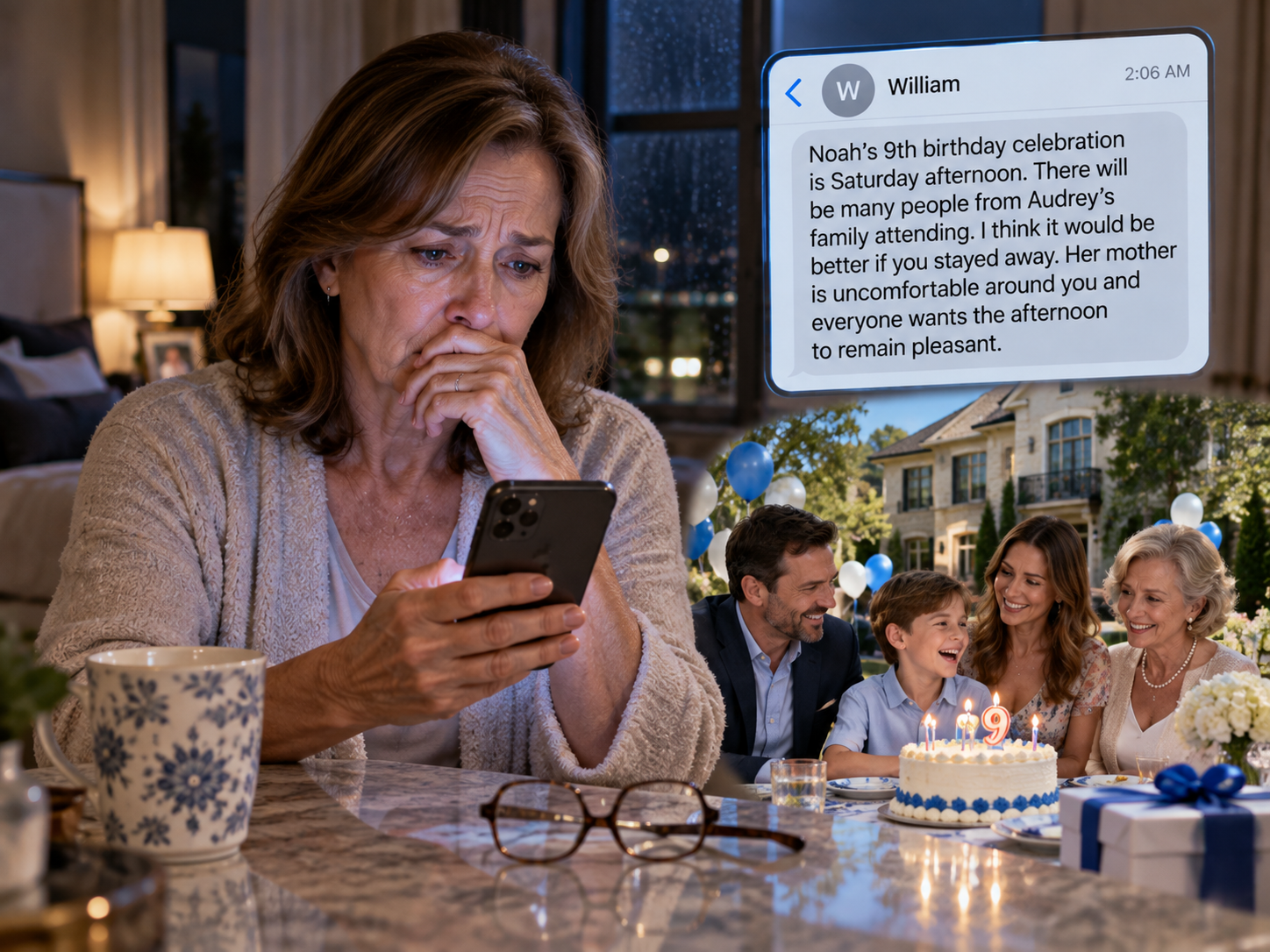
He did not tell them about the birthday party.
He did not explain how close the property had come to being sold.
He simply said that resources matter most when they are used to give someone else a chance.
I stood at the back.
William stood beside me.
“You did this,” he whispered.
“No.”
He looked at me.
“No?”
“No. We did.”
He smiled.
“I still don't think I deserve that.”
“You don't have to deserve every good thing that happens after you learn from a bad one.”
He looked toward Noah.
“He's extraordinary.”
“He is.”
“I wonder where he got that.”
“From neither of us.”
We laughed.
The ceremony ended with students walking through the old workshop.
One young girl stopped beside me.
“Are you Noah's grandmother?”
“Yes.”
“Did you build this place?”
I smiled.
“No.”
She looked confused.
“I thought you did.”
“Noah did.”
She glanced toward the workshop.
“He said his grandmother taught him that ownership isn't the same as responsibility.”
I looked at Noah.
He was helping a student adjust a small mechanical assembly.
“I told him that once.”
“He remembered.”
I smiled.
“Apparently he did.”
That evening, after everyone left, I walked through the mansion alone.
The old rooms no longer felt like memorials.
They were working spaces now.
A desk stood where Noah had once played with cards.
A drafting table occupied the corner where birthday gifts had been stacked.
The old dining room held shelves of engineering books.
The house had changed without losing itself.
I stopped beside the staircase.
For years I had believed the central question was whether I should have taken the house back.
Now I understood the better question.
What was the house for?
The answer had never been ownership.
It had been opportunity.
William found me there.
“You all right?”
“Yes.”
He stood beside me.
“Do you remember the first night?”
“What first night?”
“When you called me about the birthday.”
I smiled.
“I remember.”
“I thought you were going to destroy my life.”
“I almost did.”
He laughed.
“I deserved it.”
“You deserved consequences.”
“Fair.”
He looked around.
“I never imagined this.”
“Neither did I.”
He was quiet.
“I'm glad you didn't give the house to me.”
I turned toward him.
“That surprises me.”
“If you had, I might have sold it.”
I knew he was telling the truth.
“I believe you.”
“I would have told myself it was the responsible thing.”
“That is exactly why the trust existed.”
He nodded.
Then he said something I had never expected.
“Thank you for not making me the villain.”
I looked at him.
“You made mistakes.”
“I know.”
“But you were not only your mistakes.”
His eyes filled.
He looked away.
“Mom.”
“Yes?”
“I love you.”
“I love you too.”
He hugged me.
This time I hugged him back.
There was no contract between us.
No property.
No condition.
Only the relationship that had survived everything we had done to it.
Later that night, Noah found me in the garden.
“You're still awake.”
“So are you.”
“I wanted to check something.”
“What?”
“The trust.”
I laughed.
“You really like those documents.”
He sat beside me.
“I wanted to make sure everything is signed.”
“It is.”
“And the property can't be sold?”
“Not without following the new structure.”
“And the scholarship stays?”
“Yes.”
He nodded.
“Good.”
I looked at him.
“You don't need to protect it forever.”
“I know.”
“You're allowed to change it if circumstances change.”
“I know.”
“Then why are you worried?”
He smiled.
“Because I finally understand what it means.”
“What?”
“To inherit something.”
I waited.
“It isn't getting something someone else built.”
He looked toward the mansion.
“It is being trusted not to waste it.”
I smiled.
“That took you twenty-four years.”
He laughed.
“You had seven years of mistakes to teach me.”
“Your father would object to that math.”
“He can.”
We sat quietly.
The garden smelled of wet earth.
Somewhere near the workshop, a motion light came on.
The mansion windows glowed behind us.
I remembered the night William had asked me whether the house was really his home.
I had told him no.
At the time, I had believed the answer was legal.
Years later, I understood it differently.
A home is not created by a deed.
It is created by the people who choose to care for one another inside it.
The mansion had never been William's.
It had never been mine in the deepest sense either.
I had been its steward.
William had been its resident.
Noah became its future.
And now hundreds of young people would walk through its doors without ever knowing the family argument that had nearly taken the opportunity away from them.
That was how the story should end.
Not with someone winning.
Not with someone being humiliated.
Not with a fortune preserved for its own sake.
With something useful left behind.
The following year, the first engineering team from the foundation won a national competition.
Noah called me before sunrise.
“We won.”
I was half asleep.
“Who won?”
“The team.”
“What team?”
“Our students.”
I sat up.
“You're serious?”
“We won.”
I laughed.
“Then congratulations.”
There was a pause.
“Grandma?”
“Yes?”
“Thank you.”
“You've thanked me enough.”
“I haven't.”
“You don't owe me anything.”
“I know.”
“Then why thank me?”
“Because you could have kept the house.”
I looked toward the window.
“I almost did.”
“But you didn't.”
“No.”
“You turned something that hurt us into something that helps people.”
I smiled.
“That's what you're supposed to do with what life gives you.”
He was quiet.
Then he said, “I think I finally understand.”
“What?”
“You didn't save the house.”
I waited.
“You saved what it could become.”
I closed my eyes.
For the first time in years, the sentence felt complete.
The mansion remained standing.
Its stone walls still held the marks of time.
The garden still grew wild in places.
The old staircase still creaked on the fourth step.
Nothing about the building had become perfect.
But perfection had never been the goal.
The goal was to make sure that one family’s mistakes did not become the next generation’s inheritance.
William learned that love could survive boundaries.
Audrey learned that independence could not be built on somebody else's property.
Beatrice learned, painfully and too late, that control was not security.
Noah learned that inheritance was responsibility.
And I learned the lesson that had taken me the longest.
Giving someone everything is not always the greatest act of love.
Sometimes love means giving less.
Sometimes it means saying no.
Sometimes it means letting the person you love lose something they thought they could keep.
And sometimes, if you are lucky, what survives that loss is worth far more than the thing you were trying so desperately to protect.
Years later, when visitors asked who owned the mansion, the answer became complicated.
The trust owned it.
The foundation used it.
The students filled it.
Noah protected its future.
But whenever I walked through the garden, I remembered the frightened young father who had once stood in my kitchen and believed his life was over.
I remembered the little boy who had left a voice message asking me to bring a deck of cards to his ninth birthday.
I remembered the birthday I missed.
The house I took back.
The son I nearly lost.
And the grandson who taught all of us what the house was really worth.
Not ten million dollars.
Not the land.
Not the walls.
The chance to begin again.
And that was the inheritance I had wanted all along.
The End
Read more original stories on Feel Every Story.
The Mansion Finally Became What I Had Wanted From the Beginning, Not a Prize for My Family but a Promise to Those Who Came After
Part 8 of 24

