
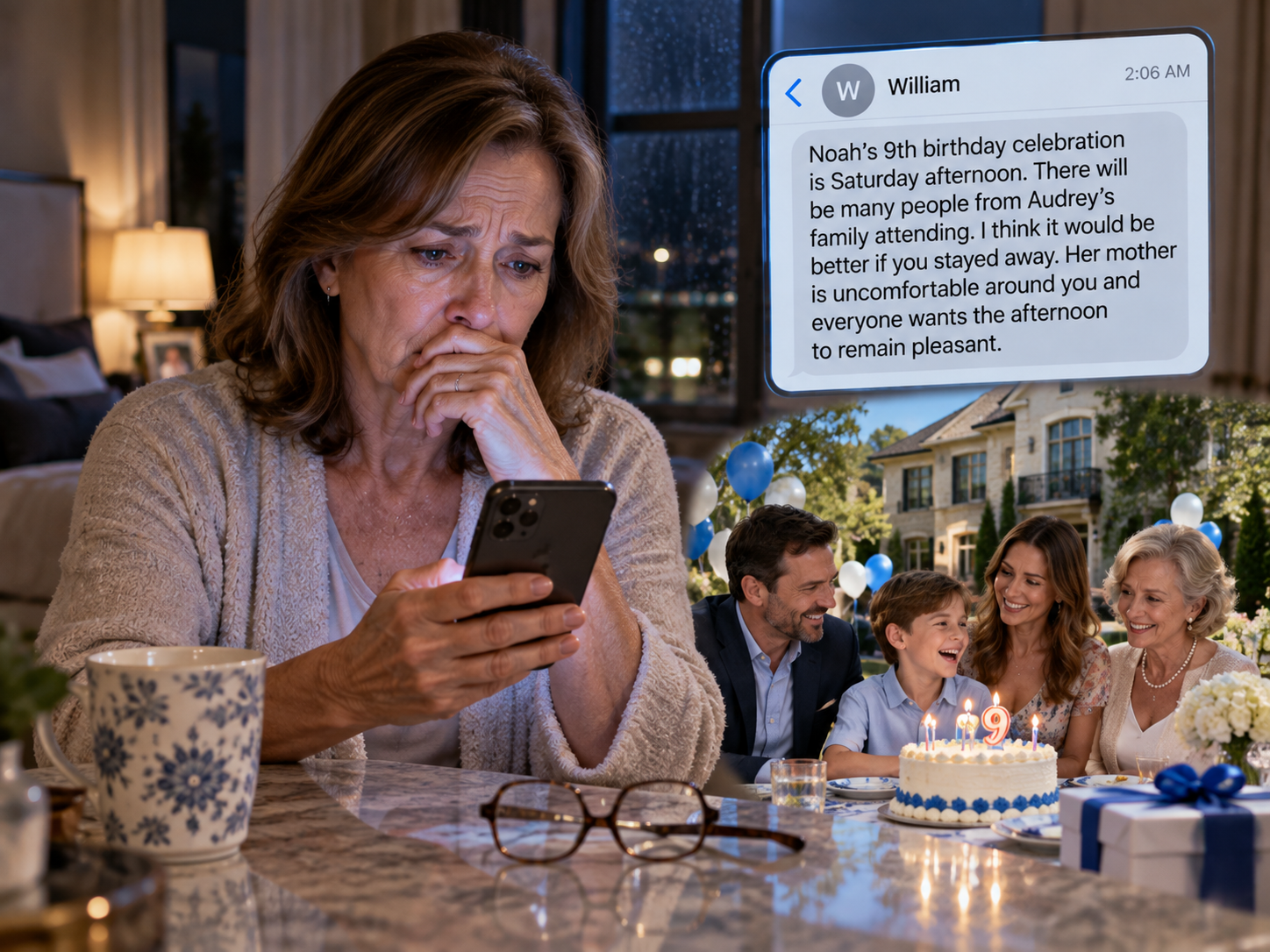
At 2:06 on Thursday morning, my phone trembled across the nightstand and pulled me out of a shallow, uneasy sleep. I reached for it expecting some emergency from the business, a wrong number, perhaps one of those automated notices that arrive at ridiculous hours. Then I saw William’s name. My son had never been good at delivering difficult news, and he certainly had never learned the art of making bad news less alarming by sending it after midnight.
His message was short. Noah’s ninth birthday celebration was Saturday afternoon, he wrote, and there would be many people from Audrey’s family attending. Then came the sentence that made me sit upright. William thought it would be better if I stayed away. He said Audrey’s mother was uncomfortable around me and that everyone wanted the afternoon to remain pleasant. I read the words again, hoping I had misunderstood them. I had not.
For several seconds I listened to rain ticking against the bedroom window. My glasses sat beside the lamp, and without them the letters on my screen blurred into gray shapes. I put them on and read the message a third time. There was no ambiguity. I had not been forgotten. I had been deliberately excluded from my grandson’s birthday.
What made the insult difficult to absorb was the house where the celebration would take place. Seven years earlier, William’s company had collapsed under a mountain of debt. He had personally guaranteed obligations he could not cover, and the family had been preparing to sell almost everything they owned. Noah had been two. William had stopped sleeping properly. Audrey had begun talking about what would happen if they had to leave San Francisco. My son, who had always measured himself by what he could provide, could barely look at me when we discussed money.
I had stepped in because I was his mother. I purchased an old San Francisco mansion on nearly two acres, a property worth close to ten million dollars even then. It had stone terraces, mature trees, a long garden and enough rooms to make a family of three seem almost lost inside it. I placed the property in a residential trust rather than handing it to William outright. He, Audrey and Noah could live there. They would pay no rent. Certain expenses would be covered. But the deed and the controlling interest remained where they belonged: with the trust I had established.
I remembered William standing in my kitchen after I told him.
“Mom, I can’t accept something like that.”
“You aren’t accepting a fortune,” I had told him. “You’re accepting a place where your family can recover while you rebuild your life.”
He had cried then. Not dramatically. He had simply lowered his head and pressed his fingers against his eyes. I remember thinking that the hardest part of being a parent was knowing when to help and when to let your child struggle. I thought I had found the right balance.
Apparently I had not.
I got out of bed and went downstairs. The kitchen was dark except for the small light above the stove. I poured myself water and stood at the island with William’s message still open. The wording bothered me. It sounded polished in a way William never sounded when he was uncomfortable. Usually he apologized too much. He called rather than texted. He filled silence with explanations because he hated disappointing me.
This message felt prepared.
I typed, Is Noah asking me not to come?
I stared at the sentence, then erased it. Noah was nine. I would not make him carry an adult conflict simply because his father had been unwilling to handle it honestly.
Instead I wrote, Did you make this decision?
The response arrived three minutes later.
Mom, please don’t make this difficult.
I read it once.
Then again.
The words hurt because they told me more than an angry message would have. Somewhere along the way, my presence had stopped being part of William’s idea of family and had become something he believed needed to be managed.
I put the phone face down.
My relationship with Audrey had never been easy, but I had worked hard to keep it civil. She was intelligent, polished and intensely conscious of how people viewed her. She remembered names and social connections. She knew which parents mattered at Noah’s school and which introductions could lead somewhere useful. I sometimes found her exhausting, but she was William’s wife, and I had no desire to compete with her.
Her mother, Beatrice, was different.
Beatrice never openly insulted me. She was too practiced for that. Her methods were quieter. A pause before answering. A compliment that somehow became criticism. An invitation that arrived after everyone else had received theirs. Family photographs in which I somehow ended up at the edge. I had initially dismissed it as vanity.
After Noah was born, I decided peace mattered more than pride.
I allowed things I would never have tolerated from a business associate. I watched Beatrice increasingly behave as though she were the senior authority in the family. I watched Audrey defer to her. I watched William avoid disagreement because disagreement made him anxious.
Whenever I thought about confronting him, I reminded myself that he was an adult. His marriage was his responsibility.
At 2:31 another message arrived.
Please just come see Noah another weekend.
That sounded more like William.
I called him. The phone rang until voicemail. I called again. Still nothing. I resisted the urge to try a third time.
Instead I went into my study and opened the bottom drawer of my desk. The original trust documents were with my attorney, Richard Hale, but I kept a complete copy. I had not looked at it in years.
The pages smelled faintly of paper and dust. My signature appeared beside William’s on the final section. I remembered Richard insisting that we make the agreement precise.
“Families are usually closest when nobody expects the contract to matter,” he had told us. “That is exactly when you need one.”
William had laughed.
“Mom would never throw me out.”
Richard had looked over his glasses.
“This document is not about what your mother intends to do. It is about making sure everyone remembers the same arrangement.”
I remembered that conversation differently now.
The trust gave William and Audrey substantial residential rights, but those rights came with conditions. They could not transfer an interest in the property, use it as collateral, make unauthorized commercial arrangements, divert trust funds or behave as though they personally owned an asset that remained protected under the agreement. There were provisions allowing the trustees to suspend or terminate occupancy after serious violations.
I stopped reading.
The idea of removing my son from that house made my stomach tighten.
I had not bought the property to control him.
I had bought it because he was drowning.
I closed the agreement and went upstairs. Sleep never returned. At 6:40, I was watching rain turn the garden silver when my phone chimed again.
This time it was Noah.
“Grandma Vicky,” he whispered in a voice that made me smile despite myself, “are you awake? Dad says I’m not supposed to call before seven, but this is a recording, so I think I found a loophole.”
I listened to the rest.
He was planning games for Saturday. He wanted me to bring the cards I had used to teach him a trick. He wanted me to teach Ethan, one of his friends, how to do it.
He expected me to be there.
I saved the recording.
That changed something.
Whatever William and Audrey had decided, they had not told Noah.
At seven I called William again. This time he answered.
“Mom.”
He sounded exhausted.
“Does Noah know I’m not coming Saturday?”
A long pause.
“Not yet.”
“Why?”
“We’re going to explain.”
“Explain what?”
“Please.”
“No. Tell me what happened.”
I heard a door close on his end.
“Beatrice thinks there’s been too much tension.”
“Between whom?”
“You know you two don’t get along.”
“I have attended dozens of events with her without causing a scene.”
“That’s not what I mean.”
“Then tell me.”
He exhaled.
“There are going to be people there who matter to Audrey’s family.”
That phrase caught my attention.
“People who matter?”
“Investors. School parents. Business contacts.”
“And I would embarrass them?”
“I didn’t say that.”
“You didn’t need to.”
“Mom.”
I looked through the window at the wet branches outside.
“Whose house is the party in?”
Silence.
“Don’t do this.”
“I asked you a question.”
“You know whose house.”
“Yes,” I said. “I do.”
William became defensive.
“We live here. Noah lives here. It’s our home.”
“I have never said otherwise.”
“Then why bring ownership into this?”
“Because someone has decided I am unwelcome in a home I provided.”
“It isn’t like that.”
“What is it like?”
He had no answer.
I waited.
Finally he said, “Can we talk later?”
“No.”
“I have to take Noah to school.”
“Then take him. We’re finished for now.”
I ended the call.
At 8:15 I called Richard.
He answered on the second ring.
“Victoria? What happened?”
“I need the complete trust file for the Kensington property.”
His tone changed immediately.
“I assume something happened.”
“I was told not to attend Noah’s birthday.”
“By William?”
“Yes.”
“Why?”
“Apparently my presence makes Audrey’s family uncomfortable.”
Richard was quiet.
“And you want the trust file because?”
“I want to know precisely what I own, what they control, and whether anything has changed since the agreement was signed.”
“Do you suspect something?”
“I don’t know.”
That was the truth.
I had no proof of anything beyond an ugly family decision. But the wording of William’s message bothered me, and another conversation had begun resurfacing in my memory.
Six months earlier, Beatrice had approached me after dinner in the mansion’s garden. She had asked whether I had ever considered transferring the property directly to William.
I had laughed.
“For what reason?”
“Estate planning.”
“My estate planning is handled.”
She had smiled.
“Of course. I only wondered whether keeping the house under your control makes William feel as though he is still a child.”
At the time, I had dismissed the comment.
Now it sounded different.
“Richard,” I said, “has anyone contacted your office about the property?”
“Not that I know of.”
“Check.”
He hesitated.
“Victoria—”
“Please.”
“All right.”
He called back at 11:17.
I was reviewing correspondence when his name appeared on my screen.
“What did you find?”
“Someone requested certified copies of public filings connected to the property about eight weeks ago.”
“Who?”
“We’re still determining that. Public records can be accessed without notifying us.”
“That alone isn’t unusual.”
“No.”
“But?”
He paused.
“Two weeks later, an attorney contacted one of the administrative trustees with what he described as a hypothetical question about challenges to residential trusts.”
My hand stopped above the keyboard.
“Which attorney?”
“I’m confirming it.”
“What exactly did he ask?”
Richard spoke carefully.
“Whether long-term occupancy, financial contributions and family reliance could create grounds for asserting an equitable interest against the grantor.”
I stood and walked to the window.
“That is remarkably specific.”
“Yes.”
“Find the attorney.”
“I’m working on it.”
“And Richard?”
“Yes?”
“Do not contact William.”
He was silent.
“Not yet,” I added.
“All right.”
After the call, I replayed Noah’s voice message.
Bring the cards, okay?
My grandson believed Saturday was about cake, games and a model airplane.
I wanted desperately to believe that was all it was.
At 4:20 Richard called again.
“I found the firm.”
“Who retained them?”
“They won’t disclose that voluntarily.”
“What do we know?”
“The inquiry came through a firm that has represented Audrey’s father before.”
I sat down.
“Anything else?”
“The attorney specifically asked whether the trust could be challenged if beneficiaries demonstrated that you exercised excessive financial control over William.”
The room became very still.
Control.
Not generosity.
Not rescue.
Control.
The word was almost identical to the implication Beatrice had made months earlier.
“Richard,” I said, “I want a complete audit of every authorization connected to that property for the past six years.”
“That will take time.”
“Start tonight.”
“Are you expecting to find a violation?”
I looked at William’s message on my phone.
“I don’t know what I’m expecting anymore.”
At 4:37, another message arrived.
It was from Audrey.
Victoria, please respect William’s decision. Saturday is important for our family.
Our family.
I read those words twice.
Then I opened the trust agreement again.
This time I did not read it as a mother who had rescued her son.
I read it as the woman whose name and money stood behind the asset.
When I reached the enforcement provisions, I called Richard back.
“Tell me exactly what happens,” I said, “if the people living in that house have violated the conditions of the trust.”
Click Here to continue read next: PART2: The Records Beneath the Birthday Party Revealed Payments Nobody Had Mentioned, and Suddenly the Family Argument Looked Like Something Carefully Planned
The Mansion Finally Became What I Had Wanted From the Beginning, Not a Prize for My Family but a Promise to Those Who Came After
Part 1 of 24

