
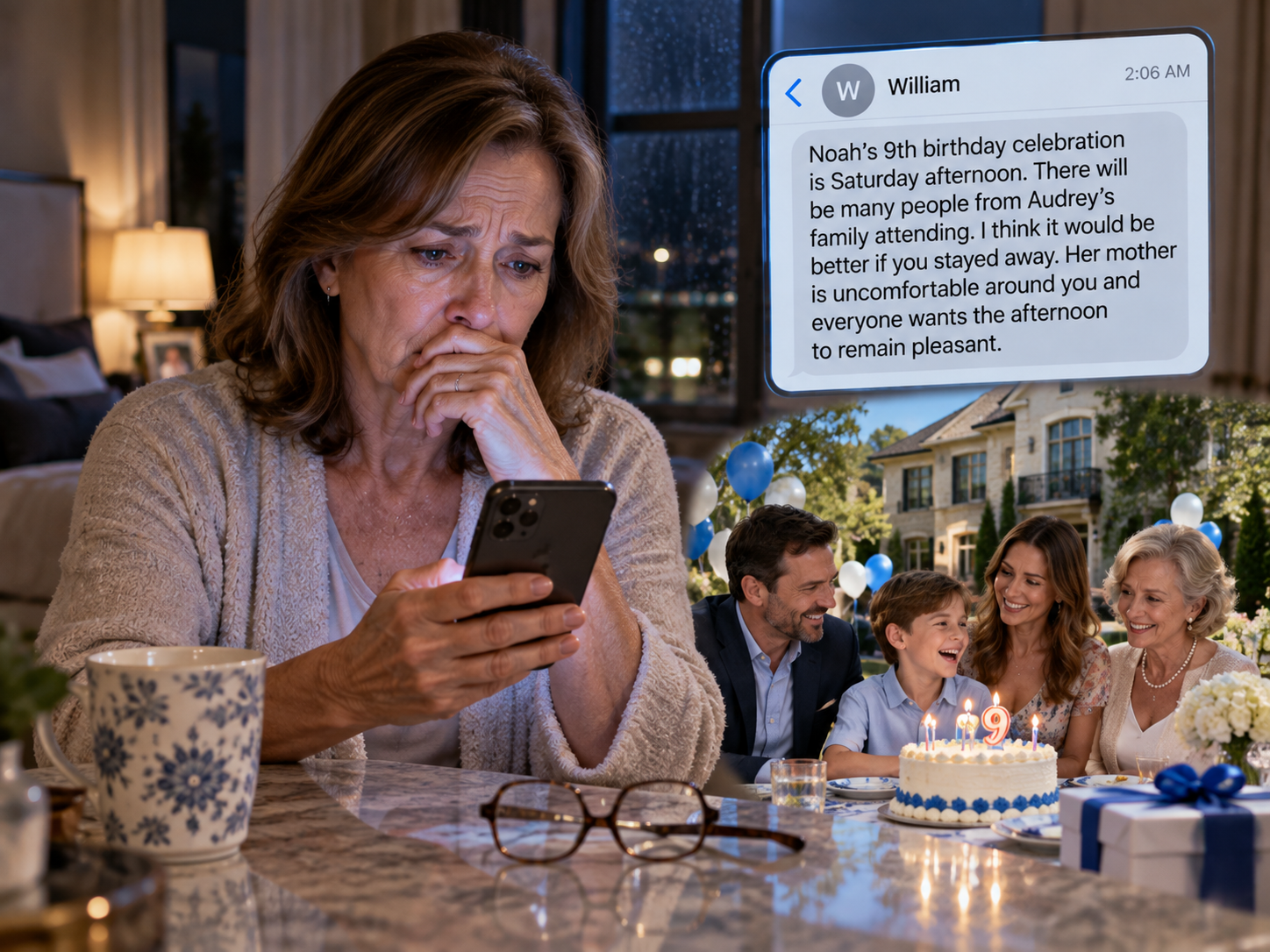
Thirty days after William and Audrey left the mansion, I woke before sunrise and found myself listening for sounds that were no longer there. The old house had always been quiet, but this was different. There was no small pair of feet crossing the upstairs hallway, no cupboard opening too early because Noah wanted cereal before anyone else was awake, no muffled argument about whether a model airplane could remain on a dining table overnight. Silence had become another room in the house.
I had expected relief. Richard had warned me that reclaiming the property might feel complicated, but I had imagined the feeling would be clean once the legal dispute ended. Instead, every empty room carried an echo of the family I had tried to protect. The house was secure. The trust was intact. The unauthorized accounts had been closed. Blackwell Pacific had withdrawn from the proposed transaction. Yet none of those victories made the place feel like home.
The investigation had also moved forward. Audrey had admitted receiving money from the developer. Beatrice had denied knowing the full extent of the arrangement, though documents suggested otherwise. The law firm that had explored challenging the trust had withdrawn from the matter after Blackwell Pacific suspended negotiations. Richard had recovered a portion of the transferred funds, while the remainder remained tied up in the continuing financial review.
William had done what I asked.
He had told the truth.
That mattered more than I wanted it to.
He had provided messages, emails and copies of documents showing that he knew Audrey and Beatrice were discussing a possible sale. He admitted that he had concealed the conversations from me because he was frightened of losing his marriage. He also admitted that he had signed financial documents without reading them carefully because he trusted Audrey to handle the household details.
The admissions did not make his choices harmless.
They simply made them understandable.
Every Saturday morning, William came to my house for coffee. At first we barely spoke. He would sit at the kitchen table, drink slowly and leave after twenty minutes. Then, little by little, conversation returned.
One Saturday he asked whether I had ever regretted buying the mansion.
I thought about the question.
“No.”
He looked surprised.
“Even now?”
“Especially now.”
“Why?”
“Because buying it was the right decision when I made it. What happened afterward does not change why I did it.”
He stared at his coffee.
“I thought you bought it because you thought I couldn't take care of my family.”
“I bought it because you couldn't take care of your family then.”
He nodded.
“That sounds worse.”
“It isn't meant to.”
“I know.”
I reached across the table and touched his hand.
“You were drowning, William. Helping you out of the water was not an insult. But eventually you had to learn how to swim.”
He gave a small, embarrassed smile.
“I think I forgot.”
“You did.”
“And you let me.”
“Yes.”
That was difficult for both of us to admit.
I had spent years believing that giving more was the same thing as loving more. When William needed help, I gave it. When Audrey wanted something, I compromised. When Noah needed something, I paid for it before anyone had to ask.
I had confused protection with permanence.
The house had become a shelter, then a habit, then an entitlement.
I had helped create that transformation.
William looked at me.
“Are you angry with yourself?”
“Sometimes.”
“For trusting us?”
“For not recognizing that trust has to change as people change.”
He was quiet.
Then he said, “I don't want Noah growing up thinking he can avoid consequences because Grandma will fix everything.”
“That is the first thing you've said in months that makes me hopeful.”
He smiled faintly.
The financial investigation ended several weeks later.
Richard called me into his office and placed the final report in front of me. Most of the money had been traced. Some had been recovered. The payments to Kensington Advisory Group had been misrepresented as property-related consulting expenses. The company had performed little of the work claimed in its invoices.
Beatrice had received substantially more money than she had admitted.
Audrey had accepted the developer's payments directly.
William had not received money from the scheme.
That distinction mattered.
It did not erase his involvement, but it established that his primary failure had been concealment and negligence rather than personal enrichment.
“Will there be criminal charges?” I asked.
Richard folded his hands.
“That depends on what the authorities decide to pursue.”
“And Beatrice?”
“She has retained separate counsel.”
“Audrey?”
“Her attorney is negotiating repayment and other consequences.”
I looked at the report.
“What about William?”
“His exposure is primarily connected to his authorization of documents and his failure to disclose the proposed sale.”
I closed the folder.
“I don't want him protected from consequences.”
Richard nodded.
“But I don't want him destroyed either.”
“I understand.”
That evening William came over with Noah.
I had not seen my grandson at the mansion since the move.
He ran through my front door carrying a cardboard box.
“Grandma!”
I crouched down as he hugged me.
“You got taller.”
“I know.”
“How do you know?”
“Dad measured me.”
“Then we need a second opinion.”
He laughed.
William stood behind him.
His clothes were simpler now. He looked thinner, too, but his posture had changed. There was less of the old nervous pride in him. He no longer seemed to be performing success for anyone.
Noah opened the box.
“My airplane is almost finished.”
He lifted the model carefully.
One wing was slightly crooked.
“I think it looks perfect.”
“It isn't.”
“Neither are most airplanes.”
William smiled.
We spent the afternoon at the kitchen table.
Noah worked on the model while William and I prepared sandwiches. It was ordinary in a way that felt precious.
Then Noah asked the question I had known would eventually come.
“Grandma, why don't we live in the big house anymore?”
William stopped slicing bread.
I looked at him.
He looked at me.
Then he nodded.
I answered carefully.
“The house belonged to a family trust. Your parents were allowed to live there, but they needed to follow certain rules. Some adults made decisions that meant they had to move.”
“Did Dad do something bad?”
William put down the knife.
“I made mistakes.”
Noah looked at him.
“Big ones?”
“Yes.”
“Are you in trouble?”
“Yes.”
Noah thought about that.
“Are you going to be okay?”
William's face changed.
“I am going to be okay because I am fixing what I did.”
Noah nodded as if that settled the matter.
“Can I have more cheese?”
William laughed.
“Yes.”
After Noah went outside, William remained at the table.
“Thank you,” he said.
“For what?”
“For not making him hate me.”
“He doesn't need to hate you.”
“I thought you might tell him everything.”
“I told him enough to understand that choices have consequences.”
William looked toward the garden.
“That was kinder than I deserved.”
“It wasn't kindness. It was parenting.”
He smiled.
“I'm beginning to understand the difference.”
That evening, after they left, I walked through the house.
For the first time, I did not feel the need to decide whether it was empty.
It was simply mine again.
I entered Noah's old bedroom.
The pale rectangle where his drawings had hung was still visible on the wall. I could have painted it. Instead I left it.
A reminder.
Not of betrayal.
Of what had been learned.
My phone rang.
Richard.
“Victoria, there is one more thing.”
I sat on the edge of the bed.
“What?”
“The trust documents contain a clause we haven't discussed.”
“I thought we had finished.”
“So did I.”
He sounded unusually serious.
“What clause?”
“It concerns what happens to the property if the original beneficiary's family eventually becomes financially independent.”
I frowned.
“What does that mean?”
“It means the trust was never intended to remain under your control forever.”
I looked around the room.
“Then what was it intended to do?”
Richard was silent for a moment.
“Your original instructions created a path for the property to pass to Noah when he reaches adulthood, provided certain conditions are met.”
I stared at the wall.
I had forgotten.
Not because the clause was unimportant, but because seven years earlier I had been thinking about keeping a roof over my son's head, not about what would happen decades later.
“What conditions?”
Richard answered.
“Financial independence. Responsible stewardship. No outstanding claims against the trust. And, importantly, the beneficiary must understand that the property is not an entitlement.”
I laughed quietly.
“That last condition seems difficult to enforce.”
“It isn't a legal condition in the usual sense.”
“What is it?”
“A statement of intent.”
I thought about Noah holding his crooked airplane.
The child who had once believed birthdays were the center of the universe had no idea a house worth millions had quietly been placed in his future.
“Why didn't you tell me this earlier?”
“Because the clause only becomes relevant after the occupancy arrangement changes.”
I stood.
“Then perhaps the time has come.”
“For what?”
“To change what the trust is protecting.”
He was quiet.
“Victoria?”
“I don't want Noah to inherit the house because he is William's son.”
“I know.”
“I want him to inherit it only if he grows into someone capable of understanding what it represents.”
“That is exactly what the trust provides.”
I looked through the window.
The garden was silver beneath the moon.
“Then prepare the amendment.”
Richard hesitated.
“Are you certain?”
“Yes.”
“What about William?”
“He will not own the house.”
“And Audrey?”
“No.”
“Then who?”
I smiled.
“Not yet.”
Click Here to continue read next: PART6: The New Trust Plan Forced William to Face the Future He Had Nearly Traded Away, While Audrey Finally Asked Me for One Chance
The Mansion Finally Became What I Had Wanted From the Beginning, Not a Prize for My Family but a Promise to Those Who Came After
Part 5 of 24

