
His foster father did not ask me to make the story sound better.
That surprised me.
My cheek was swelling quickly, and the bruise would become obvious before the evening was over. His wife had struck me first. I had picked up the mortar and hit her once when she came toward me again. Those facts were uncomfortable, but they were simple.
The baby was not simple.
His foster father kept one arm around the newborn and used the other to make the call for help. He gave the baby's condition first. Only after describing the child did he explain the confrontation.
I stood near the counter and listened.
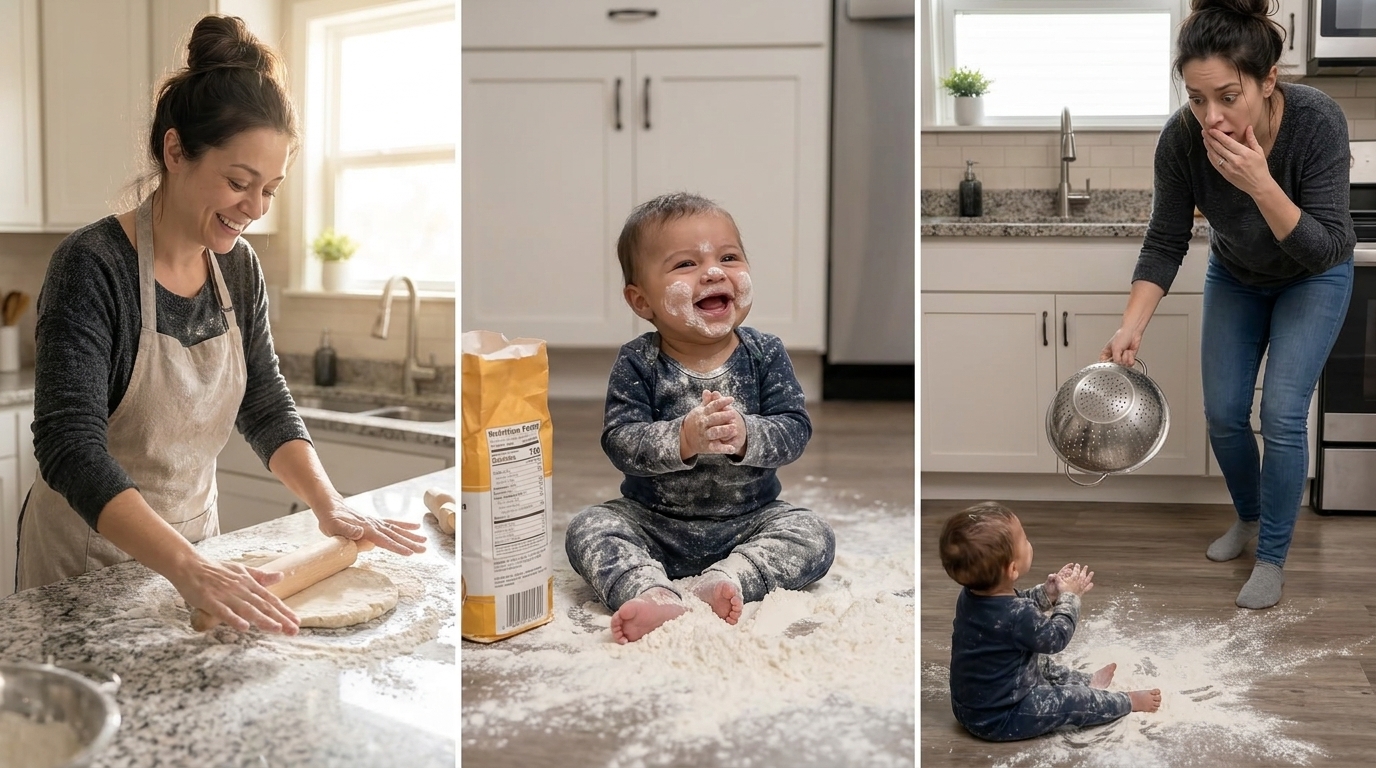
“Newborn,” he said into the phone. “There was a pressure mark around his ankle. He had been underneath a metal colander in the sink.”
He paused.
“Yes. He's breathing. He's crying.”
Another pause.
“There was also a hospital band found with him. It has another infant's name.”
I watched his face as he listened.
He did not embellish anything.
He did not call his wife a monster.
He did not call me a hero.
He simply gave the facts.
When the call ended, he looked at me.
“Tell me exactly what happened.”
So I did.
I told him what I saw when I entered the kitchen. I told him about the baby beneath the colander, the flour on the blanket, the missing sock, and the mark around his ankle.
I told him I had found the second hospital band.
I told him his wife had attacked me from behind and pushed my face into the cabinet.
I told him she came toward me again.
“I picked up the mortar,” I said. “I swung once.”
He glanced toward the stone object.
“Only once?”
“Yes.”
“What happened afterward?”
“She took the baby from the sink. I kept telling her to put him down safely. Then you came in.”
He nodded slowly.
I expected anger.
Instead, he looked at the baby.
“What matters is what happened before I walked through that door.”
The sentence stayed with me.
People often remember the loudest moment of a crisis. They remember the blow, the scream, the argument, the person who lost control. But the worst thing in that kitchen had happened before anyone raised a voice.
A newborn had been lying in a sink.
That fact could not be pushed aside simply because two adults had fought afterward.
The baby was taken for medical attention.
I went along because my eye had begun to hurt badly enough that blinking felt like pressure against a bruise. His foster father stayed close to the newborn. His wife remained behind.
As we left, I looked back into the kitchen.
The room already seemed different.
The flour still covered the floor.
The yellow glove had not moved.
The colander remained crooked in the sink.
And the hospital band lay beside the missing sock.
I wondered what would have happened if I had arrived five minutes later.
Perhaps the baby would have been moved.
Perhaps the blanket would have been shaken out.
Perhaps the sock would have been put back on his foot.
Perhaps the hospital band would have disappeared.
That thought frightened me more than my injury.
At the medical facility, the baby's crying eventually became quieter. Exhaustion replaced panic. A nurse examined his ankle carefully and documented the red pressure mark.
The blanket was examined as well.
The circumstances were recorded.
Nobody treated the kitchen objects as harmless once the full sequence had been explained.
The colander was only a kitchen utensil.
Flour was only flour.
A blanket could leave a crease.
A missing sock could fall beneath a cabinet.
But those explanations changed when they were placed together.
The baby had been under the colander.
The blanket had been dusted with flour.
His ankle carried a distinct pressure mark.
His sock was missing.
And the missing sock had been found with another newborn's hospital band.
I was asked about the confrontation again.
I repeated the same account.
His wife struck me first.
She approached me again.
I believed another attack was coming.
I picked up the mortar and swung once.
Then I stopped.
I did not follow her.
I did not strike again.
When the baby was between us, my attention shifted immediately to him.
The consistency of my answers mattered.
There were enough confusing details without anyone changing the basic sequence afterward.
Later, his foster father sat beside me in the hallway.
He looked exhausted.
“I should have noticed something,” he said.
I looked at the floor.
“I've thought that too.”
He rubbed his hands together.
“I was here.”
“So was I.”
Neither of us knew what else to say.
I had cared for the baby. I knew how light he felt when he fell asleep. I knew the little kick he made when a sock twisted around his toes. I knew the difference between his ordinary fussing and the high, frightened cry I had heard in the kitchen.
And still, I had never imagined finding him there.
His foster father finally looked at me.
“What does that other band mean?”
“I don't know.”
It was the safest answer.
Then I added, “But someone can find out.”
The hospital band was documented.
Its name and identifying information were checked against records.
The process moved away from guesses and toward facts.
That was when the question became larger.
The name belonged to another infant who had previously been connected to the same caregiving system surrounding the household.
The discovery did not prove that the other baby had been harmed.
It proved something narrower.
An identifying item from another newborn had been kept in the house.
His foster father had not known about it.
And it had been found wrapped around the current baby's missing sock.
That was enough to widen the review.
Dates were compared.
Placement records were examined.
Household notes were reviewed.
Previous concerns were considered.
The kitchen incident could no longer be treated as only an argument between two adults.
His foster father understood that.
He was given an opportunity to change his statement after hearing his wife's explanations.
He refused.
“I saw what I saw,” he said.
There was no accusation in his voice.
Only exhaustion.
His wife offered ordinary explanations for the separate objects. Flour belonged in a kitchen. The colander belonged near the sink. A blanket could press against skin. A sock could fall.
Each explanation sounded reasonable when spoken alone.
But they had not happened alone.
I had seen them together.
And now someone else was looking at the same collection of details.
The missing sock had become more important than anyone could have expected.
Because it had carried something that should never have been there.
Click Here to continue read next: PART3: Records Connected the Unfamiliar Name to an Earlier Infant, and Suddenly the Kitchen Could Not Be Treated as an Isolated Incident
The Cry Behind the Cabinet Door Forced Me to Lift an Ordinary Kitchen Colander
Part 2 of 8

