
The baby was sleeping when I arrived.
His breathing was quiet.
One hand rested beside his cheek, and the other had curled loosely against the blanket.
For several seconds, I simply stood there.
There was no emergency.
No crying.
No raised voices.
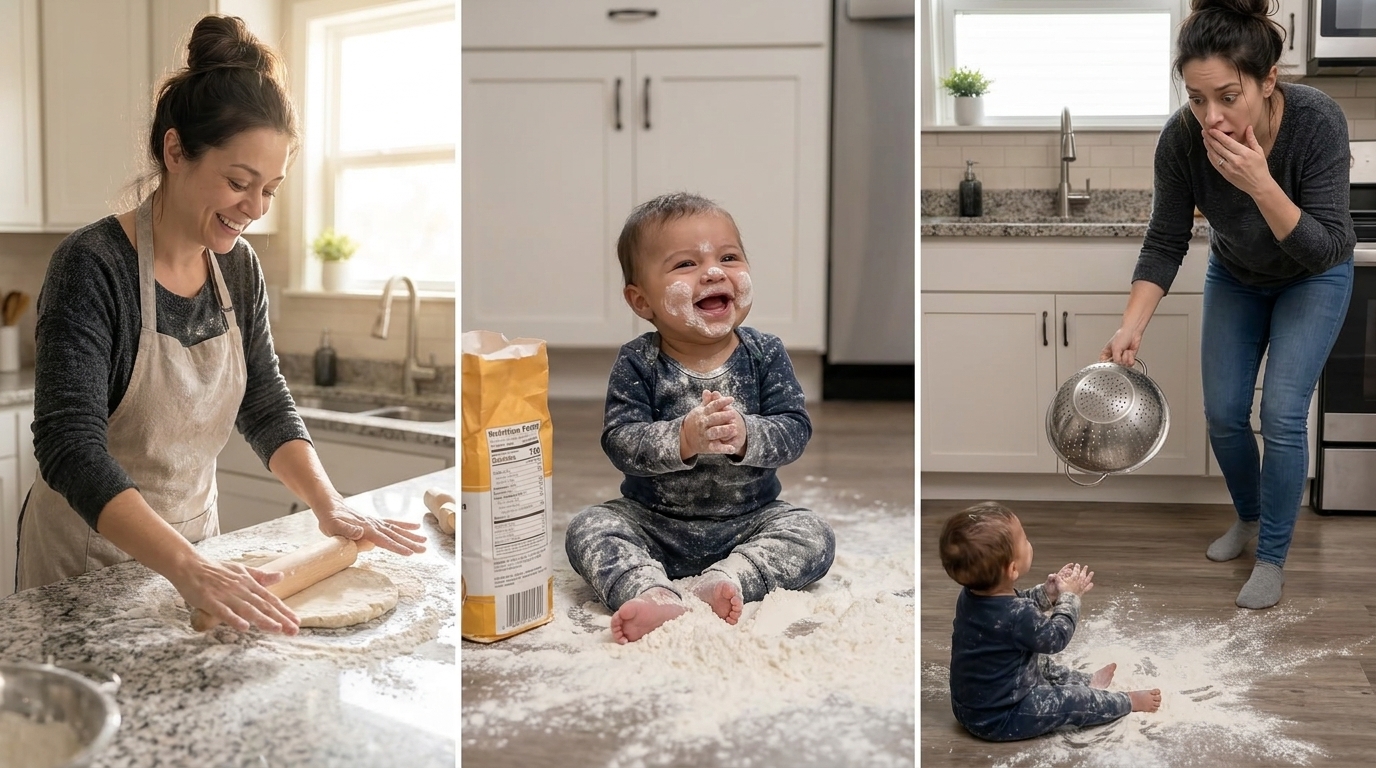
No metal bowl covering him.
No flour scattered across the floor.
The room felt almost painfully ordinary.
I welcomed that.
His foster father was nearby.
He looked tired, but different from the man I had seen in the kitchen.
The fear had not disappeared from his face completely.
It had settled into something more controlled.
He had spent weeks answering questions, cooperating with the review, and accepting that his household could not simply return to the way it had been.
He had also learned that knowing nothing about something does not necessarily make a person free from its consequences.
“I still think about that afternoon,” he said.
“So do I.”
He looked at the baby.
“I keep wondering how I missed it.”
I knew there was no answer that would make him feel better.
“You can't change what you didn't see,” I said. “You can decide what you do after you see it.”
He was quiet.
Then he nodded.
That was the closest thing to closure either of us needed.
The review had reached its conclusion.
The baby's immediate safety had been protected.
The foster mother had not been permitted unsupervised access during the period when the situation was being assessed.
The foster father's statement had remained consistent.
My account had remained consistent.
The medical observations had been documented.
The objects from the kitchen had been preserved.
And the hospital band had been traced.
The earlier infant was real.
The connection to the caregiving system was real.
The band had belonged to that child.
But the records did not establish that the earlier infant had experienced the same treatment.
That fact remained important.
There was no reason to turn uncertainty into accusation.
The second band had already done what it needed to do.
It had caused people to look closer.
It had exposed a piece of household history that the foster father did not know existed.
It had raised questions about how an identifying hospital item had been retained.
It had prevented the kitchen incident from being dismissed too quickly.
That was enough.
The evidence did not need to become a larger story in order to matter.
I had learned that slowly.
At first, I wanted every clue to explain everything.
Then I wanted the earlier records to confirm my worst fear.
Finally, I understood that truth does not owe us a dramatic shape.
Sometimes the truth is a collection of facts that fit together without becoming the story we imagined.
The baby's ankle had carried a pressure mark.
That was true.
He had been found beneath a colander.
That was true.
A confrontation had followed.
That was true.
I had been injured.
That was true.
I had struck once.
That was true.
I had stopped.
That was true.
Another infant's hospital band had been hidden with the baby's sock.
That was true.
The earlier infant had not been shown by the records to have suffered the same treatment.
That was also true.
None of those facts canceled the others.
That was the hardest part to accept.
People often think truth means choosing one version and destroying all the rest.
But sometimes truth means refusing to erase uncomfortable pieces.
I could admit that the foster mother had attacked me.
I could admit that I had struck her.
I could still insist that the baby needed protection.
I could recognize that the second hospital band was disturbing.
I could also refuse to claim that it proved something the records did not prove.
I could feel anger.
I could feel relief.
I could feel sadness.
None of those emotions changed the evidence.
The baby stirred.
His face tightened for a second.
Then he relaxed again.
I looked down.
One sock was still on.
The other was missing.
I smiled before I could stop myself.
“Again?” I whispered.
His foster father looked over.
“What?”
I pointed toward the blanket.
The little sock had slipped free and was lying beside the baby.
For a moment, neither of us moved.
Then he laughed quietly.
It was a small laugh.
Not loud.
Not carefree.
But real.
I picked up the sock.
The memory returned, as it always did.
The cabinet.
The flour.
The colander.
The baby's crying.
The second hospital band.
But the memory no longer controlled the present.
I looked at the sock in my hand.
It was just fabric.
There was nothing wrapped around it.
No hospital band.
No unfamiliar name.
No hidden message.
I placed it beside the baby.
He kicked.
The sock moved.
I adjusted it again.
He kicked harder.
The foster father laughed once more.
“Looks like he hates socks.”
“Maybe he just knows how to make people keep putting them back on.”
That made him smile.
The moment was ordinary.
That was the gift.
Not forgetting.
Not pretending.
Ordinary.
The kitchen had once taught me how quickly ordinary objects can become frightening.
The baby was now teaching me that ordinary objects can become ordinary again.
The two lessons belonged together.
Fear had made the colander unforgettable.
Time had made it possible to see it as an object again.
Fear had made the hospital band feel like the answer to every question.
Evidence had taught me that it was only one important clue.
Fear had made the missing sock seem like a warning.
The baby made it a missing sock again.
That was enough.
I never learned every private thought inside that household.
I did not need to.
Some questions remained questions.
Some explanations remained incomplete.
The earlier infant's history was reviewed, and the available evidence did not establish the nightmare I had feared.
The current baby's situation, however, had been taken seriously.
That distinction mattered.
The baby was not returned to the same conditions while the review was underway.
The adults around him were forced to confront what had happened.
The foster father could no longer say that the household was exactly what he believed it was.
He had seen too much.
I had seen too much.
The people reviewing the case had seen enough to ask questions that might otherwise never have been asked.
The missing sock had done something no one would have expected from such a tiny object.
It had carried a clue into the light.
I sometimes think about how close it came to being overlooked.
A sock can disappear beneath furniture.
A hospital band can be mistaken for rubbish.
A flour-covered blanket can be shaken clean.
A kitchen can be restored.
A bruise can fade.
But a record can preserve what happened.
A witness can speak.
An object can remain.
And when those things are handled carefully, they can stop a disturbing event from being rewritten into something harmless.
That was what mattered most.
Not punishment.
Not drama.
Not having the most frightening explanation.
Protection.
The baby had needed someone to notice.
Someone had noticed.
Then he had needed someone to tell the truth.
People did.
Then he had needed people to keep him safe while the questions were answered.
They did.
That did not erase the afternoon.
It changed what happened afterward.
My own role in it became smaller with time.
I was not a hero.
I was a person who walked into a kitchen and saw something wrong.
I was attacked.
I defended myself once.
I stopped.
Then I stayed focused on the baby.
That was all.
The foster father was not a perfect man.
He had failed to see what was happening around him.
But when he finally saw it, he chose not to hide it.
That mattered.
The foster mother remained responsible for her own actions.
The records remained responsible for what they could establish.
The evidence remained responsible for what it could prove.
And I remained responsible for telling the truth about what I had seen.
No one needed to become larger than the facts.
That was perhaps the most important thing I carried away.
The truth does not become stronger when we exaggerate it.
It becomes weaker.
And the truth does not become kinder when we hide it.
It becomes dangerous.
So I learned to leave the evidence where it belonged.
The hospital band stayed with the records.
The collected objects stayed documented.
The earlier infant's history stayed separate from what could not be proved.
The current baby's safety stayed at the center.
And the little sock eventually became what it should have been all along.
A sock.
I watched the baby kick it away again.
This time I did not tense.
I did not think about the cabinet.
I did not think about the sink.
I did not wonder whether something had been hidden beneath it.
I simply picked it up.
The baby opened his eyes.
For a moment, he looked directly at me.
Then he yawned and turned his head toward his foster father.
I smiled.
The room was quiet.
The baby was safe.
The questions that could be answered had been answered.
The questions that could not be proved had not been turned into false certainty.
The past remained part of the story.
But it no longer had to control the future.
I set the sock beside the blanket where everyone could see it.
Nothing was wrapped around it.
Nothing was hidden inside it.
Nothing needed to be discovered.
It was only a small sock beside a sleeping newborn.
And for the first time since that terrible afternoon, that was exactly what I wanted it to be.
The End
Read more original stories on Feel Every Story.
The Cry Behind the Cabinet Door Forced Me to Lift an Ordinary Kitchen Colander
Part 8 of 8

