
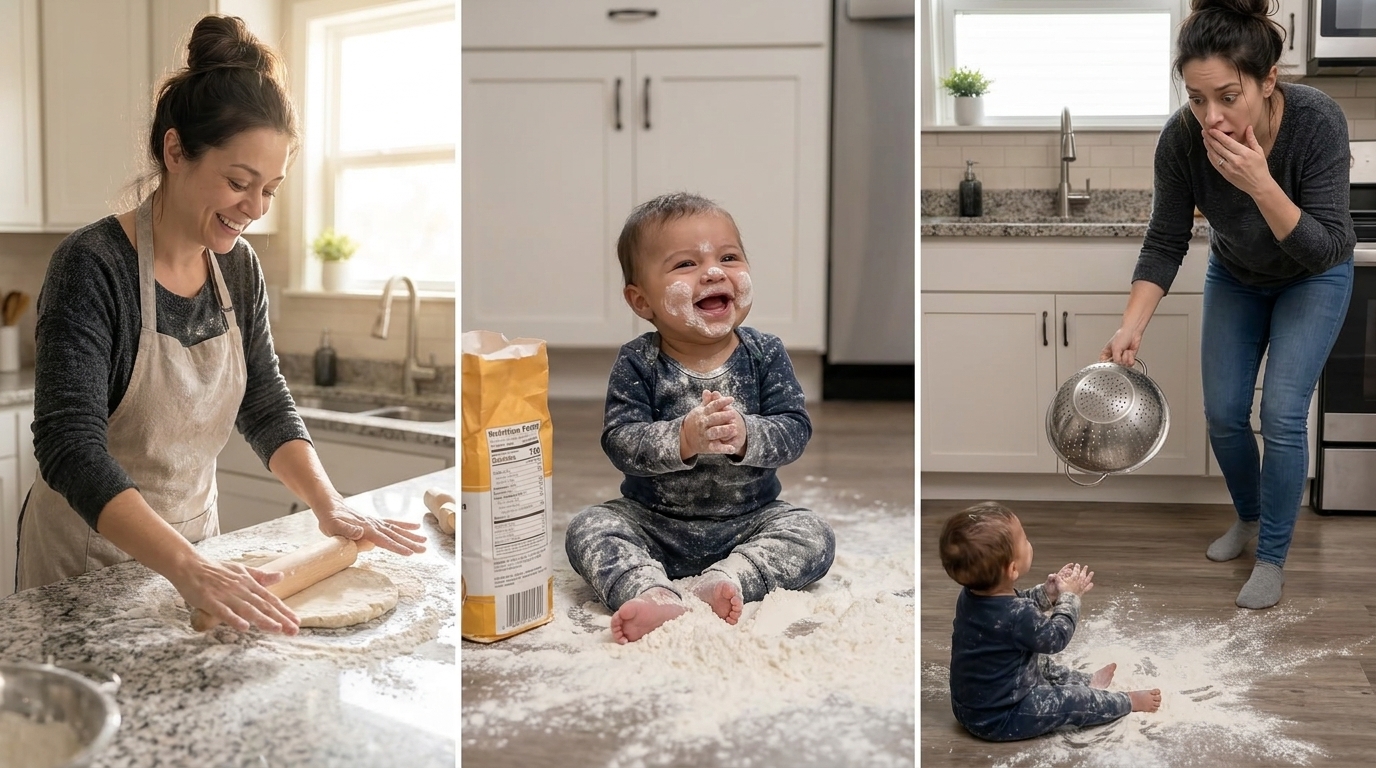
By the time the investigation reached its later stages, the bruise beneath my eye had almost disappeared.
There was no obvious mark left.
If someone had met me then, they would never have guessed what had happened.
That bothered me in a strange way.
The injury had vanished faster than the memory.
I could still see the kitchen.
I could still picture the colander.
I could still remember the baby's bare foot beneath the blanket.
The physical evidence had been collected.
The statements had been recorded.
The earlier infant's records had been reviewed.
The second hospital band had been preserved.
But none of those things could erase the first image.
Sometimes I wondered whether that was because the first image contained the simplest truth.
A newborn had been somewhere he should never have been.
Everything else came afterward.
The questions.
The arguments.
The records.
The explanations.
The uncertainty.
The baby's safety remained the reason the whole process continued.
His foster mother did not regain unsupervised access while the review was underway.
His foster father continued cooperating.
He did not turn the situation into a public battle.
He did not try to make himself look innocent.
He simply kept answering questions.
I respected that.
It would have been easy for him to say that he had not known.
And technically, he had not known about many of the things that had been discovered.
But saying “I didn't know” does not always end a responsibility.
Sometimes it begins another one.
What will you do now that you know?
That was the question facing him.
He chose to keep the baby safe.
He chose to tell the truth.
He chose not to protect his household's appearance at the baby's expense.
Those choices did not undo what had happened.
They mattered because they shaped what happened afterward.
I was asked again whether I regretted hitting the foster mother.
My answer had not changed.
I regretted that the confrontation happened.
I regretted that I had been forced to respond physically.
I regretted that a stone mortar had become part of a moment involving a newborn.
But I did not regret stopping after one strike.
I did not chase her.
I did not continue.
The baby needed attention.
That was the only priority I could recognize clearly in the middle of the chaos.
The lesson stayed with me.
Protection is not about proving that you are stronger.
It is about reducing danger.
Sometimes that means acting quickly.
Sometimes it means stopping quickly.
And sometimes it means telling the complete truth afterward, including the parts that make you uncomfortable.
The hospital band taught me something similar.
It had been tempting to make it the center of everything.
The name was unfamiliar.
The object had no obvious reason to be in the kitchen.
It belonged to another newborn.
Of course the mind wants to connect those facts into a complete explanation.
But the records stopped that impulse.
The earlier infant had been connected to the same caregiving system.
That was true.
The band had been retained.
That was true.
It had been hidden with the current baby's sock.
That was true.
There was no evidence presented to me that the earlier infant had suffered the same kitchen incident.
That was also true.
The truth could hold all four statements at once.
I did not have to choose between believing the situation was serious and refusing to invent what had not been proven.
That became one of the quietest lessons of the whole experience.
Fear wants certainty.
Evidence asks for patience.
The baby's recovery gave me something more tangible to hold onto.
He was safe.
He was being cared for.
He was no longer at the center of a chaotic kitchen.
And eventually, I saw him again.
The setting was different enough that I almost did not recognize the feeling of the moment.
There was no alarm.
No shouting.
No frantic movement.
He lay peacefully beneath a clean blanket.
Both feet were visible.
Both socks were on.
I noticed that immediately.
Of course I did.
I had seen one of those socks lying under a cabinet.
I had seen the hospital band wrapped around it.
Now the two little socks sat where they belonged.
One had begun sliding toward the heel.
The baby kicked.
I smiled.
Then the memory came back.
My hand stopped halfway.
For a brief second, I was standing in the kitchen again.
The metal.
The flour.
The bare foot.
The crying.
The red ring.
I took a breath.
Then I adjusted the sock.
There was no resistance.
No tight material.
No pressure.
Nothing hidden.
Just a loose sock on a baby who had no interest in keeping it where the adults had placed it.
He kicked again.
The sock slipped farther.
I laughed softly.
The sound surprised me.
It was the first time I had laughed around him since the incident without feeling guilty for it.
There was nothing funny about what had happened.
The laughter came from something else.
Relief.
Not complete relief.
Not the kind that erases memory.
A smaller kind.
The kind that lets an ordinary moment remain ordinary.
The baby kicked his foot free.
I picked up the sock and placed it beside him.
For a moment, I stared at it.
The same kind of object had once carried a clue that changed everything.
Now it was simply a sock.
That difference mattered.
I realized that I had been waiting for the ordinary world to return.
But perhaps ordinary life does not return all at once.
It returns through small things.
A clean blanket.
A quiet room.
A baby sleeping without crying.
A sock that falls off because the wearer keeps kicking.
A person being able to look at a kitchen sink without imagining the worst thing that happened there.
The foster father was learning that too.
He still could not look at the sink the same way.
But he could talk about the baby without his voice tightening.
He could focus on what came next instead of only what had happened.
That was progress.
It was not forgiveness.
It was not forgetting.
It was simply movement.
The foster mother remained part of the consequences of the review.
The household could not return to its former arrangement as though nothing had happened.
Trust had been damaged.
The baby's safety had exposed problems that could no longer be ignored.
The foster father had chosen to cooperate instead of hiding those problems.
The second hospital band remained part of the record.
The earlier infant's history remained part of the questions that had been asked.
But the evidence had not become something it was not.
That was important.
There was no secret second kitchen waiting to be uncovered.
No dramatic revelation emerged from the earlier records.
No proof appeared that allowed anyone to claim that every fear had been correct.
The truth was more restrained.
And because it was restrained, I trusted it more.
The current baby's situation was serious.
The adults responsible for him had been held to account for what happened.
The second band had raised legitimate concerns.
The earlier infant's records had been examined.
The questions had been documented.
The baby was safer.
Those facts were enough.
I thought about the moment I had lifted the colander.
At the time, I had expected to find an explanation.
Instead, I found a child.
That distinction became more important to me as time passed.
When frightening things happen, people often become fascinated by the mystery.
Who did it?
Why?
What else is hidden?
What does the clue mean?
Those questions matter.
But before any of them comes the person who needs help.
The baby came first.
That was why the foster father made the call before discussing the confrontation.
That was why I stopped fighting.
That was why the investigation kept returning to the newborn's condition.
And that was why the second hospital band mattered without needing to become a sensational answer.
The clue mattered because it helped protect the truth around the baby.
Nothing more needed to be claimed.
Nothing less needed to be accepted.
The final time I saw the baby that season, the sock had already fallen off.
He had managed to kick it completely free.
I picked it up from the blanket.
For a second, I held it in my fingers and remembered the kitchen.
Then I placed it beside him.
No one rushed to hide it.
No one wrapped anything around it.
No one treated it as dangerous.
It lay in plain sight.
That was when I realized how much had changed.
Click Here to continue read next: PART8: The Last Time I Looked at That Little Sock, I Finally Understood Why the Truth Needed Neither Fear nor Forgetting
The Cry Behind the Cabinet Door Forced Me to Lift an Ordinary Kitchen Colander
Part 7 of 8

