
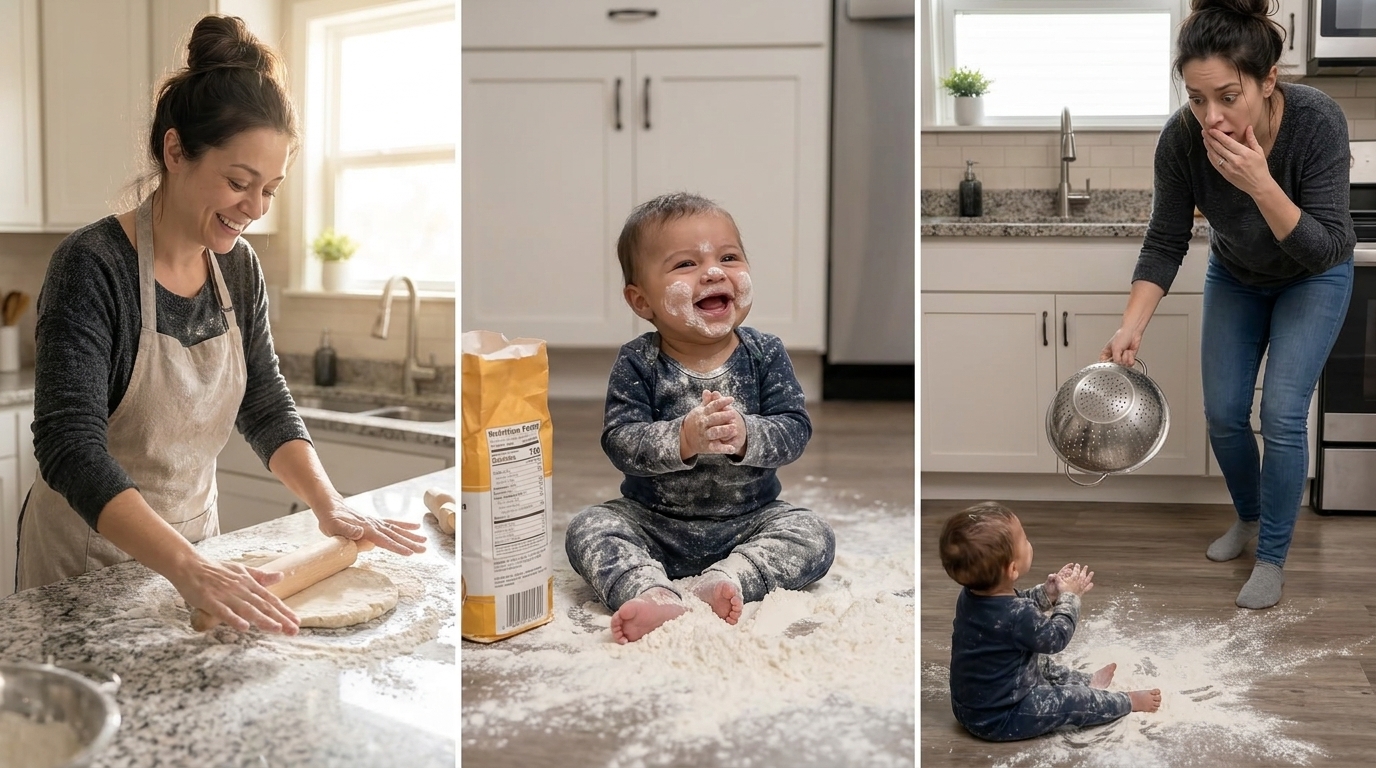
The first instinct after discovering something frightening is often to give it an explanation immediately.
I had that instinct too.
When I first saw the unfamiliar name on the hospital band, my mind wanted to connect every strange detail to it. I wanted the band to explain the sink, the colander, the pressure mark, the missing sock, and the confrontation.
But the records did not allow that kind of shortcut.
They told us only what they could prove.
The name belonged to an infant who had previously passed through the same caregiving system connected to the household.
That was important.
It was also not enough.
There was no evidence presented to me that the earlier infant had suffered the same treatment.
I had to keep that distinction clear.
The second band raised questions.
It did not answer all of them.
The people reviewing the case understood that.
They gathered the physical objects from the kitchen and documented them. The baby's medical examination was added to the record. My injury was recorded. The statements from the adults were compared.
The foster father's account was straightforward.
He had entered the kitchen and found his wife holding the screaming newborn.
He had seen me injured.
He had taken the baby from her.
My account explained what had happened before he arrived.
Together, the statements created a timeline.
The objects filled in details that neither statement could provide.
The colander showed where the baby had been.
The flour showed what had been scattered around the blanket.
The red pressure ring showed that something had pressed tightly against his ankle.
The missing sock showed that something had been displaced.
The hospital band showed that an item connected to another infant had been hidden there.
None of those facts needed dramatic language.
They were disturbing enough on their own.
His foster mother denied that the scene meant what it appeared to mean.
She explained the flour.
She explained the colander.
She explained the blanket.
She explained the missing sock.
But explanations had to account for the whole sequence, not just individual objects.
Why had the baby been beneath the colander?
Why was the blanket dusted with flour?
Why was there a distinct pressure ring around his ankle?
Why had one sock disappeared?
Why was another newborn's hospital band wrapped around it?
And why, when I lifted the colander, had she attacked me instead of immediately checking the baby?
Those questions did not require anyone to exaggerate.
They only required someone to keep asking.
His foster father did.
He no longer looked at the situation as a private family problem.
He had a responsibility to the newborn.
That responsibility came before protecting his wife from embarrassment.
It came before protecting the household's reputation.
It even came before protecting himself from what the investigation might uncover.
I watched that change in him.
Before the incident, whatever trust existed inside that home had belonged to ordinary domestic life. Afterward, every small detail carried weight.
He told me later that the kitchen sink looked different to him.
It was still the same sink.
The same cabinet stood beside it.
The same place held kitchen utensils.
But memory had changed the room.
The colander was gone from its usual place.
The flour was cleaned away.
The cabinet was wiped down.
Someone had restored the appearance of an ordinary kitchen.
But the missing sock remained preserved with the other items connected to the review.
That small object bothered me.
A sock was almost nothing.
It was soft.
It was light.
It could slip from a baby's foot without anyone noticing.
Yet that missing sock had led to the second hospital band.
Without it, the incident might have remained a terrible but isolated scene.
With it, the investigators had a reason to look backward.
They could ask whether the household had previously been connected to another infant.
They could examine whether the hospital band had been retained appropriately.
They could determine when the earlier placement occurred.
They could compare records instead of relying on assumptions.
The answers were slower than fear.
That was difficult.
People want frightening discoveries to reveal themselves immediately.
They want one confession, one explanation, one sentence that makes everything fit.
Nothing happened that way.
There were forms.
Interviews.
Medical notes.
Photographs.
Statements.
Dates.
Objects.
Small pieces of information that had to be checked against one another.
The foster father was asked again whether he had ever seen the hospital band.
“No,” he said.
His answer remained the same.
He did not suddenly remember it.
He did not claim that his wife had shown it to him.
He did not invent a story to make its presence less troubling.
He simply said he had never known it was there.
That mattered.
So did the earlier infant's records.
They established a connection, but they did not prove more than the evidence supported.
I learned to resist the temptation to fill the empty spaces.
There had been another infant.
An identifying item from that infant had remained in the household.
That item had been hidden with the current baby's sock.
Those facts were serious.
They did not need a larger story added to them.
Meanwhile, the current newborn's condition remained the immediate priority.
He had been examined.
His ankle had been documented.
The adults responsible for his placement were reviewing what had happened.
His foster mother no longer had unsupervised access to him while the process continued.
That decision brought relief.
It also brought an uncomfortable silence.
I had expected relief to feel cleaner.
Instead, I kept remembering his tiny bare foot.
I remembered the metal colander in my hands.
I remembered how light it was.
That detail stayed with me because the object itself was completely ordinary.
There was nothing threatening about a colander.
It belonged in a kitchen.
It was designed to drain vegetables, rinse food, or sit in a cupboard until needed.
Yet an ordinary object had been covering a newborn.
That was what made the memory difficult.
Ordinary things can become frightening when they are placed around someone who cannot protect himself.
My bruise changed color over the following weeks.
The deep purple faded toward yellow.
The swelling decreased.
Eventually, the pain disappeared.
But the story did not disappear with the injury.
People asked whether I regretted striking his foster mother.
I thought carefully before answering.
I regretted that the confrontation had happened.
I regretted entering a situation where a baby was already in danger and where an adult responded with violence.
I regretted that a stone mortar had become part of the scene.
But I did not regret stopping after one strike.
I had not chased her.
I had not continued the fight.
The moment the baby became the center of the struggle, I changed what I was doing.
That distinction became important to me.
Protecting someone vulnerable was not the same as winning an argument.
Sometimes protection meant reaching for the person who needed help.
Sometimes it meant stopping yourself because your movement could make the situation more dangerous.
And sometimes it meant telling the truth even when your own actions were uncomfortable to admit.
The investigation continued without the dramatic revelation my imagination had wanted.
The earlier infant's records did not produce proof of the nightmare I had feared.
There was no evidence shown to me that the other newborn had experienced the same scene.
That limitation mattered.
I refused to turn a troubling clue into a claim it could not support.
The hospital band proved that another infant had been connected to the household's history.
It proved that the band had somehow ended up hidden with the current baby's missing sock.
It raised legitimate concerns about boundaries and the handling of identifying information.
But the rest had to be established separately.
That was the lesson I kept returning to.
Evidence should never be made smaller than it is.
It should never be made larger either.
The truth was already serious.
There was no need to decorate it.
Click Here to continue read next: PART4: When the Baby Returned With Both Socks On, One Tiny Ordinary Detail Finally Allowed the Fear to Loosen Its Grip
The Cry Behind the Cabinet Door Forced Me to Lift an Ordinary Kitchen Colander
Part 3 of 8

