Mateo told me he was going to speak with his mother on a Sunday afternoon. He did not ask me to accompany him, and he did not suggest that the meeting would solve anything between us. He simply said he could no longer continue pretending that the family would recover while everyone avoided the reason it had fractured.
I wished him luck, though I was careful not to make his decision my responsibility. I had spent years hoping he would confront Carmela, and I had learned how dangerous it was to build my peace around an action someone else might or might not take. Whatever happened inside the mansion, I needed to remain focused on my son and the life we were building.
Mateo later described the conversation to me. He said he found Carmela in the sitting room, surrounded by photographs of family holidays and formal dinners. She had arranged them along the shelves, and several included Mateo as a child, standing beside her with his hand tucked into hers. He had grown up seeing those photographs as proof of a close family. That afternoon, he saw how often the pictures showed everyone smiling while the real conversations remained hidden.
Carmela greeted him warmly at first. She asked about the baby and whether I had finally allowed a visit. When he told her that I was still deciding what contact would be appropriate, her expression hardened.
“You're letting Elena punish me,” she said.
“I'm letting Elena recover from what happened.”
“I apologized.”
“You told her you were sorry, then explained why she had made you angry.”
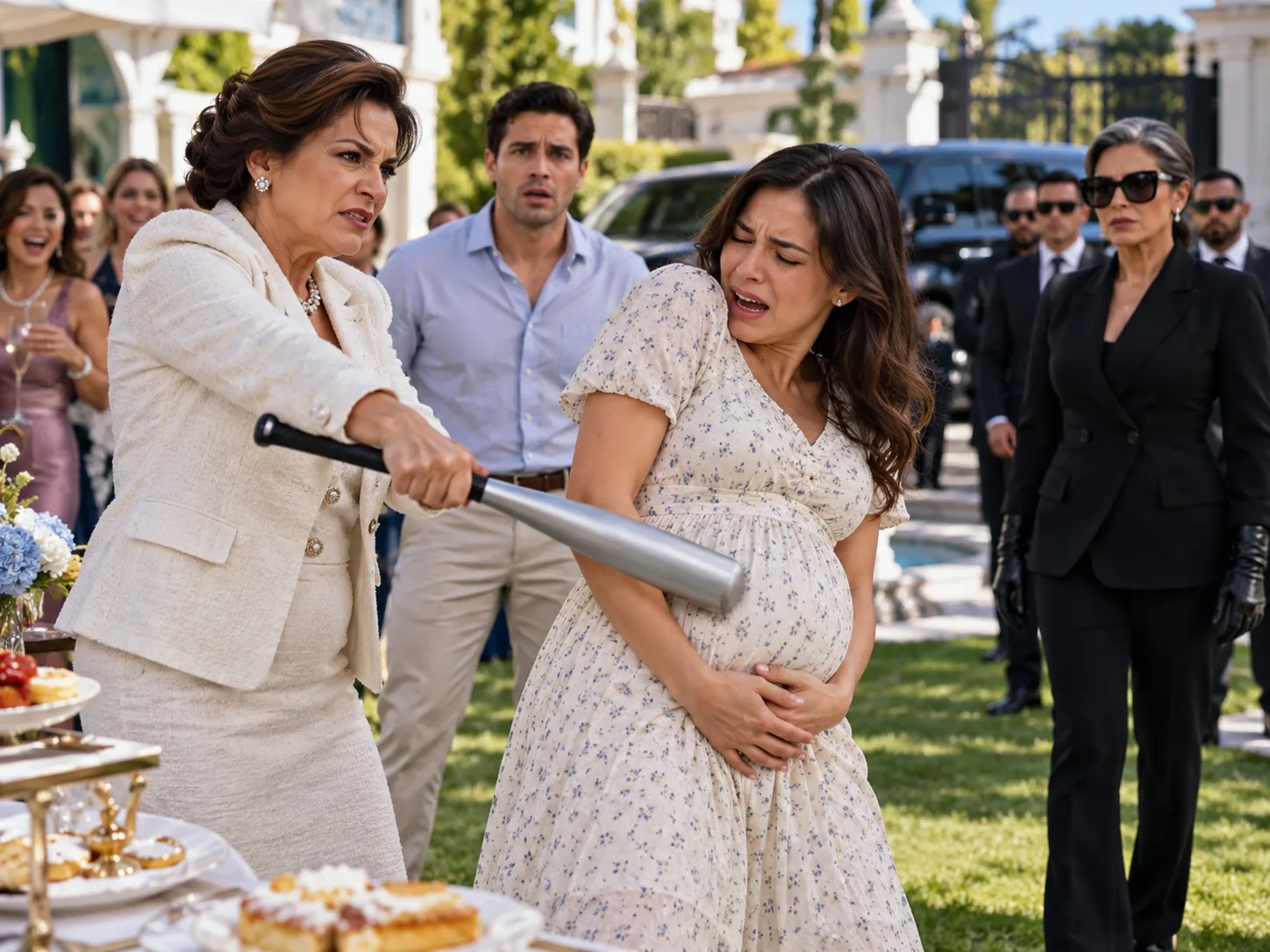
Carmela set down her teacup. “I have already admitted I was wrong to pick up the bat.”
“You hit my wife.”
“I never intended to hurt the baby.”
“You knew she was pregnant.”
He told me that the words felt strange coming out of his mouth, not because he doubted them but because he had spent so many years avoiding direct disagreement with his mother. He had always softened the first sentence, then apologized for the second, until the argument became about his tone rather than her behavior. This time, he did not retreat.
Carmela accused him of abandoning her for a woman who had never truly belonged to the family. She said my mother had manipulated me and that the legal report was proof I wanted revenge. Mateo replied that I had made my own decisions and that nobody needed to manipulate me to recognize an assault.
“She has always been too sensitive,” Carmela said. “You know how she reacts when people tease her.”
“I know how she reacted when you hit her.”
The room fell silent. Mateo said he could hear the clock ticking on the mantel, a sound he had heard throughout his childhood whenever his mother was displeased. He remembered sitting in that room as a boy, waiting for her anger to pass, learning that the safest response was to agree quickly and keep his own feelings out of sight.
He had believed that he was protecting his family by avoiding confrontation. Now he recognized that he had been protecting himself from the discomfort of disappointing her.
Carmela stood and walked toward the window. She told him that she had sacrificed everything to give him a privileged life and that he was repaying her by siding with a woman who had turned the family against her. She reminded him of the house, the family connections, and the opportunities he had enjoyed.
Mateo told her that he was grateful for what she had provided, but gratitude did not give her the right to control his marriage or hurt his wife.
She turned sharply. “So now I'm a monster?”
“No. You're my mother, and you did something terrible.”
He said she looked genuinely shocked, as if she had never considered that he could love her and still refuse to defend her actions. She asked whether he would let a single mistake destroy their relationship.
Mateo answered that the assault was not the only problem. He had watched her humiliate me for two years, and each time he had chosen the path that required the least from him. He had told himself that he would protect me later, once the argument was over, once she was calmer, once the family was no longer watching.
“There was always a later,” he said. “And then there wasn't.”
Carmela began to cry. She said she had been under stress, that the family had been divided, and that she had never imagined he would speak to her this way. Mateo told her that he was not asking her to feel ashamed for the rest of her life. He was asking her to accept responsibility and respect the boundaries I had established.
She refused to agree that I should have any say in how the family moved forward. She insisted that a grandmother had rights and that I could not keep her grandson away forever. Mateo told her that any future contact would need to be safe and appropriate, and that the baby's needs would come before her expectations.
According to Mateo, that was when she called him ungrateful.
He left the mansion without shouting or slamming the door. He said he felt shaken, but he also felt that he had finally said what he had been avoiding for years. The conversation had not changed Carmela's mind. It had changed what he was willing to pretend.
When he called me that evening, I listened without interrupting. I was proud of him for speaking honestly, but I did not tell him that this meant we could return to our marriage. He had taken an important step. There were many more things he needed to learn, and none of them could be completed in a single afternoon.
“She wasn't willing to hear me,” he said.
“You can't make her listen.”
“I know. I thought if I explained everything carefully, she might understand.”
“You've spent years believing that if you found the right words, she would stop hurting people.”
He was quiet.
“I think I wanted to believe she could change without me having to challenge her,” he admitted.
I understood that feeling. I had done something similar, waiting for Carmela to recognize my humanity while trying to become the kind of daughter-in-law she could not criticize. We had both hoped that patience would make her kinder. The difference was that Mateo had the power to confront her, while I had been the person expected to absorb the consequences.
“I'm glad you told her the truth,” I said. “Now you have to keep living by it.”
He agreed.
In the weeks that followed, Mateo continued attending counseling. He began speaking more openly about the way his family had handled conflict when he was young. He remembered how quickly Carmela's displeasure could silence a room, how relatives competed to reassure her, and how affection often returned only after everyone had agreed that she was right.
He had once thought this was normal family life. Now he was beginning to recognize the difference between respect and fear. He could not change his childhood, but he could choose not to reproduce its rules with his own son.
He asked whether I would consider another co-parenting session. I agreed, and we discussed how to handle future disagreements without involving extended family. We decided that concerns about our son would be addressed directly between us, and that neither of us would use the child to punish the other. If a question involved medical care, we would follow professional guidance rather than allowing family opinions to overrule it.
The conversation was not always easy. Mateo sometimes became defensive when I reminded him of past failures, and I sometimes struggled to distinguish a genuine improvement from a temporary response to pressure. The counselor helped us return to the specific behavior at issue rather than turning every disagreement into a verdict on our entire relationship.
I did not promise to reconcile. Mateo did not demand that I do so. We were learning to cooperate as parents while acknowledging that the marriage remained uncertain.
One afternoon, he visited our son and brought a small picture book. He sat beside the cot and read slowly, turning the pages with exaggerated care. Our son watched his face, then reached toward the bright shapes on the page. Mateo smiled and let the baby grasp his finger.
I stood in the doorway, feeling a mixture of tenderness and caution. I wanted these moments for my son. I wanted him to know his father as someone who showed up, listened, and cared for him. But I would not allow a sweet afternoon to become proof that the larger problems had disappeared.
When Mateo left, he asked whether I had noticed the baby responding to his voice. I said I had. He smiled, then thanked me for letting him visit.
After the door closed, I thought about how different that exchange was from the early weeks after the assault. Mateo had once treated my boundaries as obstacles between him and the life he wanted. Now he was beginning to understand that respecting them was part of being trustworthy.
I hoped the lesson would last. I also knew that it would be tested again, especially when Carmela realized that her son no longer responded to guilt in the same way.
The test came sooner than I expected. Mercedes called me and said Carmela was considering a family gathering to celebrate the baby. She described it as a chance to heal old wounds and asked whether I would attend if the event were held at another relative's home.
I told her I was not ready for a family gathering. I also said that no event would be used to pressure me into meeting Carmela or pretending the assault had been resolved.
Mercedes sighed. “You can't keep everyone separate forever.”
“I'm not trying to separate everyone. I'm protecting my son and myself while we work out what is safe.”
She said she understood, though her voice suggested that she still thought I was making the situation unnecessarily difficult. I ended the call politely and informed my lawyer that the family was discussing a gathering.
When Mateo asked about it, I told him what Mercedes had said. He replied that he would not attend a gathering designed to pressure me and that he had already told his mother there would be no celebration arranged without my agreement.
I thanked him. It was another choice he had made when his mother expected him to comply. I noticed it, but I did not turn it into a promise about our future.
That night, as I rocked my son to sleep, I thought about the mansion's sitting room, the photographs, and the clock that Mateo had described. Carmela had spent years creating a world in which every conflict ended with the family returning to its familiar places and smiling for another picture. She had mistaken the return of appearances for the repair of harm.
I no longer wanted a place in those photographs if the price was silence.
Mateo was beginning to understand that he could love his mother without surrendering his judgment. I was beginning to understand that I could love my husband without surrendering my safety. Neither lesson guaranteed reconciliation, but both offered us a chance to build something more honest than the family life we had tried to preserve.
Click here to continue reading: PART 11: When Carmela Finally Faced the Consequences of Her Own Choices, Elena Refused to Let Anyone Turn Accountability Into Revenge
One Blow in the Garden Exposed the Cruelty I Had Spent Two Years Pretending Was Ordinary Family Trouble
Part 10 of 28