Carmela's request for a meeting reached me three days later through Mateo's lawyer. The message said she wished to apologize in person and hoped to begin repairing the damage to the family. It also suggested that a meeting might help prevent further misunderstandings.
I read the final sentence several times. The assault had been witnessed by relatives, documented by medical staff, and reported to the appropriate authorities. There was no misunderstanding about what had happened. The question was whether Carmela could acknowledge it without reshaping the facts to protect herself.
My lawyer advised me that I was under no obligation to meet her. If I chose to do so, the meeting should take place somewhere neutral, with clear boundaries and no expectation that I would accept an apology or agree to reconcile with Mateo. I considered the advice for a day before deciding that I would meet Carmela once, provided she understood that I would leave if she tried to pressure me.
We arranged the meeting in a private room at my lawyer's office. My mother accompanied me but waited outside. Mateo was not present. I wanted Carmela to speak to me without using her son as a shield, and I wanted the conversation to remain focused on what she had done rather than what she feared losing.
She arrived wearing a cream-colored suit and carrying a small handbag. Her hair was immaculate. If she had been nervous, she concealed it behind the same composed expression she wore at family dinners. She sat opposite me, placed the handbag beside her chair, and glanced at the lawyer's notepad.
“I appreciate you agreeing to see me,” she began.
I waited.
She drew a breath. “I've had a difficult time with everything that has happened. The family has been under tremendous strain, and I regret that things reached this point.”
I looked at her. “What exactly do you regret?”
Her mouth tightened. “I regret what happened that afternoon.”
“What did you do?”
She shifted in her chair. “I lost my temper.”
“That's not what I asked.”
For the first time, her composure slipped. She glanced at the lawyer, then returned her attention to me.
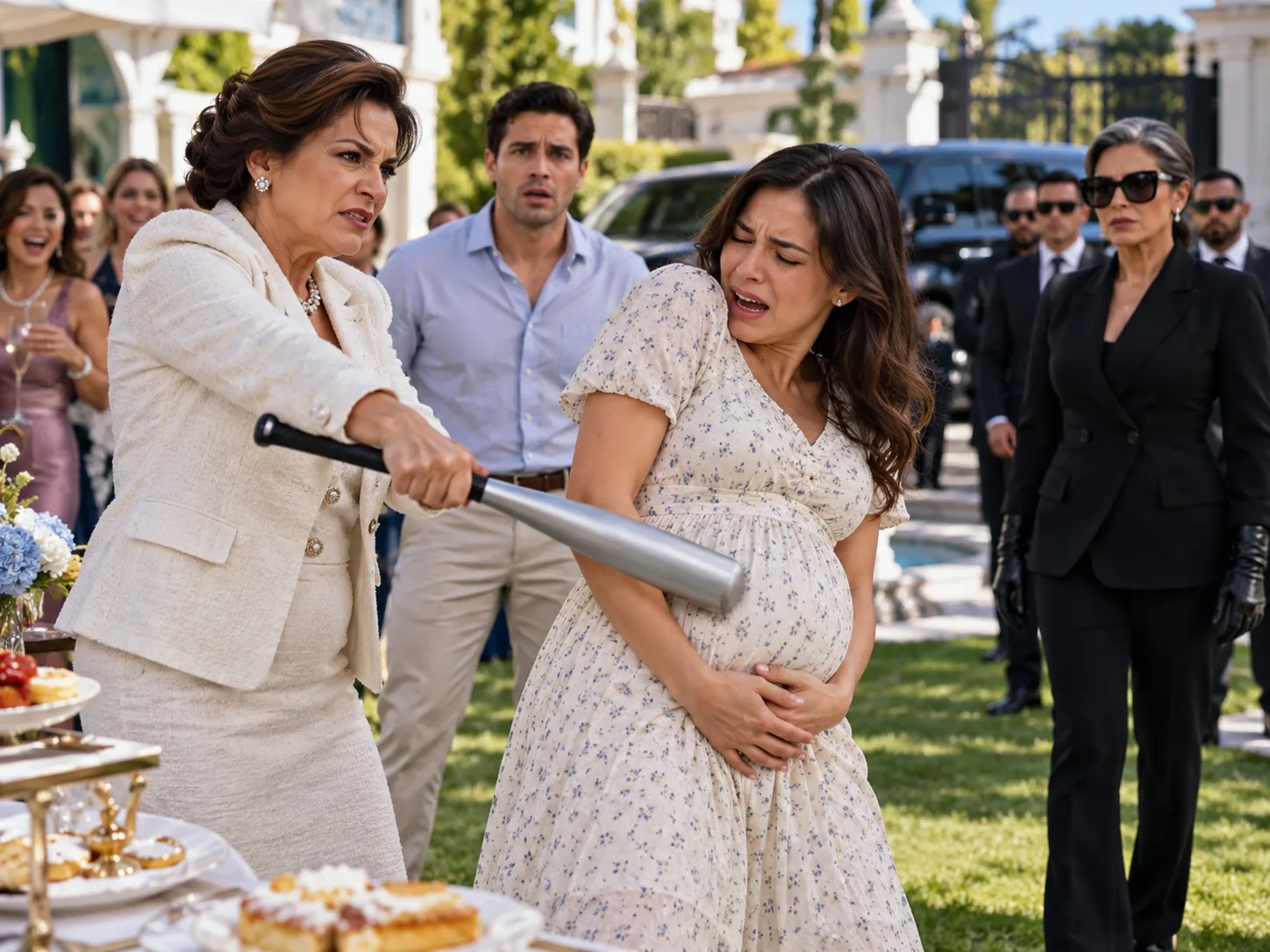
“I struck you with the bat,” she said. “I should never have done that.”
The words were quiet, and they sounded unfamiliar in her mouth. I waited for the qualification that had followed every apology she had ever offered. It came almost immediately.
“But I was drinking, and you know how tense things had become between us. I thought I was joking, and I never imagined you would be so badly frightened.”
I felt my shoulders tighten. She had admitted the action, then tried to shrink it into a joke that I had misunderstood.
“You watched me step away,” I said. “I told you not to come closer. You raised the bat and struck me while I was pregnant. What part of that did I misunderstand?”
Carmela looked offended. “I have already said I was wrong.”
“You have said you lost your temper. You have said you regret what happened. I am asking whether you understand that I was afraid for my child's life.”
She pressed her lips together. For a moment, I saw the same expression she wore when a servant made a mistake or a relative challenged her in public. It was the look of a woman who expected the conversation to end once she had conceded the smallest amount necessary.
“I didn't want anything to happen to the baby,” she said.
“But you chose to swing the bat.”
Her eyes filled with tears. Whether they came from genuine remorse or the frustration of being unable to control the conversation, I could not tell. I no longer believed it was my job to interpret every expression she made.
“I don't know what else you want from me, Elena.”
“I want you to understand that I am not responsible for protecting your reputation. I will tell the truth about what happened. I will cooperate with the legal process. And I will not return to the mansion because you have decided you are ready to apologize.”
She leaned forward. “I am your son's grandmother.”
“You may be his grandmother. That does not give you the right to hurt his mother.”
Her face hardened. “I have never been a danger to a child.”
“You were holding a bat when you hit me.”
“I didn't mean to injure you.”
“You knew I was pregnant.”
She looked away. I could see that she wanted to argue about intention, about how much force she had used, about whether she had meant to strike my abdomen. But she could not change the central fact: she had lifted a metal bat toward a woman whose hands were already protecting her unborn child, and she had chosen to swing.
I asked her one more question.
“If I had been your daughter, would you have wanted her to forgive someone who did that to her?”
She stared at me. The room became very quiet.
“That is different,” she said eventually.
“Why?”
“Because you are part of this family.”
I almost laughed, but there was no humor in me. “I was part of this family when you hit me. I was part of it when you called me a gold digger, when you mocked my background, and when you told everyone I had trapped Mateo with a pregnancy. You only seem to remember that I'm family when you want me to protect you from the consequences.”
She stood abruptly, then sat again as if she had realized that leaving would make her appear unreasonable. Her hands trembled against the edge of the table.
“You have no idea what this has done to Mateo,” she said.
I felt the familiar pull to explain that I had never wanted to hurt him, that I had tried to keep the peace, that I had spent years hoping we could all get along. I let the impulse pass.
“I know what it did to me,” I replied.
The lawyer asked whether Carmela had anything else she wished to say. She looked at me, waiting for a softer expression, a sign that I would meet her halfway. When I gave her none, she picked up her handbag.
“I hope one day you will see that I am not the person you think I am.”
“I hope one day you will see what you did without needing me to make you feel better about it.”
She left without another word.
I sat in the room for several minutes after the door closed. I had expected anger, perhaps even satisfaction at finally speaking to Carmela without Mateo translating her behavior into something more acceptable. Instead, I felt exhausted. Telling the truth had not transformed her. It had simply removed my responsibility to pretend that she had not heard me.
My mother entered after the lawyer confirmed that the meeting was over. She looked at my face and asked whether I wanted to leave. I nodded. She took my arm, and we walked to the car without discussing Carmela until we were safely on the road.
“She did apologize for striking me,” I said eventually.
My mother kept her eyes on the road. “And did she take responsibility?”
“Only until she started explaining why.”
“That is useful to know.”
I looked out the window. I had spent so long waiting for Carmela to understand that I had treated understanding as the final key to my freedom. If she could only see me as a person, if she could only admit that her behavior had been cruel, perhaps everything would become easier.
Now I understood that I could protect myself even if she never changed her mind about me.
Mateo called that evening. Carmela had told him that the meeting went badly and that I had refused to accept her apology. He sounded upset, but he did not accuse me of being cruel or ungrateful.
“Did she apologize?” he asked.
“She admitted that she hit me.”
“That's something.”
“It is. But she still wanted me to explain why I was afraid.”
He was silent for a moment. “I'm sorry.”
“Are you sorry she left upset, or sorry that she hurt me?”
He took a breath. “I'm sorry she hurt you. I'm sorry I kept asking you to make things easier for her.”
I believed that he meant those words in the moment. I also knew that belief alone could not tell me what he would do next time his mother demanded loyalty.
“I can't keep measuring your progress by what you say when you're afraid of losing me,” I told him. “I need to see what you do when standing up for me costs you something.”
“I understand.”
We ended the call without an argument. It was the first time I had been able to state a boundary to both of them without immediately rushing to soften it. I was learning that a person could be disappointed in my decision without making that decision wrong.
The following week, I received confirmation that my report remained under review. The authorities had not reached a final determination, and I was advised not to speculate about what the process might produce. I continued preserving the messages and responding to requests through my lawyer. I had no desire to turn the case into a public spectacle. I wanted the people responsible for evaluating it to have accurate information, and I wanted the pressure from the family to stop.
Mateo, meanwhile, began attending counseling on his own. He told me this in a message and made clear that he was not asking me to join him. I thanked him for telling me. I hoped the sessions would help him understand why he had spent years confusing obedience with love, but I did not treat his decision as a promise that our marriage would be restored.
At my next prenatal appointment, the doctor told me that my son was developing as expected. I listened to the explanation, asked the questions I had written down, and allowed myself a small smile when I heard his heartbeat. The sound was still powerful, but it no longer felt like a fragile secret I had to guard alone.
When I returned home, my mother had placed a small package on the nursery shelf. Inside was a knitted blanket she had begun making during the weeks when we were barely speaking. The stitches were uneven in places, and one corner was slightly longer than the others. She apologized for the imperfections.
I ran my fingers over the soft yarn. “It's beautiful.”
She smiled, and for the first time in months, our conversation moved easily from one subject to another. We talked about names, baby clothes, and whether the cot should be moved farther from the window. We disagreed about a few things, but neither of us treated disagreement as proof that the other had stopped caring.
That evening, I placed the blanket in the cot and stood beside it for a long time. The future was still uncertain. My marriage remained unresolved, and the legal process would take whatever time it required. Carmela had not become kind because I confronted her, and Mateo had not erased his failures by admitting them.
But the center of my life had shifted. I was no longer waiting for the Villalobos family to decide whether I deserved respect.
I was preparing to welcome my son into a life where respect would be the beginning, not the reward.
Click here to continue reading: PART 7: As the Birth Approached, Mateo Had to Decide Whether He Wanted to Be a Father or Merely the Son His Mother Expected Him to Remain
One Blow in the Garden Exposed the Cruelty I Had Spent Two Years Pretending Was Ordinary Family Trouble
Part 6 of 28