
The first Monday after the holiday gathering, Laura Miller arrived at the office twenty minutes early, carrying a paper cup of coffee and a folder of notes for her new team. The building was still waking up. A few lights glowed along the corridor, and somewhere behind the reception desk, a printer started and stopped with a tired mechanical sigh. She paused beside the windows overlooking the parking lot and watched the morning traffic move along the road. Once, an ordinary morning like this would have felt like a temporary pause between the life she had lost and the truth she was trying to uncover. Now it was simply Monday.
She had learned that peace rarely arrived with a dramatic announcement. It came through small, repeated experiences: sleeping until her alarm rang, making breakfast without checking the locks twice, driving to work without wondering whether someone was watching from another car. The absence of fear had become so familiar that she sometimes noticed it only when something reminded her how long she had lived without it. She still remembered the days when every unexplained sound seemed to contain a warning. She just no longer allowed those memories to decide what a sound meant.
At nine, her team gathered in a conference room for the weekly review. Three analysts sat around the table with laptops open, while a fourth joined by video from another office. Laura began by discussing the previous week's cases, including one application in which a customer had signed several documents without receiving a clear explanation of the financial consequences. It was the sort of file that might once have passed through a busy department with little attention. Under the process she had helped develop, the missing information had been noticed before the application was approved.
One of the younger analysts raised a concern. “If the customer signed the form, doesn't that establish that they accepted the terms?”
Laura looked at the document displayed on the screen. She recognized the question because she had once believed the answer was simple. “It establishes that a signature was made,” she said. “It doesn't automatically establish that the person understood every consequence or that the information was presented fairly. We need to look at the circumstances, the records, and the procedure that led to the signature.”
She did not mention Mark. She did not need to. The lesson had become part of her professional judgment, not a confession she had to offer whenever the subject arose. She explained how the team could document a customer's understanding, identify inconsistencies, and request clarification without assuming that every error was deliberate. Suspicion alone was not evidence, she reminded them. Neither was a signature proof of innocence or guilt. Good work required patience in both directions.
After the meeting, the analyst who had asked the question stayed behind. He admitted that he had been worried about slowing the department down by asking for more documentation. Laura told him that a careful review might take longer than a careless approval, but correcting a serious mistake after the fact could cost everyone far more. She spoke calmly, without trying to frighten him into agreement. When he left, she realized she had begun to enjoy mentoring people. It felt good to pass on knowledge that could protect someone, provided she remembered that her own experience was not the only way to learn.
At lunchtime, Elaine sent a message asking whether Laura wanted to meet on Saturday to look at a small art market in town. The invitation was ordinary, almost forgettable, and that was precisely why Laura smiled at it. A year earlier, she might have asked what the weather would be, how crowded the market would get, and whether she could leave early if she felt overwhelmed. Instead, she replied that Saturday sounded good and suggested they get lunch afterward.
Her phone buzzed again a few minutes later. This time it was her attorney, who had received an administrative notice concerning the final records in Mark's case. There was nothing requiring Laura's attendance and no action she needed to take. Her attorney said the file would be retained according to the normal process and that she would be contacted if anything material changed. Laura read the message twice, not because she feared a hidden meaning, but because she wanted to understand exactly what it said.
She answered with a brief thank-you, then returned to her lunch. The case still existed. Paperwork still existed. Mark's actions had not disappeared simply because Laura had stopped organizing her days around them. But the difference was that the case now occupied its proper place: one part of a complicated history, rather than the center of every future decision.
That evening, she stopped at a grocery store on the way home. She bought vegetables, bread, and a small bunch of yellow flowers she had not planned to purchase. At the checkout, she realized she had forgotten to buy coffee filters and laughed quietly at herself. The discovery felt strangely reassuring. For years, she had believed that safety meant anticipating everything before it happened. Now she was learning that a person could forget something minor, correct the mistake later, and still be perfectly safe.
At home, she placed the flowers in a glass jar and set them on the kitchen table. The repaired blue mug stood near the sink, its familiar crack still visible along one side. She had considered replacing it more than once, but she had decided that keeping it did not mean preserving Mark's place in her life. The mug belonged to her now. It held coffee, tea, and sometimes a spoon while she cooked. It was an object with a history, not a promise.
Later, while preparing dinner, Laura found an old recipe card tucked into a kitchen drawer. Mark had written the measurements in his neat handwriting years earlier, when they had first tried making the dish together. For a moment, the sight of his name brought back the warmth of that evening: flour on the counter, a radio playing in the background, and Mark insisting that he knew the recipe by heart despite repeatedly checking the card.
The memory hurt, but not in the way she once expected. She did not have to decide that every good moment had been false simply because the marriage had contained a terrible betrayal. Nor did she have to use the good moments to excuse what he had done. The past could be mixed. Love could have been real at one time, and deception could have been real later. Accepting that contradiction was harder than choosing one simple version of their marriage, but it was also more honest.
She returned the card to the drawer rather than throwing it away. Then she finished cooking, ate at the table, and washed the dishes before going upstairs. The house settled around her, its familiar creaks and soft plumbing noises no longer demanding interpretation. She checked the front door once, as she ordinarily would, and went to bed.
The next morning, she received a short email from Margaret Shaw. Margaret wrote that her family had gathered over the weekend and shared some of Peter's postcards. One of his nieces had never met him, and the family had spent the afternoon reading aloud the little observations he had sent from different towns. He had complained about bad coffee, praised a roadside diner, and described a storm that had delayed him for half a day. They were ordinary messages, but they had made him feel present again.
Laura read the email slowly. She had not known Peter, and she could not restore the years his family had spent believing the wrong story about his death. She could not tell Margaret what Peter had thought during his final hours or what he might have done if his journey had ended differently. Still, she was grateful that his family had recovered pieces of his life that did not belong to the investigation.
She wrote back that she was glad they had gathered, and that she hoped the postcards would continue to bring them good memories of him. She did not add a grand statement about justice or healing. Margaret had never asked Laura to make Peter's death meaningful. She had asked for the truth, and where the truth ended, both women had learned to leave room for uncertainty.
On Saturday, Laura and Elaine visited the art market. They walked between tables of handmade ceramics, woven bags, paintings, and small wooden ornaments. Elaine examined a set of earrings while Laura studied a landscape painted in soft shades of gray and green. The artist explained that the scene showed a marsh at sunrise, when the mist was beginning to lift from the water.
Laura bought the painting, though she had not arrived intending to purchase anything. She imagined it hanging above the small desk in her bedroom, a reminder of the quiet colors she had come to appreciate. Elaine teased her about buying art without checking every available stall first. Laura replied that there might be another painting she liked more, but she had liked this one enough to take it home.
They had lunch afterward at a small restaurant and spent nearly an hour talking about work, a television series Elaine had started watching, and the possibility of taking another short trip in spring. Not once did they discuss Mark. When his name eventually surfaced in a passing reference to an old mutual acquaintance, Laura noticed that the conversation did not collapse around it. She answered the question, then moved on.
That evening, she hung the painting above her desk. The room looked a little different afterward, though nothing important had changed. She stood back to straighten the frame and felt a quiet satisfaction in the decision. The painting was not a declaration that she had overcome everything. It was simply something she liked, chosen because she wanted it.
Before bed, Laura opened her calendar and marked the dates for a professional training session, a dinner with Elaine, and a routine appointment she had nearly forgotten. The coming weeks were no longer empty spaces she feared filling. They were ordinary commitments, some important and some trivial, that she could accept or change as circumstances required.
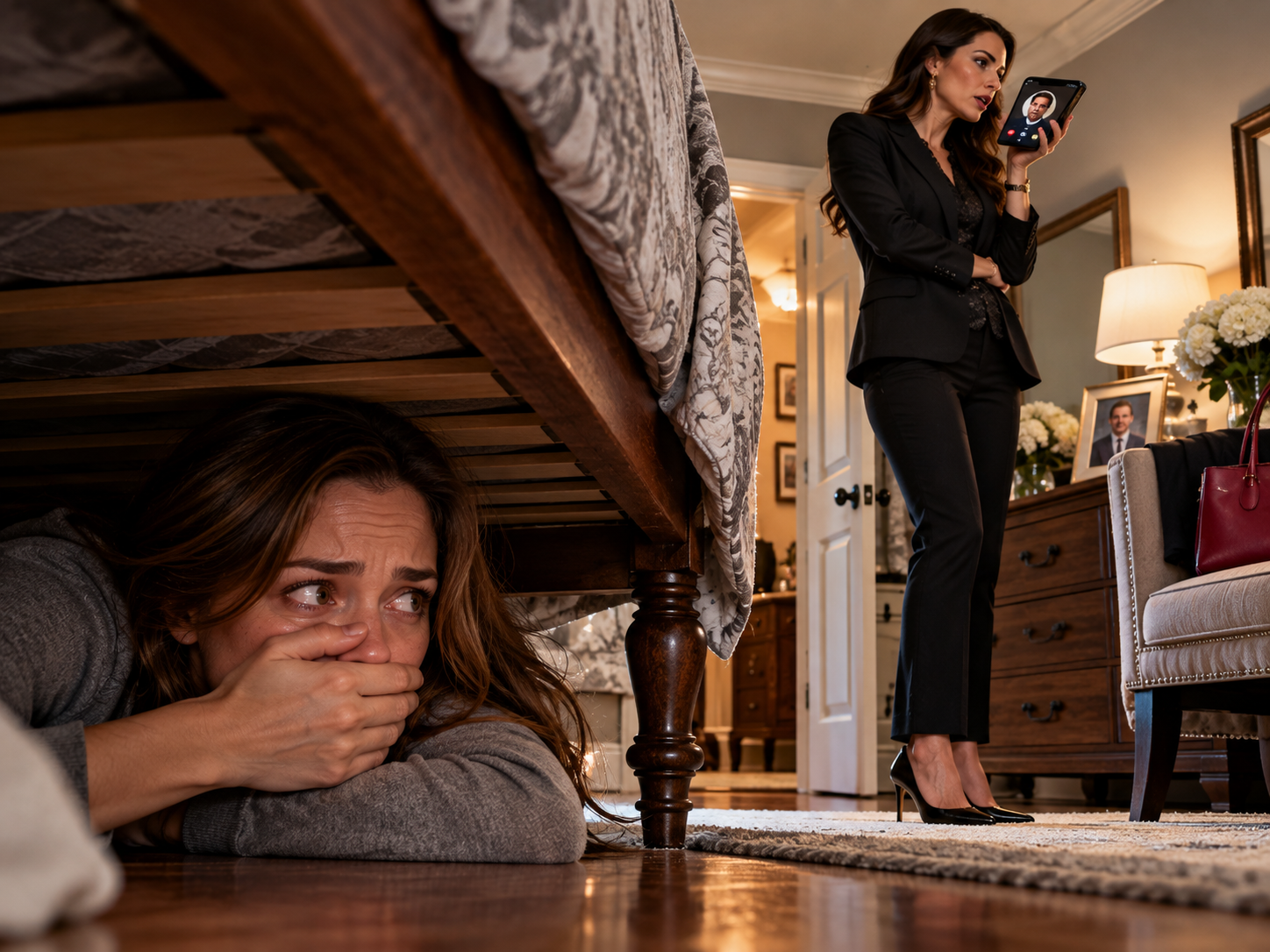
When she turned off the light, she remembered the day she had hidden beneath her bed and listened to Vanessa enter the house. The memory remained sharp: the movement of shoes across the floor, the familiar voice coming through the speaker, and the terrible realization that the man she had buried was alive. She could not change the woman she had been beneath that bed. She could only recognize how much she had learned since then.
Laura turned onto her side and closed her eyes. Tomorrow, she would have work to do. There would be decisions to make, messages to answer, and small mistakes to correct. The future was no longer a mystery she had to solve before she could enter it. For once, she was content to let it arrive one ordinary day at a time.
Click here to continue reading: PART 18: The Questions That Were Finally Allowed to Rest
The Woman Who Entered My House Without Knocking Knew My Husband’s Habits Better Than Anyone Should
Part 17 of 20

