
The invitation arrived in an email from Elaine on a Thursday afternoon. She had booked a small house near the coast for a long weekend in October and wanted to know whether I would join her. The place had two bedrooms, a kitchen overlooking a garden, and walking trails nearby. She suggested that we bring books, cook simple meals, and leave our work phones switched off whenever possible.
I read the message during a break at the office. My first response was to check the dates against my calendar and calculate how much work I would need to finish beforehand. My second was to wonder whether I would sleep comfortably in an unfamiliar house. I had not spent many nights away from home since the investigation began, and the idea of leaving my carefully established routine made me uneasy.
Then I remembered that I had already traveled to the coast with Elaine earlier in the year. That trip had been peaceful, and I had returned home feeling lighter rather than unsettled. The difference was not the location. It was the fact that I had gone because I wanted to, not because I was trying to escape something.
I accepted the invitation.
Over the next few weeks, I prepared for the trip in small steps. I arranged coverage for my work responsibilities, finished the reports due before I left, and made a list of things to pack. I bought a paperback novel from a shop near the office and put it in my bag. The simple act of choosing a book for pleasure felt like a reminder that my life contained interests that had nothing to do with the past.
The weekend arrived with clear skies and cool air. Elaine picked me up shortly after breakfast, and we drove out of Cherry Hill with the windows partly open. We talked about work for the first half hour, then moved on to music and a restaurant she wanted to try. I watched the familiar roads give way to smaller streets lined with trees, feeling the tension in my shoulders gradually ease.
The house was modest and comfortable, with wooden floors, a small garden, and a kitchen that smelled faintly of lemon cleaner. We unpacked our bags, bought groceries, and decided to walk before dinner. The trail wound through a quiet area where fallen leaves collected along the edges of the path. We spoke very little, content to listen to the wind moving through the branches.
That evening, we cooked pasta and ate at the small dining table. Elaine told me about a disagreement at her volunteer group, and I described a complicated case at work. We laughed about a colleague who had accidentally sent a meeting invitation to the wrong department. For a while, the conversation was so ordinary that I forgot how long it had been since I had spent a weekend without an appointment or an unanswered question hanging over me.
Later, I sat by the window and read until the light faded. The house was quiet, but the quiet did not feel like the silence of my bedroom after Mark's supposed death. It was simply the natural end of a busy day. I turned on a lamp, finished the chapter, and went to bed.
I slept well.
The following morning, Elaine suggested that we visit a small market in a nearby town. We bought bread, fruit, and a jar of honey from a vendor who explained that his family had produced it for years. I chose a small ceramic dish from a table of handmade items. It was dark blue with an uneven rim, and I liked the way it felt in my hands.
When we returned to the house, I placed the dish on the kitchen counter and filled it with fruit. The color reminded me of the mug I had repaired, but the association no longer carried the same emotional weight. I could appreciate the color without being pulled back into the morning I had found the mug on the drying rack.
On our final evening, Elaine asked whether I had thought about dating again. She raised the subject gently, making it clear that I did not have to answer if I did not want to.
“I haven't really considered it,” I said.
“Would you want to?”
I looked toward the window. The garden was dark, and a porch light illuminated the edge of the path.
“Maybe someday. But I don't want to make that decision because people think I should be moving on.”
“Then don't,” she replied. “You can decide when it feels right for you.”
I appreciated that she did not frame a new relationship as proof that I had recovered. I had spent enough time measuring my progress against what other people expected. If I chose to date, it would be because I wanted companionship, not because I needed to demonstrate that Mark no longer mattered.
We drove home the next morning. The familiar streets of Cherry Hill appeared gradually, and when Elaine dropped me at my house, I carried my bag inside and opened the curtains. The house looked exactly as I had left it. The plant by the window had survived the weekend without attention, and the mail sat neatly in the box near the door.
I unpacked, washed the dishes, and prepared for the workweek. There was no dramatic realization waiting for me. I had gone away, enjoyed myself, and returned home. The ordinary nature of the experience was its own reassurance.
A few days later, I received a call from a number I did not recognize. I nearly let it go to voicemail, but something in me suggested that I should answer. A man introduced himself as a former colleague of Mark's and said he had been advised to contact me through the authorities because he possessed a personal item that might belong to my husband.
I asked for his name and the reason he had the item. He explained that he had worked with Mark at the insurance company years earlier and had recently been interviewed as part of the investigation. During a move, he had found a small notebook that Mark had left in a desk drawer. He had turned it over to the police, who had confirmed that it was not needed as evidence, but he had been told that I might wish to see it.
I asked him to send the details through my attorney. I did not agree to meet him or accept the notebook directly. After the call, I contacted my attorney, who confirmed that the item could be returned to me if I wanted it. She asked whether I believed it contained information relevant to the case.
“I don't know,” I said. “And I don't want to search it for something that isn't there.”
She advised me that I could decline the item entirely. I thought about it for two days before deciding to accept it. If it was an ordinary notebook, I could decide what to do with it. If it contained relevant records, my attorney could determine whether they should be preserved.
The notebook arrived in a plain envelope. It was small, with a black cover and a few pages bent near the spine. The handwriting inside was Mark's. Most entries were brief notes about meetings, expenses, and reminders. I did not read every page. I checked for financial records or references to the investigation, then stopped when it became clear that the notebook contained no new evidence of importance.
Near the back, I found a short list of household purchases. It included coffee, light bulbs, and a replacement filter for the kitchen tap. The entries were ordinary, almost painfully so. They reminded me of the version of Mark I had known at home, the man who complained about the cost of groceries and forgot to buy batteries even when I wrote them on the list.
I closed the notebook.
For a moment, I felt the familiar urge to interpret the notes as evidence of either affection or deception. I wondered whether the ordinary details meant he had once cared about our home, or whether they were simply the habits of someone who had lived there. Then I recognized the question for what it was: another attempt to extract certainty from an object that could not provide it.
I placed the notebook in the box with the other personal records. I would keep it, but I would not spend hours examining it for hidden meanings.
The next morning, I went to work and led a meeting about the new authorization checklist. The discussion was lively, and several colleagues suggested practical improvements. I found myself fully engaged in the work, explaining how the procedure could be applied without creating unnecessary delays for clients. By the time the meeting ended, I had forgotten about the notebook.
That afternoon, my supervisor told me that the broader review had been approved for implementation. She thanked me for helping organize the work and said the team had benefited from my attention to detail.
I accepted the compliment without minimizing it. For months, I had been reluctant to take credit for anything, as though acknowledging my own abilities would somehow diminish the harm Mark had caused. I understood now that my professional competence had existed before the investigation and would continue afterward. It did not belong to him.
At home, I placed the blue ceramic dish on the kitchen counter beside the plant. The two objects looked good together. I filled the dish with apples and stood back to look at the arrangement. It was a small change, but it made the kitchen feel more like a place I had chosen rather than a room preserved for someone who would never return.
That evening, Elaine called to ask whether I wanted to attend a community event with her the following weekend. I said yes before checking my calendar. After we ended the call, I smiled at my own response. I was beginning to make plans without first considering whether they might interfere with the investigation, a habit that had once seemed impossible to break.
On the night before the event, I stood in the bedroom doorway and looked at the soft gray-blue walls. The room had become familiar in its new arrangement. The chair stood beside the window, the lamp cast a warm circle of light over the nightstand, and the photograph from the coastline hung above the dresser.
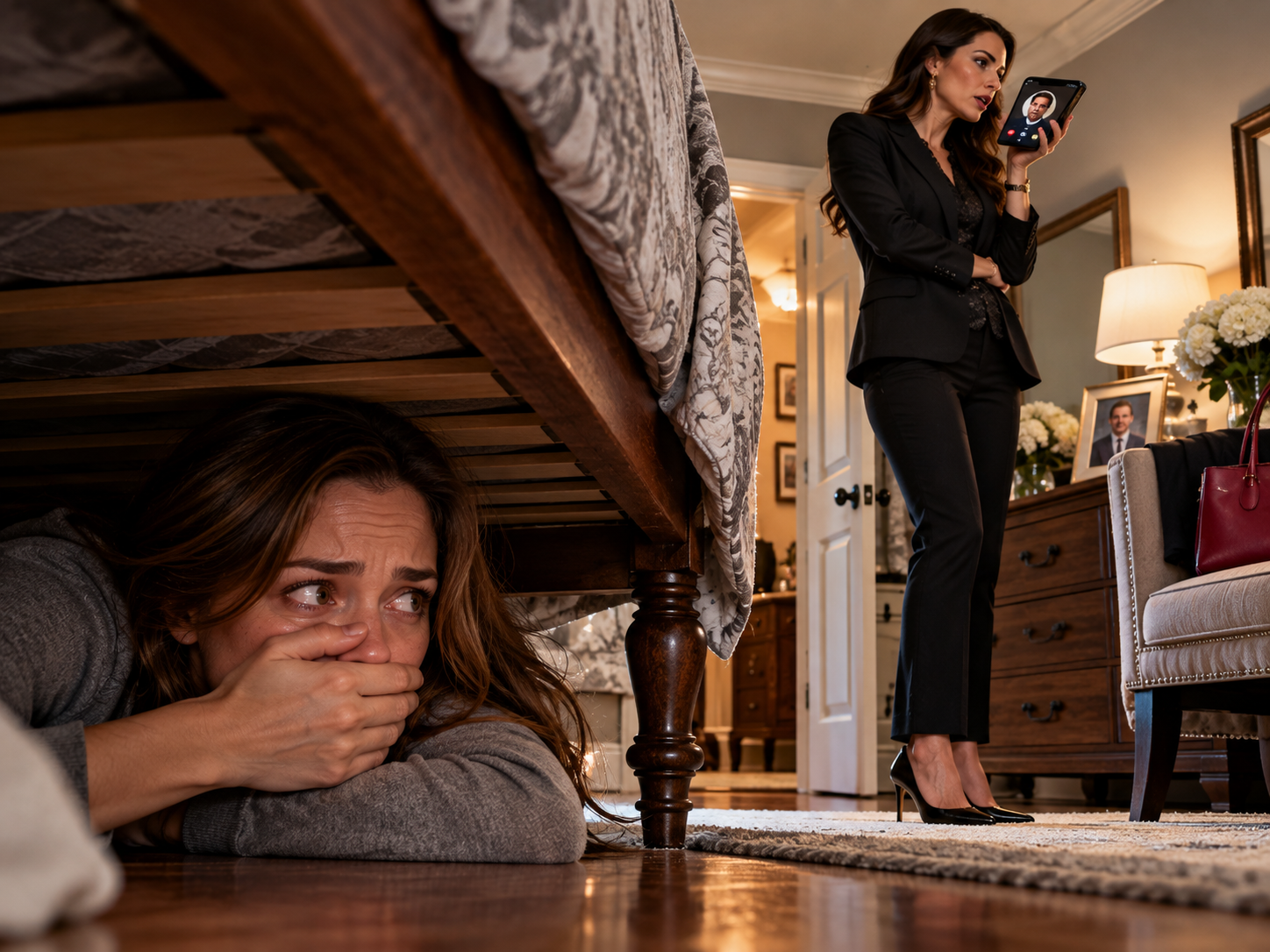
I remembered the woman who had entered the room with a red handbag and the confidence of someone who believed she belonged there. I remembered the fear of lying beneath the bed, unable to move while Mark's voice came through the speaker. The memory was still disturbing, but it no longer seemed to define the room.
I had reclaimed the space through ordinary decisions: moving furniture, changing the bedding, choosing what to keep, and learning to sleep without listening for footsteps. None of those actions had erased the past. Together, they had changed my relationship with it.
I turned off the lamp and went downstairs to prepare my things for the next day. The house was quiet, and I was looking forward to leaving it for a few hours. That simple anticipation felt like progress.
The following morning, I opened the curtains and let the sunlight enter the room. I made coffee in the blue mug, carried it to the kitchen table, and opened my calendar. The day contained a work meeting, a grocery stop, and dinner with Elaine. Nothing extraordinary was scheduled.
For a long time, I had believed that the end of my story would arrive when every question about Mark had been answered. I no longer believed that. The legal questions belonged to the investigation, and the personal questions would become easier to carry as time passed. My future did not depend on discovering one final secret.
I finished my coffee, washed the mug, and placed it in the cupboard.
Then I picked up my bag and went to work.
Click here to continue reading: PART 15: A Final Update From Detective Harris Confirmed How Much Had Changed, but the Hardest Part Was Accepting That Some Truths Would Never Feel Complete
The Woman Who Entered My House Without Knocking Knew My Husband’s Habits Better Than Anyone Should
Part 14 of 20

