
The new year began with a letter from my attorney confirming that the insurance company's review had reached its final stage. The legitimate policy payment had been separated from the disputed transactions, and the available evidence supported my account that I had signed the authorization without understanding its full purpose. The company had no basis to treat me as a knowing participant in the fraud. There were still financial matters to resolve, but I no longer faced the immediate uncertainty that had followed me since the investigation began.
I read the letter at the kitchen table, where I had once spread out the policy documents and tried to understand how Mark had used my trust against me. The sunlight fell across the page, and outside, a delivery truck stopped near the corner. I placed the letter in a folder marked Insurance and closed it. I had imagined that official confirmation would make me feel triumphant. Instead, I felt grateful that I could finally put one part of the story away.
My attorney advised me to retain copies of all relevant records in case additional questions arose. I organized the documents by date and stored them in a secure cabinet. The folder contained the authorization, the insurance correspondence, my statement, and the records that showed how the money had moved. I kept the evidence because it belonged to the truth, not because I wanted to spend the rest of my life studying it.
Mark's case continued through the legal system. I received updates when they affected me directly, but I stopped asking for every detail. The authorities had enough evidence to proceed, and my role was to provide accurate information when needed. I did not need to know where he slept each night or what he told his attorney. Those details belonged to the consequences he had created.
Vanessa's cooperation helped establish the sequence of events and identify the people who had handled some of the transactions. She also had to answer for her own conduct. I learned that she had accepted a legal agreement requiring her to provide evidence and cooperate with the investigation. I did not celebrate her difficulties, but I no longer felt compelled to protect her from them. She had made choices, and she was responsible for those choices just as I was responsible for deciding how to live with what had happened to me.
One afternoon, Vanessa sent a final message through our attorneys. She said she understood that we would probably never speak again and that she hoped I could eventually have a peaceful life. I read it once and did not respond. There was nothing left for me to explain. I had already told her what she had done, and she had acknowledged it. Continuing the conversation would not change the past.
I returned to my professional course and found that I enjoyed studying more than I had expected. The material required concentration, and concentration gave my mind a rest from memories I could not control. I began to imagine future opportunities at work that had seemed too ambitious while I was grieving. I was not trying to prove that Mark had failed to destroy me. I was simply discovering that I still had interests and plans that existed independently of him.
Elaine noticed the change before I did. During lunch one day, she asked whether I had realized how often I talked about ordinary things now instead of the investigation.
“I suppose I have less to report,” I said.
“You also look as though you're sleeping.”
“I am.”
She smiled. “Good. You deserve a life that isn't organized around what he did.”
Her words stayed with me. I had spent so long treating recovery as a task to complete that I had overlooked the quieter possibility: life could become larger than the event that had interrupted it. I did not have to reach a point where I never thought about Mark. I only had to stop making every decision in response to him.
In February, I decided to repaint the bedroom. The walls had been the same pale cream since we moved into the house, and the room still carried too many reminders of the months before Mark's disappearance. I chose a soft gray-blue color and spent a Saturday covering the furniture and taping the edges of the windows. The work was tedious, but I liked the physical effort. By evening, the room smelled of fresh paint, and the old marks around the dresser had disappeared beneath the new color.
I moved the chair away from the bed and placed it beside the window. The spot where Vanessa had left her red handbag no longer seemed important. I changed the bedding, replaced the lamp, and hung a small picture I had bought during a walk through town. It showed a quiet stretch of coastline beneath an overcast sky. The scene reminded me of the shore where Elaine and I used to walk when we needed to talk.
When I finished, I stood in the doorway and looked around. The room was not transformed into something unrecognizable. It was still the same room, with the same windows and floorboards, but the arrangement reflected my choices. I had not erased what happened. I had stopped allowing it to determine every detail.
A week later, the police requested one final interview to clarify the timing of my discovery of the original authorization. I met Detective Harris at the station and answered her questions. She was reviewing the timeline before a scheduled legal proceeding and wanted to ensure that the record accurately reflected when I had first become aware of the disputed documents.
I explained that I had not known about the separate account before Mark's death. I described how Vanessa's visit had led me to inspect the policy packet and how the photograph had prompted me to preserve the evidence. Detective Harris compared my answers with the existing statements and thanked me for my cooperation.
“Is there anything else you think I should know?” she asked.
I considered the question. There were many things I could say about Mark, but none would change the documents or the evidence. I told her that I had no additional information and that I would continue to respond if anything else was needed.
When I left the station, the sky was clear. I walked to my car without the familiar feeling that someone might be watching from across the street. I could not guarantee that the past would never intrude again, but I no longer lived as though danger was waiting behind every ordinary sound.
At home, I found a small package beside the front door. It contained a replacement handle for the blue mug, which I had ordered weeks earlier after deciding that I wanted to keep it as a household object rather than a memorial. I repaired it carefully, following the instructions, and placed it in the cupboard. The crack remained visible, but the handle was secure.
I made coffee and sat by the window. For a moment, I remembered Mark standing in the kitchen, holding the mug and complaining about the temperature. The memory came without the old rush of panic. I could see the moment as it had been, acknowledge that it belonged to my past, and let it go.
Later that month, I received confirmation that the principal insurance review was closed. The letter stated that the company had completed its examination of my claim and would contact me only if additional legal requirements arose. I filed it with the other documents and called Elaine to tell her the news.
“Does that mean it's over?” she asked.
“The paperwork is over, at least for now.”
“And the rest?”
I looked around the kitchen. The counters were clean, the mail was sorted, and the evening light had begun to fade across the floor.
“The rest is my life,” I said.
I meant it more than I expected.
The following weekend, I invited Elaine and two friends from work to dinner. I had not hosted anyone since the funeral. For a long time, the thought of having people in the house made me uncomfortable because I associated visitors with sympathy, whispered conversations, and the careful faces people wore when they did not know what to say to a grieving widow. This time, I wanted to share a meal without explaining anything.
We cooked together, argued over how much garlic belonged in the sauce, and laughed when one of the guests accidentally dropped a spoon into the sink. The conversation moved from work to travel plans to a film everyone had seen except me. No one asked about Mark, and I was grateful. When the guests left, I stood at the door and watched their cars pull away. The house felt pleasantly lived in.
I washed the dishes and placed the blue mug on the drying rack. Then I caught myself smiling at the familiar sight. The mug no longer represented a clue I had to interpret. It was simply a mug, chipped and imperfect, still useful because I had chosen to keep it.
In March, I took a short trip to the coast with Elaine. We stayed in a small hotel, walked along the beach, and ate dinner at a restaurant overlooking the water. The weather was cold enough that we kept our hands in our pockets, and the wind blew sand against our shoes. I had not realized how much I needed to be somewhere that held no memories of the investigation.
On the final morning, I walked alone along the shoreline while Elaine slept. The tide had left a dark line across the sand, and small waves broke gently near my feet. I thought about the woman I had been before Mrs. Gable confronted me about the screams. She had believed that a quiet house and a familiar routine meant she understood her life. She had trusted her husband because she loved him, and she had assumed that the truth would be waiting whenever she needed it.
I did not judge that woman for being wrong. She had made decisions with the information she had. When the evidence changed, she had changed her understanding and acted accordingly. That was not weakness. It was the only way anyone could move through a world where other people sometimes concealed their intentions.
When I returned to Cherry Hill, the neighborhood looked exactly as I remembered it. Mrs. Gable waved from her porch. A child rode a bicycle along the sidewalk, and someone was trimming a hedge near the corner. The ordinary world had continued while my private world was being dismantled, and it had continued while I learned how to live again.
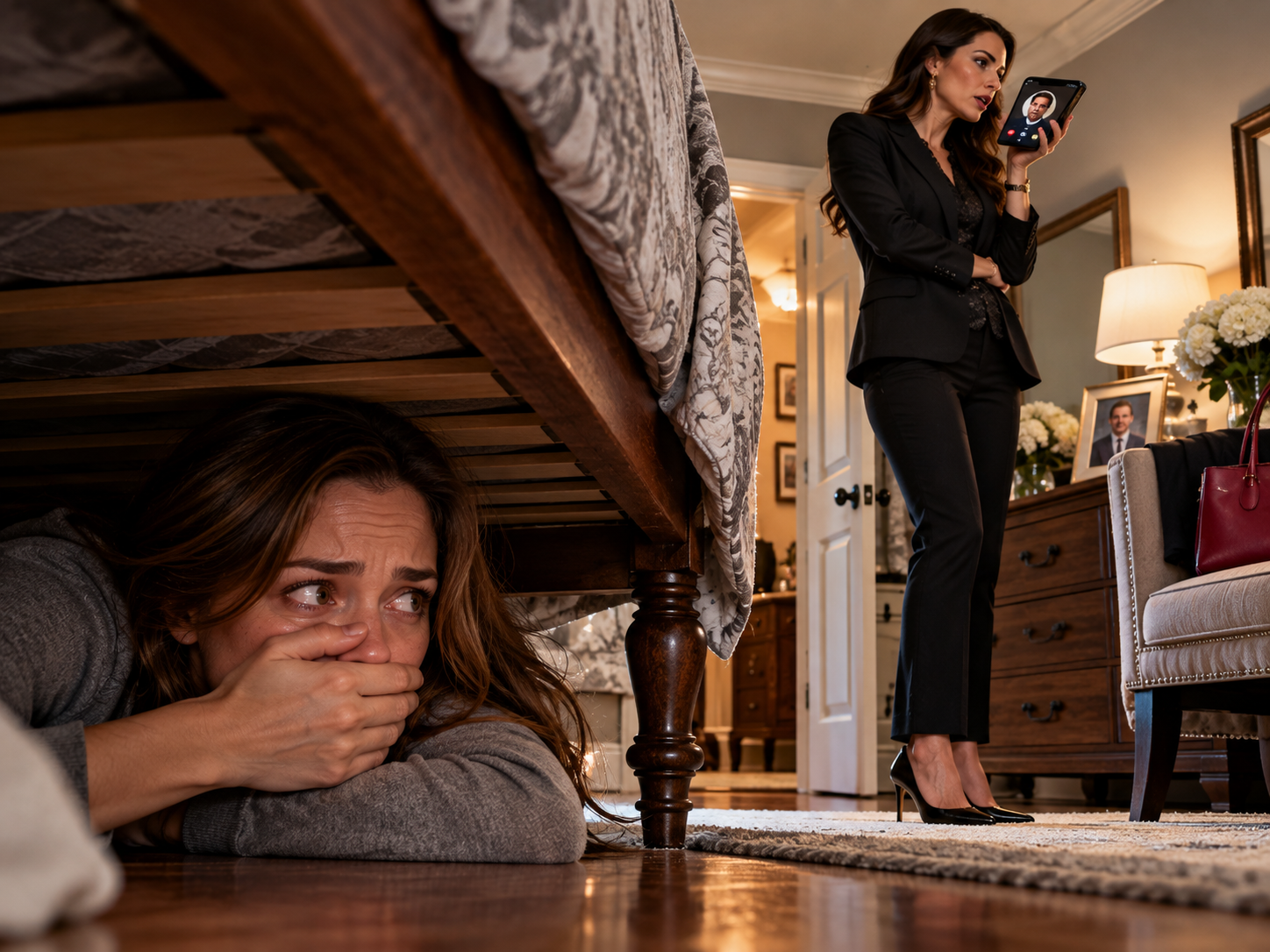
One evening, I found myself standing in the bedroom doorway, looking at the bed where I had hidden while Vanessa searched the room. The memory was still vivid: the cold floor, the dust, the woman's shoes, and Mark's voice coming from the phone. I could still recall the shock of hearing him speak, but the memory no longer controlled what happened next. I turned off the light and went downstairs to finish reading my book.
There would always be parts of the story I could not know. I might never understand every decision Mark had made or every thought that had crossed his mind during the years he spent hiding. I could not restore the time I had lost, and I could not remove the suffering his actions had caused other people. The investigation had established what the evidence could establish. The remaining questions belonged to the past, where they could stay without governing my future.
I kept the photographs and records in a secure place. I did not destroy them, because they documented what had happened and might be needed again. But I stopped opening the folders simply to reassure myself that the truth was still there. I no longer needed to prove to myself each morning that I had not imagined the voice or misunderstood the documents.
The last thing I changed was the routine I had followed for years. I stopped leaving the house at exactly the same time every morning simply because Mark had known that schedule. I began taking different routes to work, not out of fear, but because I wanted the freedom to choose. Some days I left early; other days I made coffee slowly and watched the light move across the kitchen.
The house remained quiet. The difference was that I no longer mistook quiet for safety, or safety for happiness. I had learned that a peaceful life was not one in which nothing unexpected happened. It was one in which I could respond to the unexpected without surrendering my judgment or my sense of self.
On a warm evening in April, I sat by the open window with a cup of coffee and listened to the neighborhood settle into night. Mrs. Gable was talking to someone over her fence. A car door closed down the street. The refrigerator hummed in the kitchen, and the floorboards gave a familiar creak when the house cooled.
I did not freeze or reach for my phone. I took another sip of coffee and continued reading.
Mark's disappearance had begun with a lie that seemed impossible to challenge. It had continued because he knew my habits, my trust, and the ways grief could make a person afraid to ask questions. His plan had depended on my remaining the woman he believed he understood.
But I had changed.
I had listened when something seemed wrong. I had preserved the evidence, asked for help, and refused to let him turn my love into another instrument of control. I had learned to distinguish what I knew from what I feared, and to accept that some answers would never be complete.
When I finally closed the book, the room was dark except for the small lamp beside my chair. I walked through the house, checked the lock once, and turned off the remaining lights.
There was no voice waiting in the hallway. No footsteps approached my bedroom. No stranger moved through the rooms as though the house belonged to someone else.
I went to bed, pulled the covers over my shoulders, and let the quiet remain quiet.
The truth had cost me the future I once imagined with Mark. It had also given me back the right to decide what came next.
Click here to continue reading: PART 9: Just When I Thought the Past Had Finally Lost Its Hold on Me, an Unexpected Court Notice Forced Me to Face the Consequences of Mark’s Lies Once More
The Woman Who Entered My House Without Knocking Knew My Husband’s Habits Better Than Anyone Should
Part 8 of 20

