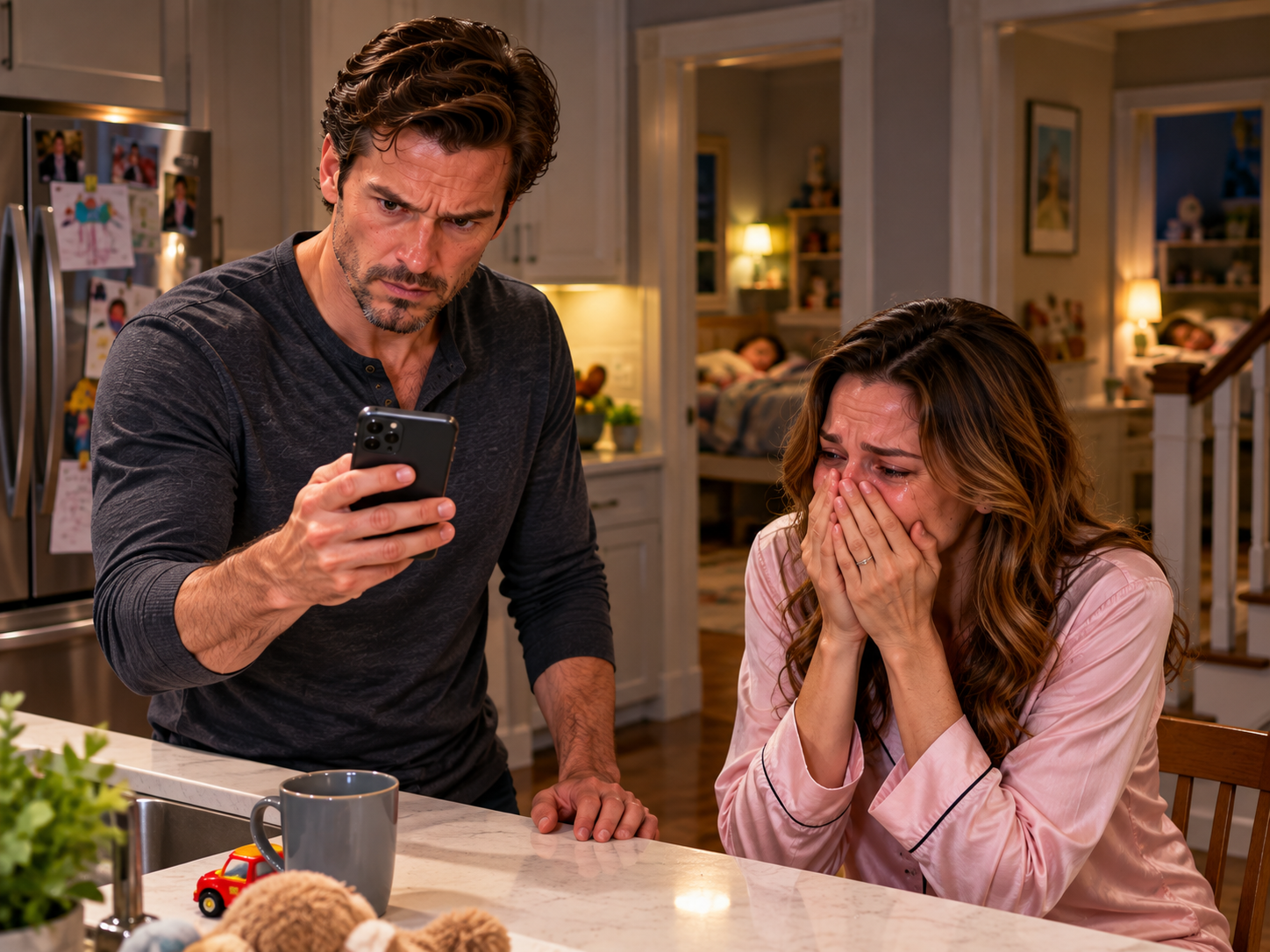
There came a morning when I looked around the kitchen and realized I no longer recognized the man who had once sat there.
The kitchen was different.
The house was different.
I was different.
But the strongest difference was inside me.
There was a time when every quiet moment gave the past an opportunity to return.
Now quiet simply meant quiet.
I could drink coffee without remembering the phone message.
I could hear a notification without feeling my stomach tighten.
I could see my former wife without replaying the affair.
That did not mean the memory had vanished.
It meant the memory no longer controlled the present.
My children had become parents.
That changed how they spoke to me.
They no longer asked only about what happened.
They asked about parenting.
About marriage.
About patience.
About money.
About fear.
About raising children without repeating their own parents' mistakes.
One afternoon, my daughter called me.
“Dad, can I ask you something?”
“Sure.”
“How did you know when to apologize to us?”
I smiled.
“I don't think I always knew.”
“Did you worry about hurting us?”
“Every day.”
“What did you do?”
“I tried to tell the truth without making you responsible for it.”
She was quiet.
“I think that helped.”
“I hope so.”
“It did.”
She paused.
“I don't remember everything from when I was little.”
“You don't need to.”
“But I remember feeling safe.”
That meant more to me than she could know.
Safety had been the thing I had wanted to give my children from the beginning.
I had believed safety meant two parents living together.
I eventually learned it meant something deeper.
It meant knowing that adults would tell the truth.
It meant knowing that anger would not determine how you were treated.
It meant knowing that both parents would show up.
It meant knowing that you were not responsible for repairing their relationship.
My son told me something similar months later.
His daughter had started asking questions about why grandparents lived in different houses.
“She asked whether you and Mom were married.”
“What did you say?”
“The truth.”
I smiled.
“What truth?”
“That we were married and then we weren't.”
“And did she ask why?”
“Yes.”
“What did you say?”
“I told her sometimes adults can't stay married.”
“That was good.”
“She asked whether we were still family.”
I laughed.
“She got that from her mother.”
“Probably.”
“What did you tell her?”
“That we are.”
My son paused.
“She said, ‘Okay.’”
I smiled.
The same answer.
The same question.
Different generation.
The children had inherited the question but not the fear.
That was how I knew we had done something right.
The divorce had not disappeared from the family history.
It had simply stopped being a wound that everyone touched.
It became a fact.
A chapter.
A lesson.
Something that had happened before the grandchildren were born.
One evening, Elena and I sat outside.
She looked at me.
“Do you ever wonder what would have happened if you stayed?”
I smiled.
“Sometimes.”
“And?”
“I don't know.”
“Do you wish you knew?”
“No.”
She looked surprised.
“Why?”
“Because I have enough life in front of me to care about.”
She smiled.
That was perhaps the greatest change of all.
I had stopped living beside an imaginary alternative life.
For years, I had compared my reality to the life I believed I should have had.
The comparison was endless because the imaginary life had no problems.
In that version, my wife never cheated.
Our children never experienced divorce.
We grew old together.
Everything worked.
But imaginary lives are unfair.
They contain only the choices we wish we had made.
Real life contains consequences.
It also contains surprises.
The granddaughter who climbs into your lap.
The son who calls for advice.
The daughter who asks you to dance at her wedding.
The woman you meet later who teaches you that trust can exist again.
The former spouse who eventually becomes someone you can sit beside without anger.
Those things were real.
I would not trade them for an imaginary version of my past.
One afternoon, my former wife and I attended our grandson's school performance.
We sat several seats apart.
The children performed a short play.
Our grandson forgot his line.
The teacher whispered something.
He recovered.
Everyone applauded.
My former wife laughed.
I laughed too.
Afterward, our grandson ran toward us.
“Did you see me?”
“Yes,” we both said at the same time.
He looked between us and laughed.
“You said the same thing.”
My former wife smiled.
“Great minds.”
He grabbed both our hands.
For a few seconds, we stood there together.
Not as husband and wife.
Not as people pretending the past had never happened.
As grandparents.
That was enough.
On the drive home, I thought about how strange life could be.
The man who had once believed divorce meant permanent destruction was now standing in a school hallway holding hands with the person who had once broken his trust, while their grandson proudly told them about his performance.
There was no perfect explanation for it.
There didn't need to be.
Life had simply continued.
That night, I opened an old box.
Inside were photographs from university.
The picture of us at graduation.
Our wedding.
The first apartment.
Our daughter as a baby.
Our son asleep against my chest.
The family vacations.
I looked at the photographs without anger.
That was new.
I did not need to destroy them.
I did not need to hide them.
I did not need to pretend they represented something they no longer did.
They were evidence of a life that had existed.
I put them back in the box.
Then I added a photograph of my grandchildren.
The old and new generations together.
Different chapters.
One family.
I closed the lid.
There was a time when I thought healing meant throwing the box away.
I understood now that healing meant being able to open it without falling apart.
My daughter called me the following weekend.
“Dad?”
“Yeah?”
“Mom told me something.”
“What?”
“She said you forgave her years ago.”
“I did.”
“Did you ever tell her that?”
“Yes.”
“Why didn't I know?”
“Because it wasn't your business.”
She laughed.
“You really kept that separate.”
“I tried.”
She became quiet.
“I think that was kind.”
“It wasn't always easy.”
“I know.”
Then she said something that stayed with me.
“You didn't protect us by hiding the truth.”
I waited.
“You protected us by not making us carry it.”
I closed my eyes.
Maybe that was the clearest description anyone had ever given me.
I had spent years wondering whether I had handled the divorce correctly.
There was no perfect answer.
But I knew I had tried to make sure my children never became messengers, judges, or weapons.
That mattered.
They were allowed to love their mother.
They were allowed to love me.
They were allowed to be angry.
They were allowed to forgive.
They were allowed to build lives unrelated to our mistakes.
That was freedom.
And perhaps freedom was the greatest thing I could leave them.
Years earlier, I had wanted to give them a family with both parents.
I still wished I had been able to.
But I could not rewrite history.
What I could do was give them something else.
A family where truth mattered.
A family where people took responsibility.
A family where leaving a broken relationship did not mean abandoning the people inside it.
A family where forgiveness did not require forgetting.
A family where love could survive a marriage ending.
One evening, my son asked me whether I had any advice for his daughter when she grew up.
I smiled.
“That's a dangerous question.”
“Why?”
“Because she'll probably ignore it.”
He laughed.
“Probably.”
I thought for a moment.
“Tell her to pay attention to actions.”
“Not words?”
“Words matter.”
I paused.
“But actions tell you whether words are real.”
He nodded.
“Anything else?”
“Yes.”
“What?”
“Tell her never to confuse being loved with being controlled.”
He looked thoughtful.
“And?”
“Tell her honesty matters even when honesty is difficult.”
He smiled.
“You've thought about this.”
“For a long time.”
He put a hand on my shoulder.
“I'm glad you did.”
I looked at him.
“Why?”
“Because we learned from it.”
That sentence brought everything together.
The betrayal had not been a lesson I wanted.
The divorce had not been a chapter I chose.
But my children had watched what happened afterward.
They had watched me leave without abandoning them.
They had watched their mother accept responsibility.
They had watched both of us learn to cooperate.
They had watched me forgive without returning to a marriage that no longer worked.
They had watched love take new forms.
And now they were raising children of their own.
That was the legacy.
Not the affair.
Not the divorce.
Not the photographs from the worst night of my life.
The legacy was what we did afterward.
I thought about the younger man I had been when I met my wife at university in 2014.
He believed love meant finding the person who would stay forever.
He believed a family could be protected by making promises strong enough.
He believed if he loved someone well enough, they would never hurt him.
I don't judge that younger man.
He was hopeful.
He was sincere.
He wanted something beautiful.
I still wanted something beautiful.
I had simply learned that beauty without honesty could not hold a life together.
Trust had to be chosen every day.
So did responsibility.
So did forgiveness.
So did moving forward.
My former wife and I never got our old marriage back.
We never should have.
That chapter had ended.
But the family that came from it did not end.
It changed.
It grew.
It became larger than the marriage that had once defined it.
And one evening, surrounded by my children and grandchildren, I looked around the table and realized that the thing I had feared most had never happened.
My family had not disappeared.
It had survived.
Not perfectly.
Not painlessly.
But honestly.
I finally understood that I had spent years asking the wrong question.
I had kept asking whether leaving had saved my family.
The better question was whether I had remained present enough to help my family become something new.
The answer was yes.
That was enough.
Click here to continue reading: PART 13: As the years became quieter, I stopped measuring my life against the marriage I lost and began noticing how much of my family had grown from what survived
The message that appeared on my wife’s phone looked harmless at first, until I opened it and discovered months of choices I could never unknow
Part 12 of 28