
The first time Brittany mentioned the woman, she sounded embarrassed.
The second time, she sounded angry.
The third time, she sounded worried.
I finally asked her to tell me what was happening.
We met at the same café where she had first admitted that she had misunderstood the marriage.
She arrived carrying a folder.
I recognized it immediately.
“More documents?”
She smiled faintly.
“Unfortunately.”
She sat down.
“My dad is engaged.”
I nodded.
“I heard.”
She looked surprised.
“From who?”
“Someone we both know.”
She shrugged.
“I didn't want to tell you because I thought you'd think I was trying to hurt you.”
“I don't.”
She looked down.
“He met her while we were still going through the divorce.”
I said nothing.
“I'm not telling you because I think you should care.”
“Good.”
She smiled.
“I thought you'd say that.”
“Then why are you telling me?”
She pushed the folder toward me.
“Because I found something.”
I did not touch it.
“What?”
“Letters.”
“From him?”
“Yes.”
“To her?”
“Yes.”
My stomach tightened.
“Why would I want to read them?”
“You don't.”
She paused.
“But I think you should know what they say.”
I shook my head.
“No.”
She looked relieved.
“Okay.”
I waited.
She continued.
“He told her that he had been trapped in a marriage where he was financially responsible for everything.”
I almost laughed.
“He told her that?”
“Yes.”
“Did he mention the payments?”
“He said you insisted on handling them.”
I looked at the table.
There it was again.
The story changed depending on who was listening.
To Brittany, I had been controlling.
To his new partner, I had been obsessive about money.
To himself, perhaps, he was the victim.
The details shifted.
The structure remained.
I was always the problem.
Brittany watched me.
“Are you angry?”
“No.”
“Why not?”
“Because I know what happened.”
She looked confused.
“But doesn't it bother you that he's lying?”
“People tell stories that protect the version of themselves they can live with.”
She considered that.
“That sounds sad.”
“It is.”
She was quiet.
Then she said, “I don't think he is happy.”
I looked at her.
“That's not something you need to solve.”
“I know.”
“Do you?”
She nodded.
“I think I'm finally learning.”
That mattered.
She had changed.
Not dramatically.
Not perfectly.
But enough.
She had begun taking responsibility for her own life.
She had a job.
She paid her rent.
She stopped asking her father to solve every problem.
She had started budgeting.
She even apologized once when she was late repaying a friend.
Those were small things.
Small things are often how people change.
I asked about her own plans.
She told me she was finishing school.
She wanted to work in marketing.
She was considering moving to another city.
I listened.
For the first time, our conversations were not about Richard.
That felt healthy.
Then she asked me a question.
“Do you ever regret leaving?”
I thought about it.
“No.”
“Not even a little?”
“I regret things that happened.”
“That isn't what I asked.”
“I know.”
I looked out the window.
“I don't regret leaving.”
She nodded.
“Good.”
I smiled.
“Why?”
“Because I don't want you to think I caused it.”
I understood then.
She had been carrying guilt.
Not all of it belonged to her.
But some did.
I told her that.
“You were part of what happened.”
Her face fell.
“But you weren't responsible for my marriage.”
She looked at me.
“That distinction matters.”
She nodded slowly.
“I think I needed to hear that.”
We finished our coffee.
Before leaving, she asked whether I would attend her graduation.
I smiled.
“If you want me there.”
“I do.”
“Then I'll be there.”
Her eyes became wet.
“Thank you.”
I touched her hand.
“Finish your degree.”
She laughed.
“I will.”
When I drove home, I realized something had shifted between us.
I no longer saw her as the young woman who had called me the help.
She was becoming someone else.
And I was no longer trying to become her mother.
That was important.
The relationship could exist without pretending it had always been something it was not.
A few months later, I attended her graduation.
Richard was there.
So was his fiancée.
I saw them across the auditorium.
For a moment, old memories rose.
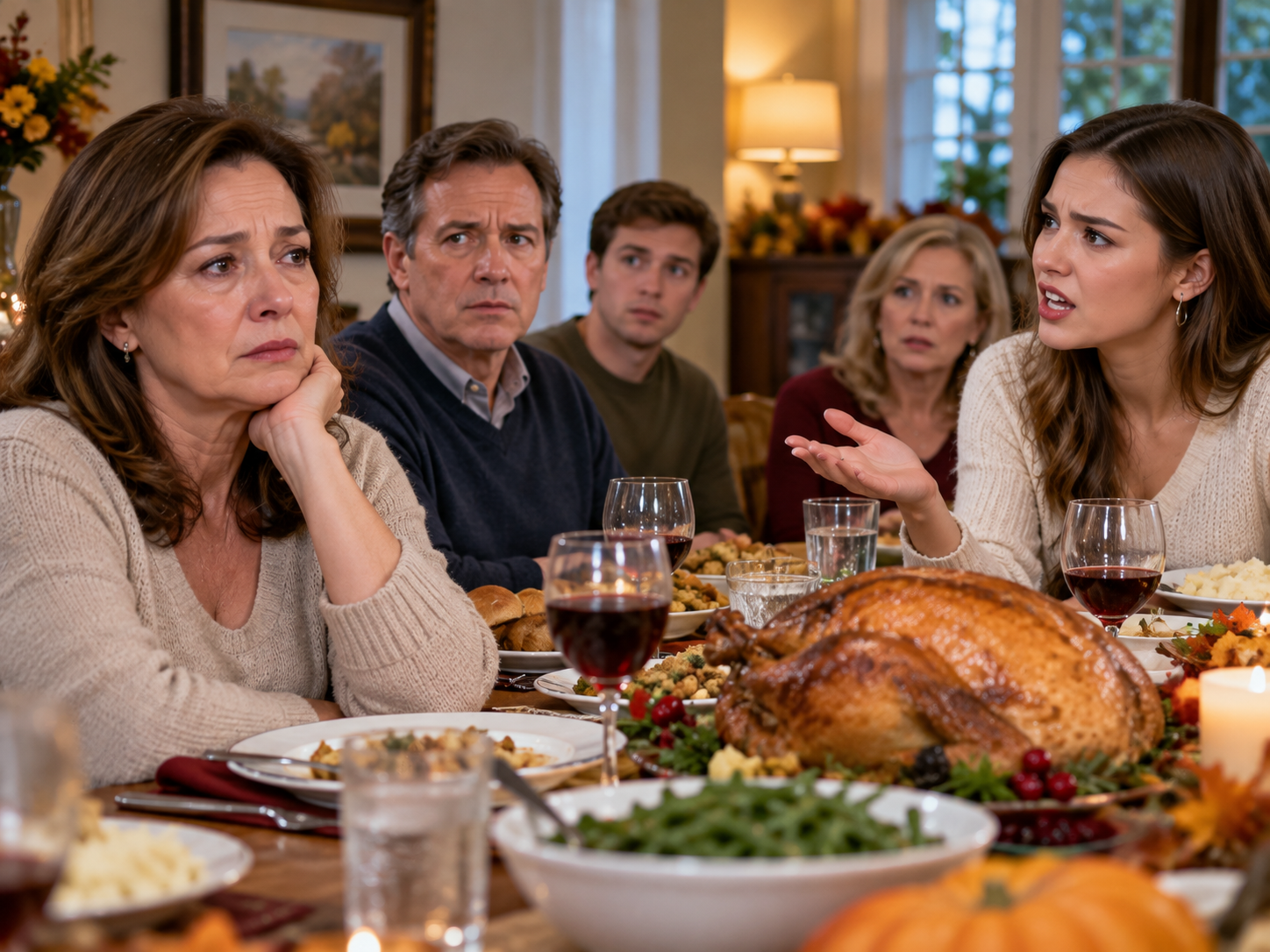
The Thanksgiving table.
The argument.
The folder.
The café.
The divorce papers.
Then the graduates walked onto the stage.
Brittany's name was called.
She smiled when she received her diploma.
I stood and applauded.
Richard did too.
Our eyes met across the crowd.
He nodded.
I nodded back.
Nothing more.
Afterward, Brittany found me.
She hugged me.
“I did it.”
“Yes, you did.”
She looked at Richard.
Then back at me.
“I want you to meet someone.”
She introduced me to one of her professors.
Then to a friend.
Then to a coworker.
She never called me anything except Brenda.
That was fine.
It was honest.
Later, while people gathered for photographs, Richard approached.
“You came.”
“She invited me.”
“I know.”
He looked at Brittany.
“She did well.”
“She did.”
He hesitated.
“Thank you.”
“For what?”
“For not abandoning her.”
I studied him.
“You were her father.”
“I know.”
“You still are.”
He nodded.
There was something uncomfortable in his expression.
Perhaps shame.
Perhaps gratitude.
Perhaps both.
“I handled things badly,” he said.
“Yes.”
He almost smiled.
“You don't make it easy.”
“I stopped making it easy for you.”
He looked down.
“I deserved that.”
I did not answer.
There was nothing more to say.
His fiancée called his name.
He turned.
“I should go.”
“Okay.”
He walked away.
I watched him for a moment.
Then I turned back to Brittany.
She was laughing with her friends.
I smiled.
The past did not disappear.
It simply stopped controlling the present.
That distinction took me years to understand.
Forgiveness did not erase the records.
It did not erase the email.
It did not erase the insult.
It did not require me to pretend Richard had been someone he was not.
Forgiveness, if I was going to use that word at all, meant I no longer needed punishment to prove that what happened mattered.
The consequences already existed.
The marriage ended.
The accounts were divided.
The trust was gone.
The life we had built was finished.
Nothing I could do would change those facts.
I did not need revenge.
I needed peace.
Months passed.
Brittany moved to another city for work.
She called occasionally.
Sometimes she asked advice.
Sometimes she just wanted to talk.
The first time she asked about a budget, I laughed.
“What?”
“You finally understand why I kept spreadsheets.”
She groaned.
“Don't remind me.”
I laughed.
It felt good.
Not because the past was funny.
Because it no longer hurt in the same place.
One Saturday morning, I received a package.
Inside was a framed photograph from Brittany's graduation.
She had written a note on the back.
Thank you for showing me that being independent doesn't mean never accepting help. It means knowing who you are responsible for.
I read the sentence several times.
Then I put the photograph on my desk.
That afternoon, I called Carol.
She came over.
We drank coffee.
I showed her the picture.
She smiled.
“She finally got it.”
“I think so.”
“Do you?”
I looked at the photograph.
“I hope so.”
Carol nodded.
“That's enough.”
She was right.
People do not always become the people we wish they would.
Sometimes they become slightly better.
Sometimes that is enough.
One evening, months later, I received a text from Richard.
Brittany got promoted.
I replied:
That's wonderful. Congratulations to her.
He sent another message.
She says you helped her.
I stared at the screen.
Then I wrote:
She helped herself.
I sent it.
There was no response.
I put the phone away.
That was the final thing I wanted him to understand.
I had not saved Brittany.
I had not rescued her.
I had not transformed her life.
I had simply stopped rescuing everyone long enough for people to discover that they could stand on their own.
That was what boundaries had done.
They had not destroyed my family.
They had revealed where each person actually belonged.
Brittany belonged in her own life.
Richard belonged in his.
I belonged in mine.
The old version of me would have called that sad.
The woman I had become called it honest.
Click Here to continue read next: PART8: When Richard finally asked me for one last favor, I had to decide whether helping him would be kindness or simply another way of losing myself.
One careless sentence at Thanksgiving finally showed me what my husband had been expecting from me all along, and what he had never intended to give back.
Part 7 of 16

