
The summer after Brittany's visit was unusually warm.
The kind of summer where the pavement seemed to hold the day's heat long after sunset, and the garden needed watering before breakfast if I wanted the herbs to survive.
I enjoyed it.
There was something satisfying about caring for things that did not demand anything beyond what I could freely give.
Every morning, I walked outside with a cup of coffee and checked the plants.
The basil was thriving.
The rosemary had grown thick.
The mint had begun escaping its pot, which Carol insisted was exactly what mint did when given an opportunity.
I laughed when she said it.
“Some things don't know when to stop.”
She was kneeling beside me, pulling weeds.
“Like you?”
“Especially me.”
We spent the morning in the garden.
There was no schedule.
No one waiting for me to solve something.
No one asking whether I had transferred money.
No one expecting me to remember a deadline that belonged to someone else.
It still amazed me how ordinary freedom could feel.
After lunch, Carol left.
I stayed outside.
The diary from my younger years was on the table inside.
I had started reading it again.
Not every page.
Just enough to remember the person I had been before life became complicated.
Sometimes I disagreed with her.
Sometimes I wanted to warn her.
Sometimes I wanted to hug her.
She had been idealistic.
She believed people were mostly honest.
She believed love made people better.
She believed if you worked hard enough, you could build almost anything.
She had been wrong about some things.
She had also been right about others.
The most important promise she had written remained the simplest.
Never abandon yourself to keep someone else.
I had spent months thinking about that sentence.
Eventually, I realized the promise was not really about marriage.
It was about identity.
I had abandoned pieces of myself in many situations before Richard.
I had agreed to things because disagreeing felt uncomfortable.
I had apologized when I had done nothing wrong.
I had tried to make difficult people comfortable.
Marriage had simply given those habits a larger stage.
That realization changed how I looked at my past.
I stopped blaming Richard for every weakness I had brought into the relationship.
He was responsible for his choices.
I was responsible for mine.
That distinction was important.
Taking responsibility did not mean taking blame for another person's behavior.
It meant acknowledging where I had ignored my own boundaries.
That was something I could change.
One evening, I received a message from Richard.
He asked whether I would meet him for coffee.
I almost said no.
Then I remembered the old promise.
Never abandon yourself.
It did not mean never speak to someone from your past.
It meant knowing why you were doing it.
I replied that I could meet him the following week.
We chose the same café where we had once discussed the financial account.
When I arrived, Richard was already sitting by the window.
He stood when he saw me.
“You look well.”
“So do you.”
We sat.
He ordered coffee.
I ordered tea.
For a moment, neither of us spoke.
Then he said, “I wanted to thank you.”
“For what?”
“For something I didn't understand until recently.”
I waited.
“You were right about responsibility.”
“I wasn't trying to be right.”
“I know.”
He looked at his hands.
“My marriage to you taught me that.”
I raised an eyebrow.
“That's an unusual conclusion.”
He smiled.
“I've had time to think.”
“Thinking can be useful.”
He nodded.
“My wife and I have been talking about money.”
I waited.
“I told her everything.”
“That is good.”
“I mean everything.”
I smiled faintly.
“That sounds uncomfortable.”
“It was.”
“Honesty usually is.”
He laughed.
Then his expression became serious.
“She asked me why I hid things from you.”
“And what did you say?”
“That I was afraid.”
“Of what?”
“Of losing the life I wanted.”
I looked at him.
“And did you?”
He thought about it.
“Yes.”
There was no bitterness in the answer.
That mattered.
“I thought I could protect the marriage by avoiding difficult conversations,” he continued. “Instead, I made the marriage impossible to trust.”
I nodded.
“That is what happened.”
“I know.”
We sat quietly.
Then he said, “I don't expect you to forgive me.”
“You've said that before.”
“I mean it.”
“I know.”
He looked out the window.
“I also don't expect you to care about what happens to me.”
“I do care.”
He turned toward me.
“But caring doesn't mean returning.”
“I understand.”
That was perhaps the most important conversation we had ever had.
Not because it repaired anything.
Because neither of us was asking the other to rewrite history.
He accepted that I had left.
I accepted that he was moving forward.
There was no promise.
No reconciliation.
No hidden possibility.
Just acceptance.
Before we left, he said, “Your diary.”
I looked at him.
“What about it?”
“Brittany told me about it.”
I smiled.
“She tells everyone everything.”
“She said you wrote about never abandoning yourself.”
I felt a strange warmth in my chest.
“She did.”
“I wish I'd understood that when we were married.”
I looked at him.
“You wouldn't have understood it then.”
“Maybe.”
“People understand things when they're ready.”
He nodded.
We said goodbye.
This time, when I walked away, I felt nothing pulling me backward.
That was how I knew.
I had not simply left Richard.
I had left the need to imagine a different ending.
The past could remain exactly what it was.
I did not have to improve it.
I did not have to punish it.
I did not have to romanticize it.
I could remember it.
That was enough.
The next morning, I opened my diary.
I wrote a new entry beneath the old promise.
I did not abandon myself forever.
I just forgot how to listen.
Then I closed the book.
I thought that was the end of the lesson.
It wasn't.
A few weeks later, Brittany called.
She sounded excited.
“I have news.”
“What happened?”
“I got promoted.”
“That is wonderful.”
“And I'm moving.”
“Where?”
“Closer to the city.”
I smiled.
“Congratulations.”
She laughed.
“Dad thinks I should buy a house.”
“Can you afford one?”
“I don't know.”
“Then don't let anyone rush you.”
She paused.
“You sound exactly like yourself.”
“Good.”
She laughed.
Then she became serious.
“I've been thinking about something.”
“What?”
“The way I treated you.”
I sighed.
“We've talked about this.”
“I know.”
“But?”
“I think I finally understand what I did.”
I listened.
“I thought you were taking something away from me.”
“What?”
“My father.”
I frowned.
“I never wanted him.”
“I know.”
“But I thought you did.”
“That wasn't my responsibility.”
“I know that now.”
She took a breath.
“I was angry because I was afraid.”
I smiled.
“That's often true.”
“You were becoming important to him.”
“Yes.”
“And I thought that meant less for me.”
I nodded.
“But love isn't a pie.”
She laughed.
“What?”
“You don't divide it into pieces.”
“I know.”
“Your father could love you and love me.”
“He just didn't know how to balance it.”
“Perhaps.”
There was silence.
Then she said, “I'm glad you didn't become my mother.”
I smiled.
“Why?”
“Because then I'd probably still be angry with you.”
I laughed.
“That makes no sense.”
“It does to me.”
She continued.
“You became someone else.”
“What?”
“Someone I could choose to keep in my life.”
That answer touched me.
I did not need a title.
I did not need recognition.
Choice mattered more.
She chose to call.
She chose to visit.
She chose to apologize.
I chose to answer.
That was enough.
After the call, I walked outside.
The sun was beginning to set.
The garden smelled of rosemary and wet soil.
I sat in the chair beside the little table.
The empty chair was beside me.
For years, an empty chair had frightened me.
Now it simply meant there was room.
Room for a friend.
Room for a child.
Room for a conversation.
Room for silence.
Room for nobody.
I smiled.
I had spent so long believing that every empty space needed to be filled.
Now I understood that some spaces were meant to remain open.
They gave you somewhere to breathe.
Click Here to continue read next: PART14: The final family gathering forced everyone to sit at the same table again, and I discovered that peace was not the absence of awkwardness.
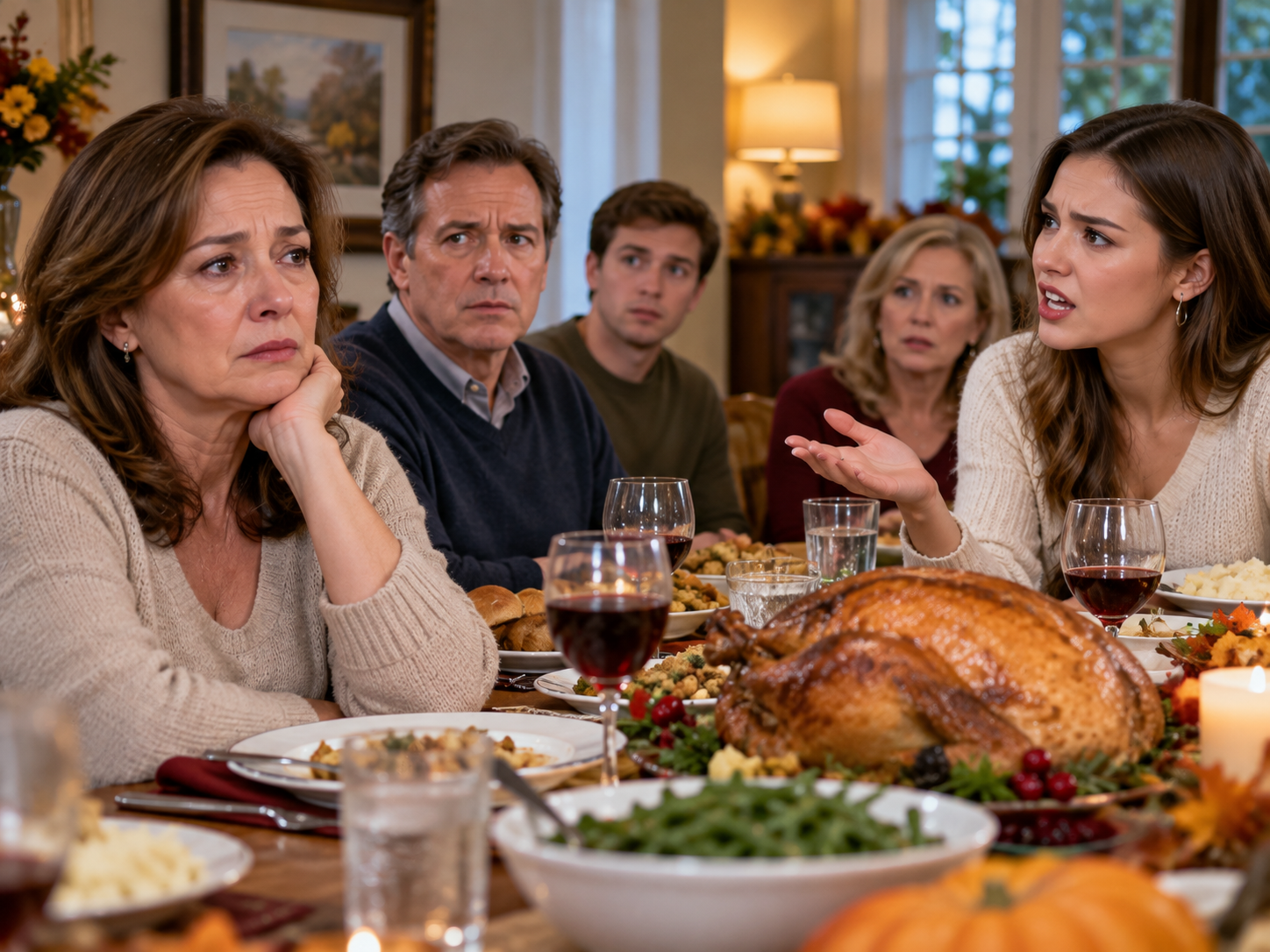
One careless sentence at Thanksgiving finally showed me what my husband had been expecting from me all along, and what he had never intended to give back.
Part 13 of 16

