
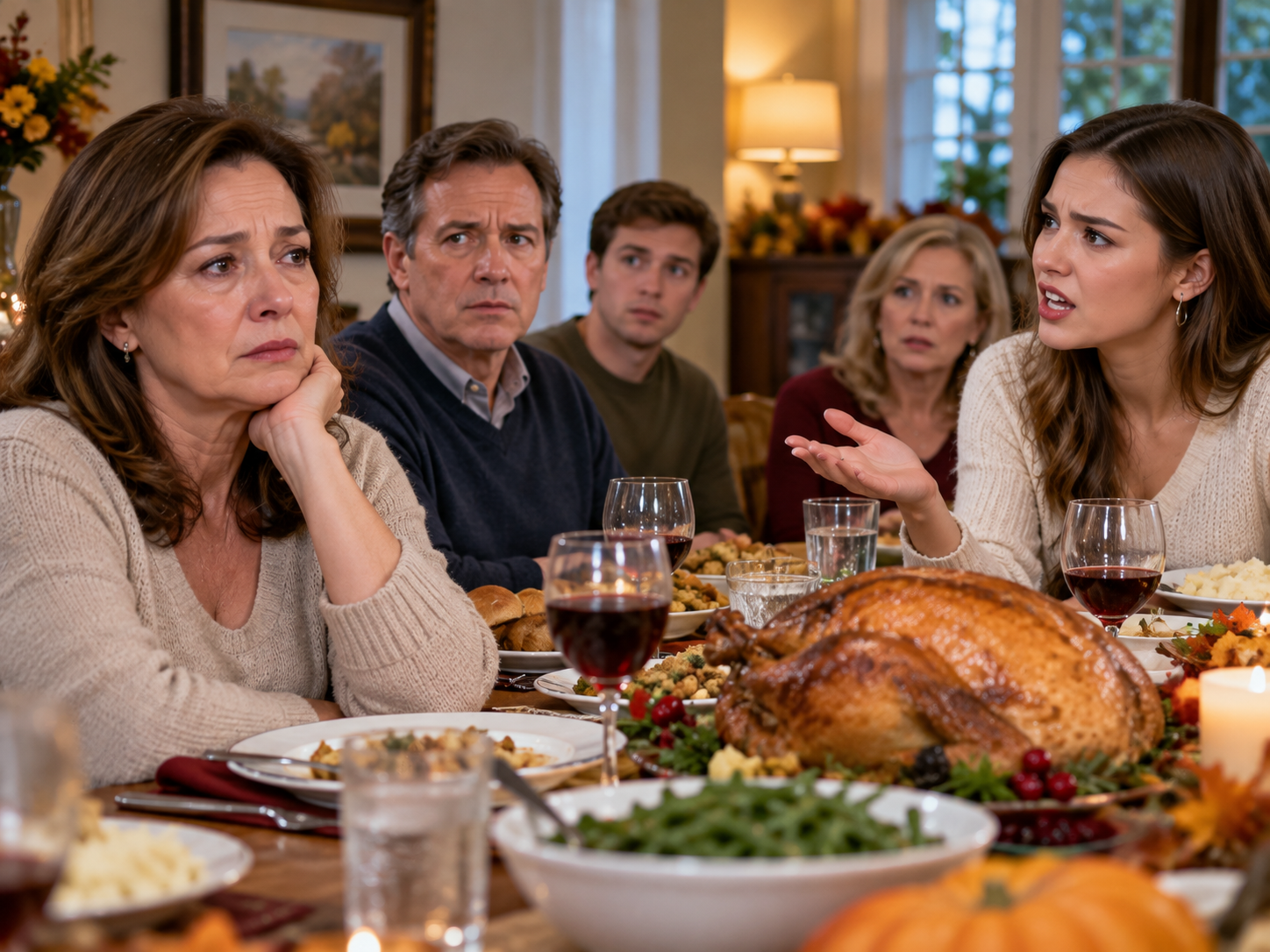
A year after the dinner that ended my marriage, I hosted Thanksgiving in my townhouse.
The turkey was smaller.
The table was smaller.
The guest list was smaller.
Everything was smaller.
And somehow, nothing felt missing.
Carol brought the green bean casserole.
She still put too many onions on top.
Gary still complained about football.
Lucas arrived in his work boots, carrying a bottle of wine and smelling faintly of cold air and machine oil.
Two close friends joined us.
There was no Richard.
There was no Brittany.
There was no tense silence waiting for someone to say something cruel.
At one point, I stood in the kitchen with a dish towel in my hand.
Steam rose from the serving dish.
I looked at the dining room.
Everyone was talking.
Carol was laughing.
Gary was arguing about a referee's decision.
Lucas was reaching for another roll.
It looked ordinary.
But I remembered the year before.
The same kind of dish.
The same kind of kitchen.
The same kind of towel.
And the sentence that had changed everything.
For a moment, I felt the old ache.
Not because I wanted my marriage back.
Because I remembered how badly I had wanted it to be something it was not.
Lucas came into the kitchen.
He looked at the serving dish in my hands.
“Give me that.”
“I've got it.”
“I know.”
He took it anyway.
That simple gesture nearly brought tears to my eyes.
Not because I needed rescuing.
Because he had noticed.
There was a difference.
In my old life, people noticed what I could carry.
In my new life, people noticed when I was carrying too much.
That distinction mattered.
After dinner, everyone lingered.
The house filled with the soft sounds of people who were comfortable enough not to perform.
Someone washed dishes.
Someone wrapped leftovers.
Someone found a container without asking me where it was.
Nobody treated my ability to organize a household as an invisible service.
They simply helped.
Later, I stepped outside onto the patio.
The air was cold.
My breath appeared in small white clouds.
A dog barked somewhere down the street.
A car passed at the end of the block.
I stood there with my arms folded.
I thought about the woman I had been twelve months earlier.
She had believed peace meant preventing conflict.
She had believed love required endurance.
She had believed that if she worked hard enough to make a household function, eventually everyone inside it would recognize her as essential.
She had been wrong.
Not because helping people was wrong.
Not because generosity was weakness.
Because generosity becomes dangerous when other people begin treating it as an obligation.
That was the part I had not understood.
I had not lost my marriage because I stopped paying for Brittany's expenses.
I had stopped paying because the marriage had already shown me what it thought I was worth.
The financial records had only made the truth visible.
The email had confirmed it.
The dinner had exposed it.
The divorce had simply made the decision official.
I went back inside.
Carol was standing in the kitchen.
She looked at me.
“You're thinking too hard again.”
I laughed.
“Probably.”
She handed me a glass of iced tea.
We sat on the patio after everyone else left.
The evening was warm enough for short sleeves.
Carol watched me for a while.
Then she said, “You know what I think?”
“I usually regret asking.”
She smiled.
“I think you spent too much of your life believing endurance was a virtue by itself.”
I looked at her.
“That sounds suspiciously prepared.”
“I came up with it in traffic.”
I laughed.
She took a strawberry from the bowl between us.
Then she said, “People who benefit from your steadiness stop seeing it as something you give them.”
I knew exactly what she meant.
They begin to experience it as the environment.
Like weather.
Like gravity.
Like the lights turning on when you flip the switch.
Brittany had grown accustomed to comfort.
Richard had grown accustomed to my competence.
Neither had stopped to ask who was making that comfort possible.
And when I finally removed myself from the system, they had called the change cruel.
That was the part I no longer carried.
I did not need them to agree with my decision.
I did not need Richard to admit he had been wrong.
I did not need Brittany to become a different person overnight.
I needed only to stop participating in a life that required me to disappear inside it.
Months later, Brittany and I spoke again.
The relationship was not repaired in some perfect way.
There was no dramatic mother-daughter reconciliation.
She was not my daughter.
Richard had made sure I remembered that.
But she was a young woman who had learned something difficult about the adults around her.
She had found work.
She was paying more of her own expenses.
She was learning what adulthood actually cost.
That mattered.
I told her I wished her well.
She told me she was sorry.
I believed that she meant it as much as she knew how to mean it.
That was enough.
Forgiveness, I learned, did not have to mean reopening a door.
Sometimes forgiveness was simply deciding not to spend any more of your life arguing with the person who hurt you.
Richard and I spoke only when necessary.
Paperwork.
Taxes.
The occasional practical question.
There was no hatred.
That surprised me.
I had expected anger to remain longer.
Instead, it faded into distance.
One spring afternoon, I saw him again at the hardware store.
He had asked how I was.
I said I was fine.
He told me I looked good.
I told him he did too.
Then he admitted that he had not thought his words would matter so much.
I had looked at him and told him that was always the problem.
He had not thought.
Or perhaps he had thought, but not deeply enough to imagine consequences.
Either way, I no longer needed the answer.
That was another thing freedom gave me.
The ability to stop needing explanations.
For years, I had believed closure required another person to understand what they had done.
It doesn't.
Sometimes closure is simply waking up one morning and realizing you no longer need the apology.
My mornings became quiet.
I woke before the alarm.
I made coffee.
I opened the curtains.
I watched the sky brighten.
Sometimes I cooked.
Sometimes I ate toast.
Sometimes I met Carol for lunch.
Sometimes Lucas came by and helped with something around the house.
I bought the paint for my downstairs bathroom.
I chose the color myself.
I rearranged furniture because I liked it that way.
I learned how peaceful a home could feel when nobody was waiting for you to become useful before treating you with affection.
There was no grand transformation.
That is what people misunderstand about leaving.
The hardest part is often not the day you leave.
It is the weeks and months afterward when you discover how many small habits were built around another person's expectations.
I had to learn not to check my phone every few minutes.
I had to learn that a bill arriving was not automatically my problem.
I had to learn that saying no did not make me selfish.
I had to learn that another adult being disappointed with me did not mean I had done something wrong.
Those lessons were quieter than the divorce.
They were also more important.
One evening, I stood in my kitchen washing a coffee cup.
The light outside was fading.
The townhouse was quiet.
I looked at my reflection in the dark window.
For a moment, I saw myself as I had been years earlier.
Younger.
More hopeful.
More willing to explain.
More willing to endure.
I did not feel angry toward that woman.
She had been trying to build something.
She simply had not understood that a home cannot become a family through one person's labor alone.
That night, I dried the cup.
Put it away.
Turned off the kitchen light.
And went upstairs.
I slept without waiting for footsteps.
Without wondering whether someone was angry.
Without calculating tomorrow's expenses in my head.
Without preparing an explanation for why I had boundaries.
That was peace.
Not the cheap kind.
Not the kind that comes from swallowing your own feelings to prevent an argument.
The expensive kind.
The kind that costs you a marriage.
The kind that costs you a comfortable illusion.
The kind that asks you to walk away even when other people insist you are the problem for refusing to keep carrying them.
I had spent years believing that keeping everyone comfortable was the same thing as keeping a family together.
It wasn't.
Sometimes keeping everyone comfortable only keeps a broken arrangement hidden.
The truth becomes visible when the person doing the carrying finally puts everything down.
That was what happened to me.
I stopped paying.
I stopped explaining.
I stopped fixing.
And once I stopped, I could finally see what had been standing underneath all of it.
My marriage had not depended on love.
It had depended on my willingness to maintain it.
That distinction changed everything.
A year after the dinner, I stood in the kitchen during Thanksgiving and watched my son carry the heavy serving dish away from me.
“Got it,” Lucas said.
Two words.
Nothing dramatic.
Nothing sentimental.
But they stayed with me.
Because for the first time, someone had noticed that I was carrying something heavy and offered to take part of the weight without being asked.
That was the kind of family I wanted.
Not perfect.
Not polished.
Not free of disagreements.
Just honest.
A family where help was recognized as help.
Where care was not treated as an unlimited resource.
Where love did not require one person to become invisible.
Later that night, I stepped outside again.
The air was cold enough to sting.
I looked back through the window.
Warm light filled the room.
People I loved were inside.
The house was quiet in the right way.
I realized the greatest change had not been my address.
It had not been the divorce.
It had not even been the money.
It was that I no longer believed peace required me to make myself smaller.
That belief had cost me years.
Losing it gave me the rest.
I was fifty-two.
I was not starting over.
I was continuing.
Only now, I was doing it without disappearing into someone else's comfort.
The next morning, I woke before sunrise.
I made my coffee.
Two scoops.
A little too strong.
I stood at the kitchen counter while the sky slowly changed outside the window.
No one called.
No one demanded.
No one assumed.
No one needed me to prove that I belonged.
I listened to the quiet.
And for once, the quiet did not feel empty.
It felt like mine.
Click Here to continue read next: PART5: The quiet life I had built began to change when an unexpected message from Brittany reopened questions I thought the divorce had finally buried.
One careless sentence at Thanksgiving finally showed me what my husband had been expecting from me all along, and what he had never intended to give back.
Part 4 of 16

