
The apology came in a handwritten letter.
Richard had never been good at writing letters.
That was why I knew it mattered.
The envelope arrived on a Monday.
My name was written carefully across the front.
I opened it at the kitchen table.
The letter was several pages long.
He did not ask me to respond.
He did not ask me to forgive him.
He simply described what he had done.
He wrote that he had known Brittany's financial obligations were his responsibility.
He wrote that he had allowed me to become responsible for them anyway.
He admitted that he had described my generosity to Brittany in ways that protected himself.
He admitted that he had expected me to remain because I had remained before.
He admitted that when I finally left, he had initially blamed me because accepting responsibility was harder.
I read slowly.
There were no excuses.
That mattered.
But the letter did not change my feelings as much as I expected.
I was grateful.
Not relieved.
Not suddenly healed.
Grateful.
Because sometimes an apology is valuable simply because it tells the truth.
I folded the letter.
Then I placed it beside the diary.
I did not throw it away.
I did not frame it.
I kept it.
Not as proof.
As evidence that people can eventually become honest.
Brittany called that evening.
“Did you get the letter?”
“Yes.”
“He sent me one too.”
“What did yours say?”
“He apologized.”
“That is good.”
She was quiet.
“Are you going to answer him?”
“I don't know.”
“You don't have to.”
“I know.”
I looked at the letter.
“I think I already said what I needed to say.”
She understood.
“That's probably enough.”
It was.
The following weekend, I met Carol for lunch.
She asked about the letter.
I told her.
She nodded.
“Do you feel better?”
“Different.”
“How?”
“I don't need him to admit it anymore.”
She smiled.
“That is probably the real apology.”
I laughed.
“Maybe.”
We ate quietly for a while.
Then she said, “You know what I am proud of?”
“What?”
“You didn't become bitter.”
I looked down.
“I almost did.”
“Almost doesn't count.”
I smiled.
“I still get angry.”
“Of course.”
“I still remember.”
“You should.”
“But I don't live there.”
She nodded.
That was the difference.
The past was part of my history.
It was not my address.
That evening, I went home and opened the diary.
I wrote about the letter.
I wrote that I had spent years wanting Richard to understand.
Now he did.
And strangely, I no longer needed that understanding to feel whole.
That was freedom.
Not forgetting.
Not pretending.
Simply no longer needing another person's recognition to validate your own experience.
I closed the diary.
Then I went into the garden.
The evening was warm.
The herbs had grown wild.
I trimmed the mint.
I watered the basil.
I removed a few dead leaves.
Gardens require attention.
But they also require restraint.
If you overwater them, they suffer.
If you never prune them, they become tangled.
If you control everything, they stop growing naturally.
I smiled at the metaphor.
Life was similar.
Love was similar.
People were similar.
You could care without controlling.
You could support without carrying.
You could make room without disappearing.
The next month, Brittany invited me to a small family gathering.
Richard was there.
His wife was there.
Lucas came.
Carol came.
The evening was easy.
No one was pretending.
At one point, Brittany raised her glass.
“To new beginnings.”
Everyone laughed.
I lifted mine.
“To learning.”
Richard looked at me.
I smiled.
“To learning,” he repeated.
That was enough.
Later, Brittany asked me to step outside.
“I want to show you something.”
She took me to her car.
Inside was a small cardboard box.
“What is this?”
“My old things.”
She opened it.
There were photographs.
School papers.
A few childhood objects.
Then she pulled out a folded sheet.
It was the copy of the message she had once read about me.
The old email.
I stared at it.
“You kept that?”
“Yes.”
“Why?”
“To remember.”
I looked at her.
She continued.
“I used to read it and believe it.”
She folded it.
“Now I read it and understand how wrong it was.”
I nodded.
“That is why I kept it.”
I understood.
Sometimes you need to remember the person you were before you learned better.
She put it back in the box.
“I don't want to hate Dad.”
“You don't have to.”
“But I don't want to excuse him either.”
“You shouldn't.”
She nodded.
“I think that's what you taught me.”
“I didn't teach you that.”
“You did.”
I smiled.
“Then use the lesson.”
She laughed.
We returned inside.
The rest of the evening passed quickly.
When I drove home, I thought about the old email.
Once, it had felt like evidence of betrayal.
Now it felt like evidence of change.
The words had not changed.
I had.
That was powerful.
A sentence can remain exactly the same while the person reading it becomes someone entirely different.
I parked in my driveway.
The house was dark.
I turned on the porch light.
Inside, I made tea.
I sat at the little table.
The two chairs were still there.
I smiled.
I thought about the first night after leaving.
How I had expected loneliness.
How I had found relief instead.
I thought about the first message from Brittany.
The legal account.
The old letters.
The apology.
The graduation.
The dinner.
The painting.
The garden.
The diary.
Every piece had brought me here.
Not to a perfect ending.
To a truthful one.
There is a difference.
A perfect ending would have erased the pain.
A truthful ending allowed the pain to have happened without allowing it to define the rest of my life.
I opened Richard's letter one final time.
I read the last line.
He had written that he hoped one day I would remember the good without forgetting the truth.
I folded the paper.
That was exactly what I wanted.
I could remember the good.
There had been good.
I could remember the laughter.
The early mornings.
The trips.
The moments when Richard had made me feel loved.
Those memories did not need to be destroyed simply because the marriage ended badly.
But I could also remember the truth.
The financial deception.
The disrespect.
The silence.
The expectation that I would always remain.
Both could exist.
Neither canceled the other.
That was perhaps the hardest lesson of all.
People are rarely only one thing.
Richard had loved me.
Richard had hurt me.
Both were true.
I had loved him.
I had stayed too long.
Both were true.
Brittany had been cruel.
Brittany had grown.
Both were true.
The past did not need to become simple for me to move forward.
I turned off the kitchen light.
I went upstairs.
The diary was beside my bed.
I placed Richard's letter beneath it.
Then I turned out the lamp.
For the first time, I felt no need to choose which memory deserved to survive.
They could all remain.
I was simply no longer living inside them.
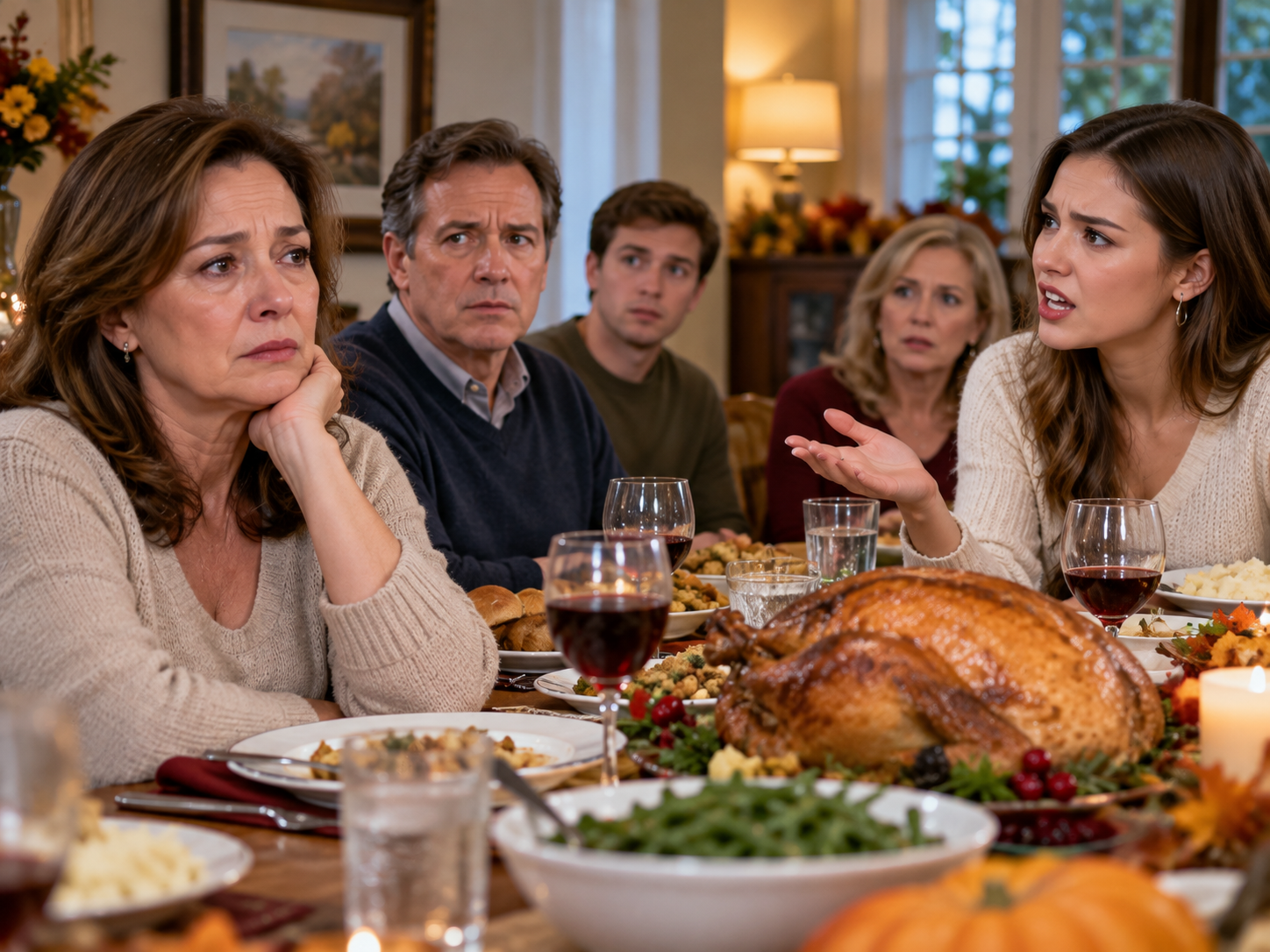
Click Here to continue read next: PART16: Years later, I finally understood what that Thanksgiving had really given me: not an ending, but the freedom to choose myself without hating anyone.
One careless sentence at Thanksgiving finally showed me what my husband had been expecting from me all along, and what he had never intended to give back.
Part 15 of 16

