
The request came on an ordinary Wednesday.
Richard called at seven in the evening.
I almost did not answer.
Something in me said to let it go.
But I picked up.
“Hello?”
“It's me.”
“I know.”
He laughed quietly.
“I suppose you do.”
“What do you need?”
There was a pause.
“I need a favor.”
I closed my eyes.
Of course.
Some things changed slowly.
“What kind?”
“I need you to sign something.”
My stomach tightened.
“What?”
“It's related to the house.”
“The house was settled.”
“I know.”
“Then what is this?”
He explained that he was refinancing part of the property with his new wife.
There was an old document that needed clarification.
He said my signature would make the process easier.
I told him to send everything to my attorney.
He sighed.
“I was hoping you would trust me.”
I looked around my kitchen.
The same kitchen where I had once reviewed his daughter's bills.
The same counter where I had discovered his email.
The same place where I had decided to leave.
“Trust isn't the issue.”
“What is?”
“Procedure.”
“You always have to make everything formal.”
“Yes.”
He was silent.
Then he said, “I miss when things were simple.”
I almost smiled.
“They weren't simple.”
“They felt simple.”
“Because I was carrying them.”
He did not argue.
That was progress.
He sent the document.
I forwarded it to my attorney.
She reviewed it.
There was no reason for me to sign.
She told me so.
I informed Richard.
He sounded disappointed.
“Are you sure?”
“Yes.”
“It wouldn't cost you anything.”
“That isn't the point.”
He sighed.
“I don't understand why you can't do one thing for me.”
I sat down.
Because I knew the answer.
“I have done many things for you.”
“I know.”
“And every time, I told myself it was one last thing.”
He became quiet.
I continued.
“This is exactly why I have to say no.”
He did not respond.
Then he said something unexpected.
“I understand.”
I waited.
“I don't like it.”
“I know.”
“But I understand.”
For the first time, I believed him.
We ended the call.
I thought that would be the end.
It wasn't.
A few days later, Brittany called.
“Dad told me you wouldn't sign.”
“I couldn't.”
“I know.”
She paused.
“He wasn't angry.”
“That is good.”
“He said he finally understands.”
I smiled.
“That would be good.”
Then she said, “He asked me whether you hate him.”
I laughed softly.
“What did you tell him?”
“I told him no.”
“That was kind.”
“I told him you just don't need him anymore.”
I stopped smiling.
That was exactly right.
Not hate.
Not revenge.
Needlessness.
There is a particular kind of freedom in no longer needing another person to validate your decision.
For years, Richard's opinion had mattered.
Whether he thought I was kind.
Whether he thought I was difficult.
Whether he thought I was loyal.
Whether he thought I was selfish.
Now those judgments could exist without controlling me.
I did not have to correct them.
I did not have to defend myself.
I simply had to live.
The following spring, I sold the old furniture I had kept from the marriage.
Not everything.
Some things had sentimental value.
Most did not.
I sold the dining table.
The chairs.
A cabinet.
A lamp.
The sofa.
The old bedroom set.
I replaced them slowly.
Not with expensive things.
With things I liked.
That was the strange pleasure of living alone.
I could choose something simply because I liked its shape.
No negotiation.
No compromise.
No explanation.
I bought a small wooden table for the kitchen.
It was imperfect.
One corner had a tiny mark.
I loved it.
I bought two chairs.
One for me.
One for whoever came over.
That felt like enough.
Carol helped me assemble them.
She held one side while I tightened the screws.
“This thing is crooked.”
“It isn't.”
“It is.”
“You're holding it crooked.”
“I am not.”
She looked at me.
“You're still controlling.”
I laughed.
“So are you.”
We finished the table.
Then we sat down.
Carol looked around the kitchen.
“You seem happy.”
“I am.”
“Really happy?”
“Yes.”
She nodded.
“Good.”
I looked at her.
“Do you think I was stupid?”
“For what?”
“For staying so long.”
She shook her head.
“No.”
“Why not?”
“Because you stayed until you understood.”
“That took years.”
“Some lessons do.”
I thought about that.
She continued.
“The important thing is that once you understood, you stopped lying to yourself.”
That sentence stayed with me.
Stopping the payments had been important.
Leaving had been important.
The divorce had been important.
But the deepest change had happened inside.
I stopped telling myself that endurance was proof of love.
I stopped calling silence peace.
I stopped calling exhaustion generosity.
I stopped calling being needed the same thing as being valued.
Those changes were invisible to everyone else.
They were everything to me.
Brittany visited that summer.
She came to my townhouse for lunch.
She had grown into a confident young woman.
She brought flowers.
“I didn't know what to bring.”
“You didn't have to bring anything.”
“I know.”
She placed them in a glass jar.
We ate on the patio.
She told me about her work.
Her apartment.
Her plans.
She was saving for a house.
I smiled.
“You're becoming responsible.”
She groaned.
“Don't say it like that.”
“How should I say it?”
“Like I'm impressive.”
“You're impressive.”
“Better.”
We laughed.
Then she became serious.
“I need to tell you something.”
“What?”
“I apologized to Dad.”
“For what?”
“For the way I treated you.”
I listened.
“What did he say?”
“He said he understood.”
“That sounds healthy.”
“It was strange.”
“How?”
“He didn't defend himself.”
I smiled.
“Maybe he learned something too.”
She looked at me.
“Do you think people can change?”
“Yes.”
“Even him?”
“Yes.”
“Do you trust him?”
I thought carefully.
“Trust isn't something I have to give him anymore.”
She understood.
That was enough.
We finished lunch.
Before she left, she hugged me.
“I love you.”
The words surprised me.
Not because they were unwelcome.
Because they were honest in a way they had never been before.
I hugged her back.
“I love you too.”
She pulled away.
Then she smiled.
“I'm still not calling you Mom.”
I laughed.
“I would be worried if you did.”
She drove away.
I watched until her car disappeared.
Then I went inside.
I washed the plates.
I put the glasses away.
I wiped the table.
The same motions.
A different life.
That evening, Richard sent me a message.
She had a good time.
I replied:
So did I.
Nothing more.
A few minutes later, he wrote:
Thank you.
I did not answer.
Not because I was angry.
Because there was nothing else to say.
The years afterward were ordinary.
That is perhaps the happiest part.
There were no dramatic returns.
No secret reconciliation.
No grand apology.
Life simply moved forward.
I watched Brittany build her career.
I watched Lucas settle into his own life.
Carol remained the person who could tell me I was overthinking something before I had finished explaining it.
I traveled a little.
I learned to paint.
I planted herbs in small pots by the kitchen window.
I joined a book club.
I discovered that I liked jazz.
I bought a chair that was completely impractical because it was comfortable.
Nobody complained.
Nobody asked what it cost.
Nobody told me it was unnecessary.
I sat in it whenever I wanted.
Sometimes I laughed at how small that freedom was.
Then I realized small freedoms are still freedoms.
One October evening, I sat in that chair with a cup of tea.
Outside, rain tapped against the windows.
My phone was on the table.
I looked at it.
No messages.
No emergencies.
No requests.
For a moment, I thought about how different that silence would once have felt.
Then I smiled.
The house was quiet.
Not empty.
Quiet.
There was a difference.
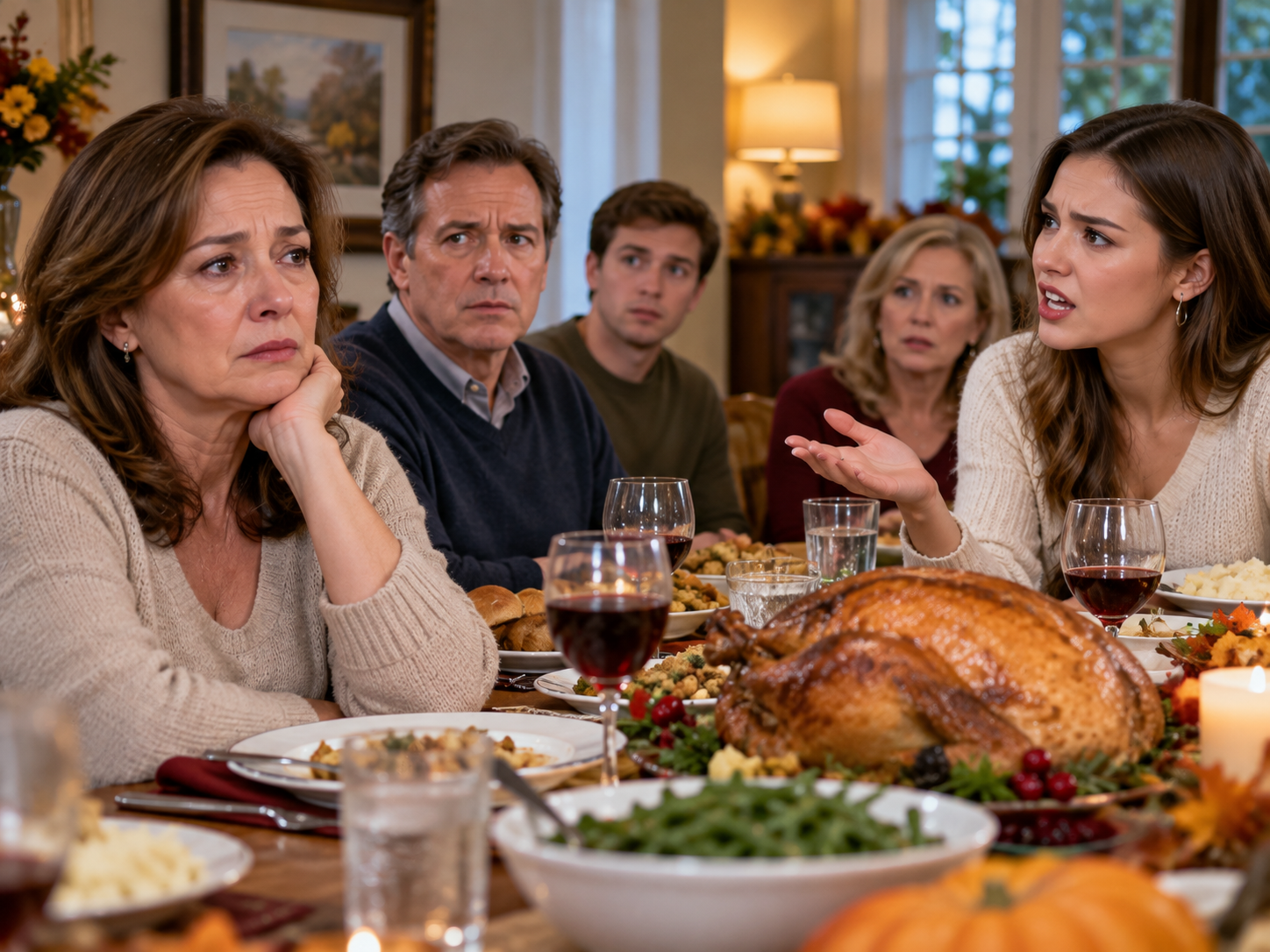
I thought about the Thanksgiving dinner years earlier.
The sentence.
The insult.
Richard's silence.
The folder.
The email.
The first time I removed my payment information.
The café.
The divorce.
The account.
The legal letters.
Brittany's graduation.
The final request.
All of it seemed connected now.
Not because everything had happened according to some perfect plan.
It hadn't.
I had made mistakes.
Richard had made mistakes.
Brittany had made mistakes.
But the truth had eventually become impossible to ignore.
I had spent seventeen years believing that keeping the peace was one of the central duties of love.
It wasn't.
Love could survive disagreement.
Respect could survive boundaries.
A family could survive saying no.
What could not survive was one person continually shrinking while everyone else grew comfortable.
That was what had happened.
And when I finally stopped shrinking, the marriage could not continue.
At the time, I thought that meant I had failed.
Years later, I understood something else.
Sometimes a relationship ends because one person finally becomes honest about what it has already become.
That honesty can feel like destruction.
It can look like selfishness.
It can frighten people who benefited from the old arrangement.
But truth does not become cruelty simply because someone dislikes hearing it.
I finished my tea.
I stood.
I turned off the lamp.
Before going upstairs, I paused in the kitchen.
The little wooden table stood near the window.
Two chairs.
One empty.
One mine.
I smiled.
The second chair mattered.
Not because I needed someone to fill it.
Because I had finally learned that making room for another person was different from giving them control of the whole house.
That was the lesson I had been missing.
I could love people without carrying them.
I could help without surrendering responsibility for my own life.
I could forgive without returning.
I could remember without returning to the place where I had been hurt.
And I could sit alone without feeling abandoned.
The next morning, I woke before sunrise.
I made coffee.
Two scoops.
A little too strong.
I opened the curtains.
The sky was pale gray.
For a moment, I stood there listening to the quiet.
Then my phone buzzed.
A message from Brittany.
Good morning. Hope you have a beautiful day.
I smiled.
I replied:
You too.
I put the phone down.
No explanation.
No obligation.
No problem to solve.
Just a message from someone whose life had once been tangled with mine and now existed beside it.
I carried my coffee to the kitchen table.
I sat in my chair.
Outside, the day began.
And for the first time in a very long time, I did not wonder what I was supposed to do for everyone else.
I simply wondered what I wanted to do with my own day.
That question felt ordinary.
It also felt like freedom.
Click Here to continue read next: PART9: The life I thought had finally settled was interrupted by one unexpected visit, and this time Richard arrived carrying a truth I could not dismiss.
One careless sentence at Thanksgiving finally showed me what my husband had been expecting from me all along, and what he had never intended to give back.
Part 8 of 16

