
The first formal questions were not dramatic.
They were precise.
Where had the baby been found? Who had been present? What had been touched? What had been moved? When had the foster father entered the room? When had the baby been removed from the sink? Who had handled the hospital band?
I answered each question as carefully as I could.
The person taking my statement did not seem interested in making the story sound worse than it was. That helped. I had already learned that the facts were disturbing enough without exaggeration.
I described the kitchen exactly as I remembered it.
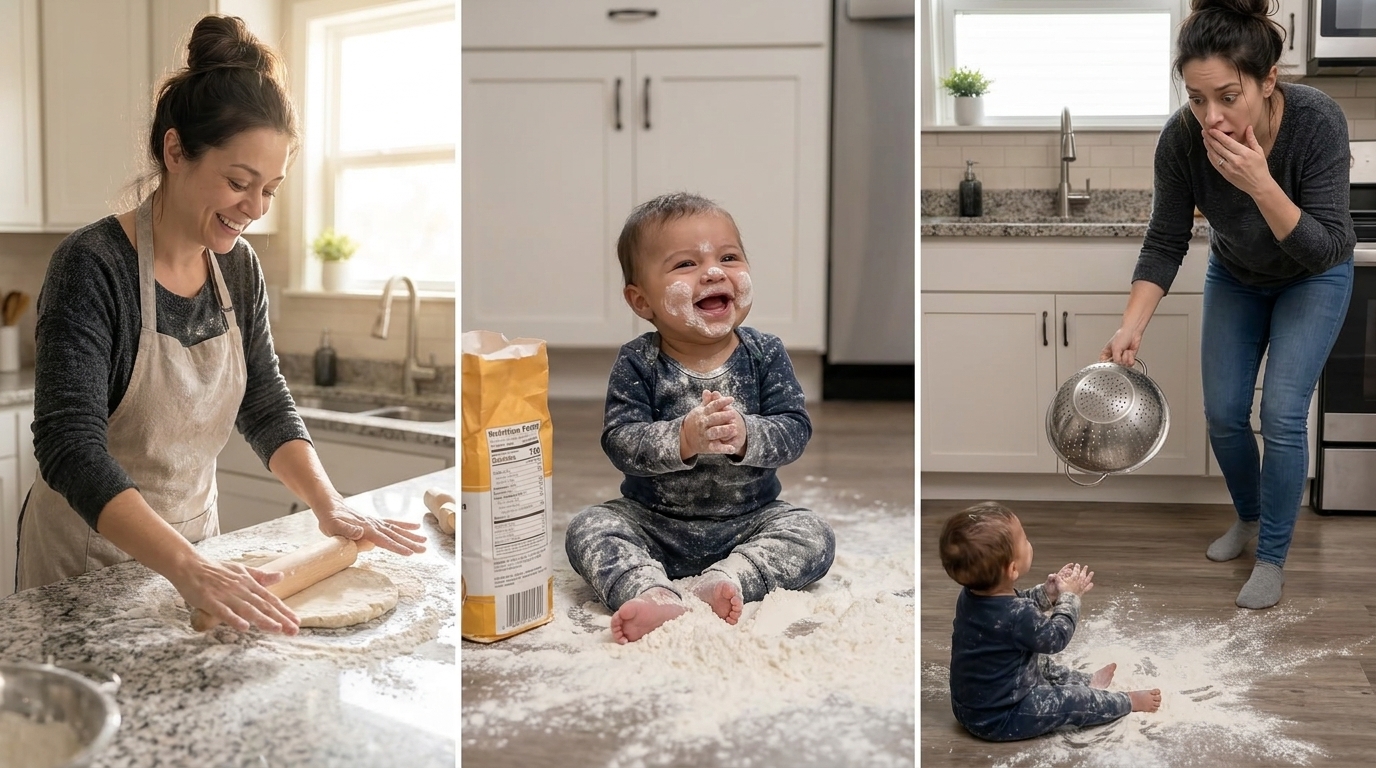
The sink was against the wall. The colander had been upside down over the baby. Flour covered parts of the blanket and floor. A yellow rubber glove remained nearby. One sock was missing. The baby's ankle carried a red ring that looked too even to be an ordinary crease.
Then I described the hospital band.
I explained where I found it and how it had been wrapped around the missing sock.
I did not say what I thought it meant.
That was important.
I had thoughts, of course. Anyone would. But a thought was not evidence, and I had become painfully aware of how quickly fear could turn a question into a conclusion.
The person taking my statement asked about the foster mother.
I told the truth there too.
She had attacked me from behind.
My cheek had struck the cabinet.
She had moved toward me again.
I had believed another attack was coming.
I had picked up the stone mortar and struck once.
Then I stopped.
The person writing everything down looked up.
“You didn't strike her again?”
“No.”
“Did you pursue her?”
“No.”
“Why did you stop?”
“The baby was there.”
The answer came more quickly than I expected.
There was nothing complicated about it.
Whatever anger I had felt disappeared the moment I understood that the struggle itself could put the newborn in greater danger.
Afterward, I thought about how easily that part could have been misunderstood.
Someone looking only at the aftermath might see two adults, an injured face, a stone mortar, and a confrontation.
Someone who looked at the entire sequence would see something different.
A newborn had been found in an unsafe position.
An adult had tried to stop the person who uncovered him.
The person who intervened had defended herself once and then stopped.
The baby's safety had remained the central concern.
His foster father understood that.
He repeated his own account without changing it.
He had entered the kitchen and found his wife holding the screaming newborn.
He had seen me injured.
He had taken the baby from her.
He had heard my explanation.
He had seen the second hospital band.
He did not pretend that he had witnessed what happened before he entered.
That restraint mattered.
He could have guessed.
He could have repeated something his wife told him.
He could have filled gaps with assumptions.
Instead, he separated what he knew from what he did not.
When the questions turned toward his wife, he became quiet.
She had her own explanation for the objects in the kitchen.
The flour had been ordinary household flour.
The colander was an ordinary kitchen utensil.
The blanket could have caused a mark.
The missing sock could have fallen.
The hospital band, she said, had no significance that she was willing to discuss.
That last answer created more discomfort than the others.
If the band had no significance, why had it been there?
If it had belonged to another infant, why had it been kept?
And why had it been wrapped around the current baby's sock beneath the cabinet?
No one answered those questions immediately.
The records had to be checked.
The name on the band was entered into the review.
The result came back as something both important and limited.
The band belonged to another newborn who had previously been connected to the same caregiving system.
That fact widened the inquiry.
It did not prove that the earlier baby had been harmed.
It did not prove that the same thing had happened before.
It did not explain why the band had been retained.
But it established a connection that could not reasonably be ignored.
The foster father heard the information and lowered his eyes.
“I've never seen that name before,” he said.
He had said the same thing in the kitchen.
His answer had not changed.
That consistency seemed to trouble him more than the discovery itself.
He realized that something connected to another infant had been inside his home without his knowledge.
The household he thought he understood suddenly contained a piece of history he had never seen.
He was asked whether he wanted to change his statement.
He looked exhausted.
“No.”
The answer was quiet.
The person speaking with him waited.
He continued.
“I've told you what I saw. I don't want to add things I didn't see, but I don't want to take anything back either.”
That was the moment I understood what his decision would cost.
He was not choosing between his wife and a stranger.
He was choosing between silence and the baby's immediate safety.
There was no applause for that decision.
No dramatic transformation.
He simply sat there with his hands clasped together and looked like a man who had discovered that protecting someone could require admitting how badly he had failed to notice what was happening around him.
The newborn was moved out of the immediate situation while the review continued.
His foster mother was not allowed unsupervised access to him.
That decision brought relief.
It also left a strange emptiness behind.
For days, I had expected to hear the baby's cry again.
Instead, the rooms around me were quiet.
The quiet should have helped.
It did not.
At night, I remembered the colander.
I remembered lifting it and seeing the baby's face.
I remembered how the metal had felt in my hands.
It had been light.
That bothered me.
Something so ordinary had covered something so vulnerable.
I kept thinking about how close the scene had come to disappearing.
If I had entered the kitchen later, the baby might have been moved.
The blanket might have been cleaned.
The sock might have been put back on.
The hospital band might have been removed.
Nothing about the sink would have looked remarkable.
That thought made me understand why evidence mattered.
Not because every object contains a secret.
Most objects do not.
But when several ordinary details appear together in a disturbing sequence, each one can help preserve what would otherwise be forgotten.
The missing sock was one of those details.
It did not look important.
It did not announce itself.
It simply lay beneath the cabinet.
Yet it had led to the second hospital band.
The band had led to the records.
The records had led backward to another infant.
And that connection had made it impossible to treat the kitchen as an isolated argument.
The review continued.
The baby's medical notes were examined.
My injury was documented.
The physical objects were retained.
Statements were compared.
Dates were checked.
Nothing moved as quickly as fear.
But something was moving.
The truth was being separated from assumption one small fact at a time.
Click Here to continue read next: PART6: The Earlier Infant’s Records Changed the Question Completely, but They Refused to Give Fear the Answer It Wanted
The Cry Behind the Cabinet Door Forced Me to Lift an Ordinary Kitchen Colander
Part 5 of 8

