
The earlier infant's records arrived without the dramatic revelation I had imagined.
That was almost a relief.
I had spent too many days wondering whether the unfamiliar name on the hospital band would uncover another hidden incident.
Instead, the records showed a more complicated truth.
The infant had indeed been connected to the same caregiving system.
The hospital band belonged to that child.
But there was no evidence presented to me that the child had suffered the same treatment the newborn had experienced in the kitchen.
I remember sitting quietly after hearing that.
Part of me felt disappointed.
Another part felt grateful.
Fear had been waiting for confirmation.
It did not deserve one merely because the circumstances were frightening.
The facts were enough.
The earlier infant's identity explained where the hospital band came from.
It did not explain how the band had ended up beneath the sink.
That remained a separate question.
The review therefore changed direction.
Instead of asking whether the second baby had definitely suffered the same thing, people asked what had happened to the hospital item after the earlier placement ended.
Who had retained it?
Why had it remained in the household?
Why had it been kept with the current baby's sock?
And why had the foster father known nothing about it?
Those were narrower questions.
They were also more useful.
The foster mother was asked about the band again.
Her explanation remained incomplete.
She did not provide a clear reason for keeping it.
She offered explanations for other objects but did not make the second band disappear simply by refusing to discuss it.
The evidence remained.
So did the questions.
I found myself thinking about how differently the story might have developed if I had decided that the band proved everything.
I could have convinced myself that every unexplained detail belonged to one larger secret.
I could have taken the earlier infant's history and filled the empty spaces with the worst possibility.
But that would have turned fear into a storyteller.
And fear is not reliable.
The investigators seemed to understand that better than I did.
They kept returning to what could be established.
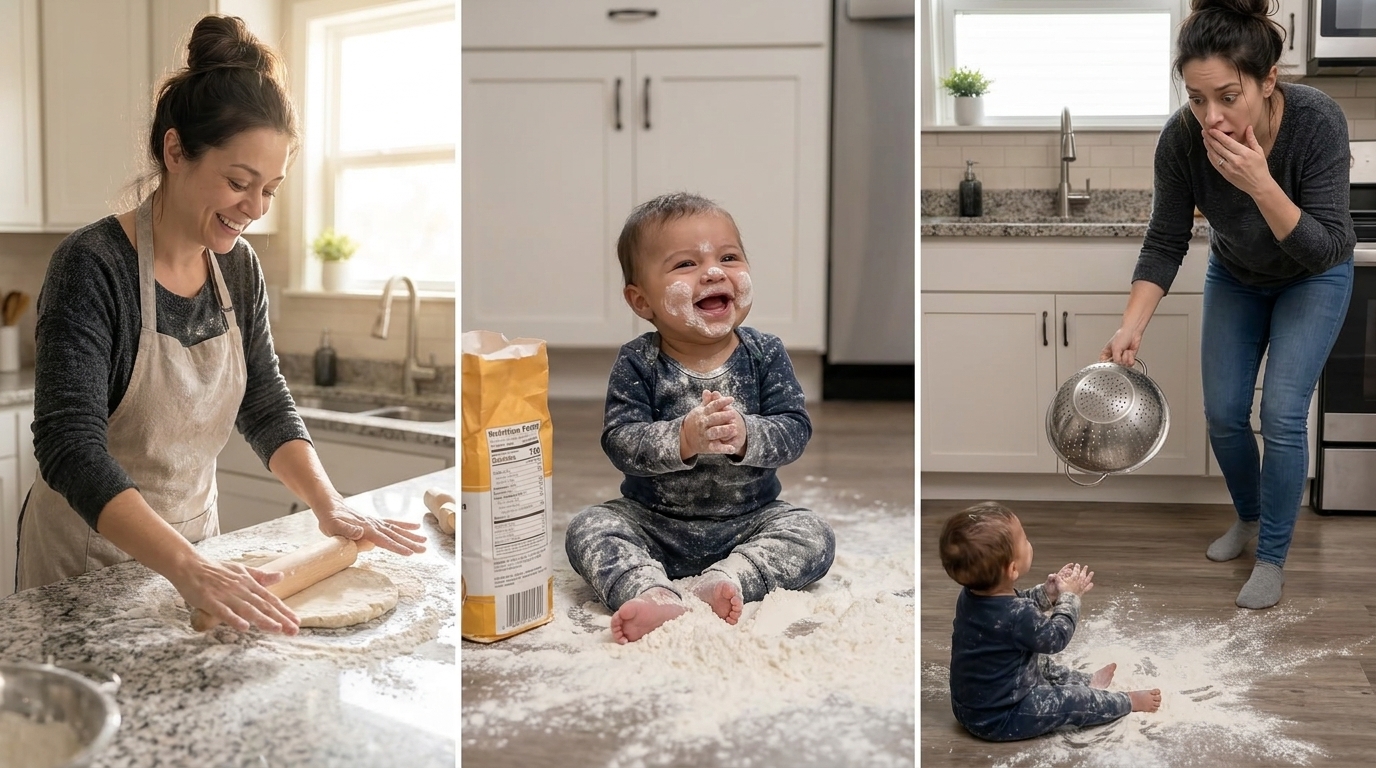
The current baby had been found beneath the colander.
That was established.
The blanket had been dusted with flour.
That was established.
The ankle carried a pressure ring.
That was established.
The baby had been grabbed during the confrontation.
That was established.
The foster mother had attacked me.
That was established.
I had struck once with the mortar.
That was established.
The second hospital band belonged to another newborn.
That was established.
The rest required caution.
That distinction gradually became one of the most important parts of the whole experience.
The foster father struggled with it.
He wanted answers too.
Sometimes he wanted them faster than the evidence could provide them.
One evening, he sat with me and rubbed his palms together.
“I keep thinking there has to be one explanation,” he said.
“Maybe there isn't one.”
He looked at me.
“What do you mean?”
“Some things may connect. Some may not. We have to let the facts show us.”
He looked toward the floor.
“I hate that answer.”
“So do I.”
For a moment, neither of us spoke.
Then he said, “I should have noticed.”
I knew what he meant.
He had lived in that house.
He had trusted the person beside him.
He had assumed that the baby was safe.
Those assumptions had protected him from noticing things that, in hindsight, seemed impossible to ignore.
But hindsight is cruel.
It gives ordinary details a meaning they did not have before the truth became visible.
Before the incident, a colander was a colander.
A missing sock was a missing sock.
A glove was a glove.
A bag of flour was a bag of flour.
Afterward, every object seemed to be waiting for an explanation.
I understood why he felt guilty.
Still, guilt could not change the past.
What mattered now was what he did next.
He continued cooperating.
He did not ask anyone to soften the report.
He did not pressure me to change my statement.
He did not defend his wife by inventing a version of the kitchen that neither of us had seen.
That did not erase his earlier failure to notice.
But it mattered.
The baby's safety came first.
The newborn remained away from the situation while the adults responsible for his care were reviewed.
The foster mother had no unsupervised access.
The foster father continued to provide information.
And the investigation kept the hospital band with the other collected evidence.
I sometimes wondered whether the little object would have seemed important to anyone else.
It was only a narrow strip of material.
The printed information was small.
The edges had softened from handling.
Yet it had crossed from one baby's history into another baby's immediate life.
That was what made it disturbing.
An identifying object should belong to a particular record and a particular person.
It should not become something hidden in a kitchen.
The band did not need to prove abuse to raise a legitimate concern.
It raised questions about boundaries.
It raised questions about how personal information had been handled.
It raised questions about what had been retained after a previous placement.
And it raised questions about why the current baby had been involved at all.
Those questions were enough.
The current baby's situation was already serious.
No additional tragedy needed to be invented.
As the weeks passed, my physical injury improved.
The swelling beneath my eye faded.
The bruising changed color.
Eventually, I could look in a mirror without immediately seeing the kitchen.
But certain sounds still brought it back.
The scrape of metal against a sink.
A cabinet door slamming.
A baby crying suddenly from another room.
Even the soft rustle of a blanket sometimes made my hands tense.
I disliked that.
I wanted the memory to become smaller.
Instead, I had to learn how memory works.
It does not always shrink because we command it to.
Sometimes it becomes less painful only after we stop fighting it.
I began to separate the pieces.
There was the baby.
There was the confrontation.
There was the second hospital band.
There was the earlier infant.
There were the unanswered questions.
They belonged to the same story, but they did not all have the same answer.
That realization gave me some peace.
I no longer needed the hospital band to explain everything.
It had already explained something important.
It had shown that another infant was part of the household's history.
It had shown that an identifying item from that infant had been retained and hidden with the current baby's missing sock.
That was enough to justify looking backward.
The records did not reveal the nightmare I had feared.
I accepted that.
The absence of proof was not something to be disappointed by.
It was something to respect.
The foster father eventually had to return to the house with other people present to collect belongings.
He told me afterward that the kitchen felt unfamiliar.
“The sink is the same,” he said.
“I know.”
“The cabinet is the same.”
“I know.”
“But I can't look at it the same way.”
I understood.
A place can remain physically unchanged while becoming emotionally impossible to recognize.
The colander was gone.
The flour had been cleaned.
The cabinet had been wiped.
The yellow glove was no longer there.
The room had been returned to ordinary life.
But the memory remained.
The missing sock remained preserved with the other collected items.
He told me that when he saw it, he understood how strange the whole thing had become.
A tiny piece of clothing had become the thread connecting the immediate incident to an earlier chapter of the household's history.
Without it, the story might have ended at the kitchen.
With it, people had looked backward.
That was the value of a clue.
Not that it tells you everything.
That it tells you where to look next.
Click Here to continue read next: PART7: Time Took Away the Bruise, but the Baby’s Bare Foot Kept Returning Until One Final Visit Made the Memory Bearable
The Cry Behind the Cabinet Door Forced Me to Lift an Ordinary Kitchen Colander
Part 6 of 8

