
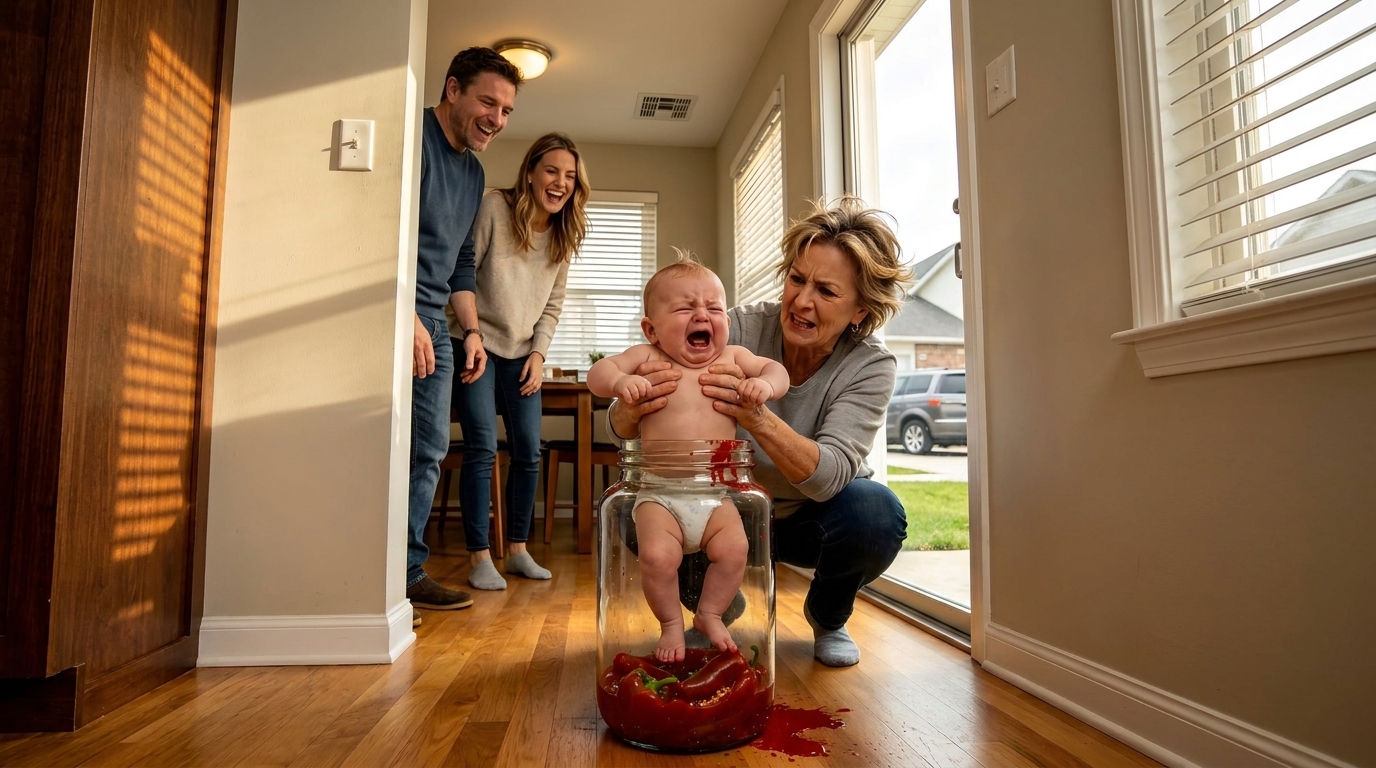
The house was quiet the next morning.
The father woke before sunrise and lay awake for several minutes, staring at the ceiling. The previous day returned in fragments—the baby crying, Grandma falling, the jar against the table, his girlfriend standing by the door, the phone in the responder's hand.
For once, he did not search for a better explanation.
He remembered what he had done.
He got out of bed and walked into the kitchen.
The chair near the dining table was still crooked.
He straightened it.
Then he stopped.
He had spent years believing that fixing something meant putting it back exactly where it had been.
The chair could be straight again.
The table could be cleaned.
The broken rhythm of the room could look ordinary.
None of that would undo what happened.
His phone remained silent.
He did not message his girlfriend.
He did not call Grandma.
He made coffee and sat alone.
Later that morning, he received instructions about the next steps he needed to take. There would be conversations he could not avoid, consequences he could not negotiate away, and boundaries he would have to respect whether he liked them or not.
He accepted them.
Not gracefully.
Not happily.
But without arguing.
That was the beginning.
Grandma spent the morning resting with the baby nearby. Her hip still hurt when she stood, and the bruise on her arm had darkened. She thought about her son more than she wanted to.
She loved him.
That had never changed.
But love did not require pretending.
Her daughter-in-law—her son's girlfriend—had been frightened enough to ask for help. The baby had been caught in an adult conflict. Grandma had been placed in the middle of it and had fallen while trying to keep the child safe.
She could not erase those facts simply because the person responsible was her son.
The girlfriend stayed with her sister.
She did not know what the future would hold.
She only knew what she needed immediately: distance, safety, and time to think without someone standing in front of a door telling her she could not leave.
That boundary was respected.
The father wanted to contact her.
He did not.
He wanted to explain that he had never intended to hurt anyone.
He did not send it.
He wanted to say that he loved the baby.
He knew that saying it repeatedly would not prove anything.
Instead, he began doing the harder work.
He accepted responsibility for the controlling behavior that had existed before the incident.
He acknowledged that the jar had not appeared from nowhere.
It had been one terrible choice inside a pattern of smaller choices he had previously dismissed.
That realization frightened him more than the responders had.
Because it meant the solution could not be as simple as apologizing for one afternoon.
He had to change the person who had thought blocking a door was acceptable.
Days passed.
The family remained cautious.
Grandma eventually spoke with him.
They sat outside, separated by a small table.
He did not touch her.
“How is your hip?” he asked.
“Better.”
He nodded.
“I've been thinking about what you said.”
“Which part?”
“That forgiveness isn't the first thing.”
Grandma looked at him.
“What did you learn?”
He took a breath.
“That I keep wanting forgiveness because it would make me feel better.”
She said nothing.
“And that's selfish.”
“Yes.”
“I need to accept that you may be angry with me for a long time.”
“Yes.”
“That she may never trust me the same way.”
Grandma nodded.
“And that seeing my son isn't something I can demand.”
Her expression softened slightly.
“No.”
He looked down.
“I miss him.”
“I know.”
“I don't want him to grow up afraid of me.”
“Then don't give him a reason to be.”
The father nodded.
That was all she said.
There was no dramatic reconciliation.
No embrace.
No promise that everything would return to normal.
Instead, there was something more honest.
A boundary.
And a possibility.
Weeks later, the family met again under very different circumstances.
The baby was older by only a little, but the change seemed enormous to the father.
He stood several feet away.
Grandma held the child.
The girlfriend remained nearby.
The father waited.
He did not ask to hold the baby.
Grandma looked at him.
“You can sit.”
He sat.
The baby looked toward him.
The father smiled.
“Hi.”
The child moved his hands.
The father laughed softly.
It was the first easy sound anyone had heard from him in a long time.
The girlfriend watched carefully.
He did not move closer.
He understood now that trust was something the other person decided to offer.
Not something he could force.
Grandma eventually placed the baby in a safe seat nearby.
The father remained seated.
“I want to thank you,” he said.
“For what?”
“For stopping me.”
Grandma looked at him.
“You shouldn't have needed stopping.”
“I know.”
“And you should never forget that.”
“I won't.”
The girlfriend spoke quietly.
“I don't know what our relationship will become.”
He nodded.
“I understand.”
“I may need a long time.”
“I understand.”
“I may say no.”
“I understand.”
She studied him.
“You really mean that?”
“Yes.”
He looked at the baby.
“I finally understand that your no isn't something I have to defeat.”
She said nothing.
But she did not leave.
That was enough for that day.
The central wound did not disappear.
The bruise on Grandma's arm faded.
Her hip improved.
The scratch on the dining table remained for a while before being repaired.
But the memory stayed.
The father continued working to change his behavior. He learned to recognize anger before it became action. He learned that fear of losing someone did not give him ownership over them. He learned that an apology without changed behavior was only another form of asking someone else to make him comfortable.
The family did not pretend the incident had never happened.
They spoke about it when necessary.
They also stopped allowing it to define every moment.
The baby grew.
The father remained part of his life only within boundaries that others considered safe.
He accepted those boundaries.
That acceptance became the most meaningful proof that he had changed.
One evening, months after the incident, Grandma returned to the dining room alone.
She looked at the table.
The scratch had been repaired.
The chair stood straight.
The room looked ordinary again.
But she knew better.
She remembered the fear.
She remembered the jar.
She remembered her son standing in the doorway afterward, trying to make the truth smaller.
Then she remembered the day he finally stopped.
The father had not become a different person overnight.
There had been no single sentence that repaired everything.
There had only been choices.
Some terrible.
Some better.
And, eventually, enough better choices to create the possibility of trust again.
The baby began crying from the next room.
Grandma smiled and went to him.
Outside, the father was waiting for his scheduled time to see his child.
He did not knock repeatedly.
He did not demand that anyone open the door.
He waited.
When the door finally opened, he entered only after being invited.
He looked at the baby.
Then at Grandma.
Then at the child's mother.
“Thank you,” he said.
She nodded.
He sat down.
The baby reached toward him.
The father waited for permission.
When it came, he held out his hands.
The child was placed carefully into them.
The father looked down at his son and closed his eyes for a moment.
There was no triumph in his face.
Only relief, gratitude, and the weight of knowing how close he had come to losing the right to be there.
He held the baby gently.
The child settled against his chest.
Grandma watched.
She did not forget the day her son had raised that jar.
She never would.
But she also recognized something important.
The truth had not destroyed the family.
The lies had nearly done that.
Once the truth was spoken, everyone finally knew what had to change.
And the father understood the lesson he had resisted from the beginning: love was not measured by how tightly he could hold on to someone.
It was measured by whether they were free to feel safe in his presence.
He looked down at his son.
“I'll do better,” he whispered.
This time, he did not make the promise to persuade anyone.
He made it to remind himself what the rest of his life would require.
The baby reached up and touched his face.
The father smiled.
And for the first time since the jar struck the table, the room was quiet for a reason that did not frighten anyone.
The End
Read more original stories on Feel Every Story.
The Jar Was Still on the Table When the Father Gave an Explanation That Made Everyone Stop Listening
Part 8 of 8

