
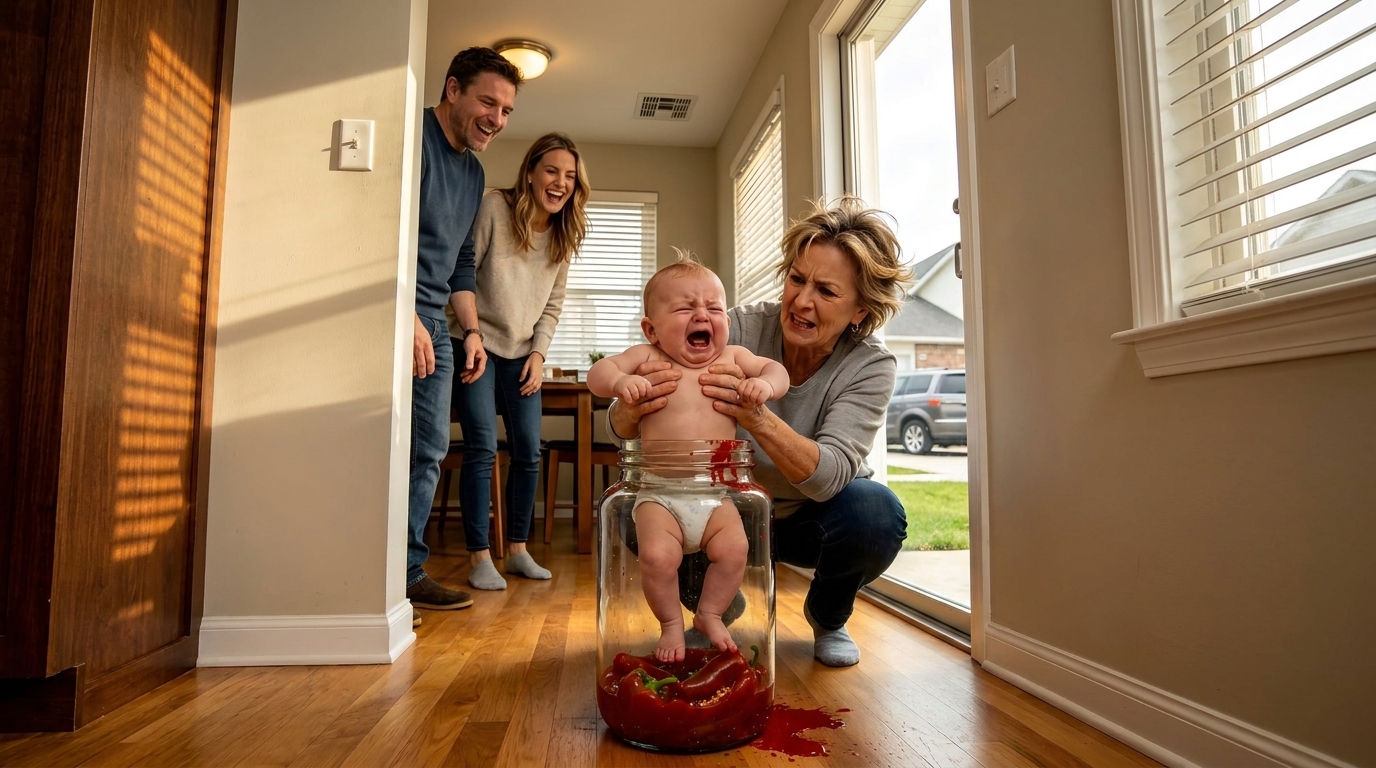
Grandma kept her eyes on the father while the room waited for him to answer. She did not raise her voice. She did not need to. Her certainty had already changed the atmosphere.
“You opened the back door,” she said.
The father shook his head.
“You looked inside.”
“No.”
“You saw me.”
“I didn't.”
“You spoke to her.”
His girlfriend, standing near the wall, shifted uneasily.
The father noticed.
He turned toward her for half a second before facing Grandma again. “Mom, you need to stop.”
“I saw you.”
“You were on the floor.”
“I wasn't blind.”
The responder stepped between the rising voices without physically moving into anyone's space. “Let's slow this down.”
Grandma nodded.
The father did not.
He looked toward his girlfriend. “Tell them.”
She swallowed.
“Tell them what?” she asked.
“That I wasn't inside.”
Her eyes flicked toward the floor.
“I don't know.”
The father stared at her.
“You were there.”
“I was there.”
“So you know.”
“I know I was frightened.”
“That isn't what I asked.”
The responder lifted a hand. “Nobody needs to answer for someone else.”
The father exhaled through his nose and stepped away from the table.
For the first time, the witness noticed that he had been avoiding the back door.
It stood open behind him.
A strip of afternoon light fell across the floorboards and stopped beneath the table. Near the threshold was a small smear of dirt, as if someone had stepped inside and then turned around. The witness remembered seeing the door open earlier. At the time, it had seemed meaningless.
Now it did not.
The responder followed the witness's glance.
“You said he came through that door?”
The witness nodded. “Yes.”
“When?”
“I can't give you an exact time.”
“Before the incident?”
The witness hesitated.
“I heard the baby crying first. Then I saw him.”
The father immediately interrupted. “No. You didn't.”
The responder turned toward him. “Let them finish.”
The witness took a breath. “He was at the door. He looked inside.”
“What did he do?”
“Nothing at first.”
“Did he say anything?”
“I couldn't hear him.”
Grandma answered for them. “He said something to her.”
The father turned sharply. “You couldn't have heard that.”
“I did.”
“You were on the floor.”
“I was conscious.”
He stepped toward her. “You don't understand what you're saying.”
She looked up at him. “I understand exactly what I'm saying.”
The baby stirred in her arms.
She immediately lowered her voice.
“He looked at you,” she told the father. “Then he looked at the baby. Then he said something to her.”
His girlfriend's face tightened.
The responder noticed.
“What did he say?”
Grandma shook her head. “I don't remember every word.”
The father gave a short breath that almost sounded like relief.
“But I remember what happened next,” she continued.
His expression changed again.
“You walked away.”
He stared at her.
“You didn't come toward the baby,” she said. “You didn't ask if I was hurt. You didn't ask why the baby was crying.”
The father swallowed.
“You left.”
“I went outside because I thought someone else was already helping.”
“No.”
“Mom—”
“You saw.”
He looked away.
The responder remained silent for several seconds.
Then they asked, “Why did you tell us you were outside the entire time?”
The father looked back.
“I was outside.”
“That isn't what I asked.”
“I told you what I remembered.”
“Your memory has changed twice.”
“No, it hasn't.”
“You first said you didn't know what happened. Then you said you saw the jar afterward. Now you're saying you were outside.”
“I was outside.”
“Were you ever inside before the intervention?”
The father hesitated.
His girlfriend closed her eyes.
That tiny movement was enough to make the witness look at her.
The father saw it too.
“Why are you doing that?” he asked her.
She opened her eyes. “Doing what?”
“Looking at the floor.”
“Because everybody is staring at me.”
“Because you know what happened.”
“I know what I saw.”
The father’s voice dropped. “Then say it.”
She didn't.
The responder stepped closer. “You don't have to be pressured into answering.”
The father turned away.
Grandma watched him carefully.
“He's trying to make this smaller,” she said.
He spun around. “I am trying to keep everyone from destroying this family over something that happened in seconds.”
Grandma's expression did not change.
“You don't protect a family by changing what happened.”
He looked wounded for the first time.
“Do you really think I wanted this?”
“No.”
The answer seemed to surprise him.
Grandma adjusted the blanket around the baby.
“I think you wanted something else.”
He stared at her.
“What?”
“You wanted not to be responsible for what you saw.”
The room became silent.
The responder looked down at their notes.
The father laughed once, without humor. “That's ridiculous.”
“Then prove me wrong.”
“How?”
“Tell the truth.”
He looked at the open back door.
No one spoke.
Then the responder asked, “When you came through that door, what did you see?”
The father did not answer.
“Was Grandma already on the floor?”
Silence.
“Was the baby crying?”
Silence.
“Was the jar in someone's hand?”
His lips parted.
The witness could see his throat move.
Finally he said, “I don't remember.”
Grandma's eyes closed.
The father immediately added, “Everything happened so fast.”
The responder wrote something down.
That bothered him.
“What are you writing?”
“Your answer.”
“You're making this sound worse than it was.”
“We're recording what people tell us.”
“People are confused.”
“Then consistency will help.”
The father stared at the responder.
The responder continued calmly. “If this was an accident, the sequence should not be difficult to explain.”
The father looked toward his girlfriend again.
She whispered, “Please don't.”
He heard her.
“So you do remember,” he said.
She shook her head.
“I remember enough.”
He walked toward her.
The responder stepped between them.
“Stay where you are.”
The father stopped.
For several seconds, nobody moved.
Then the baby began crying again.
Grandma immediately turned away from the argument.
“It's all right,” she murmured. “You're safe.”
The witness watched her face as she rocked him.
The father watched too.
Something passed through his expression—fear, perhaps, or regret—but it disappeared quickly.
The responder picked up the jar.
“This needs to be kept aside.”
The father nodded.
“Fine.”
“And I need to ask you for something else.”
“What?”
“Your phone.”
The father's hand moved automatically toward his pocket.
The responder noticed.
He noticed that they noticed.
“Why?”
“Because I need to establish the timeline.”
“You think my phone has something to do with this?”
“I don't know.”
The father didn't take it out.
Grandma looked at his hand.
His girlfriend did too.
The witness suddenly remembered another detail: when the father had first appeared at the back door, he had looked down at his phone before looking into the room.
At the time, nobody had thought anything of it.
Now the memory felt different.
The responder held out a hand.
“Your phone.”
The father stared at it.
Then he slowly reached into his pocket.
He took the phone out.
But he did not hand it over.
He simply held it.
And in that pause, everyone in the room understood that whatever was on the screen mattered to him more than he wanted them to know.
Click Here to continue read next: PART3: He Had One Last Chance to Keep the Timeline Simple, but the Phone in His Hand Made Silence More Dangerous Than Any Answer
The Jar Was Still on the Table When the Father Gave an Explanation That Made Everyone Stop Listening
Part 2 of 8

