
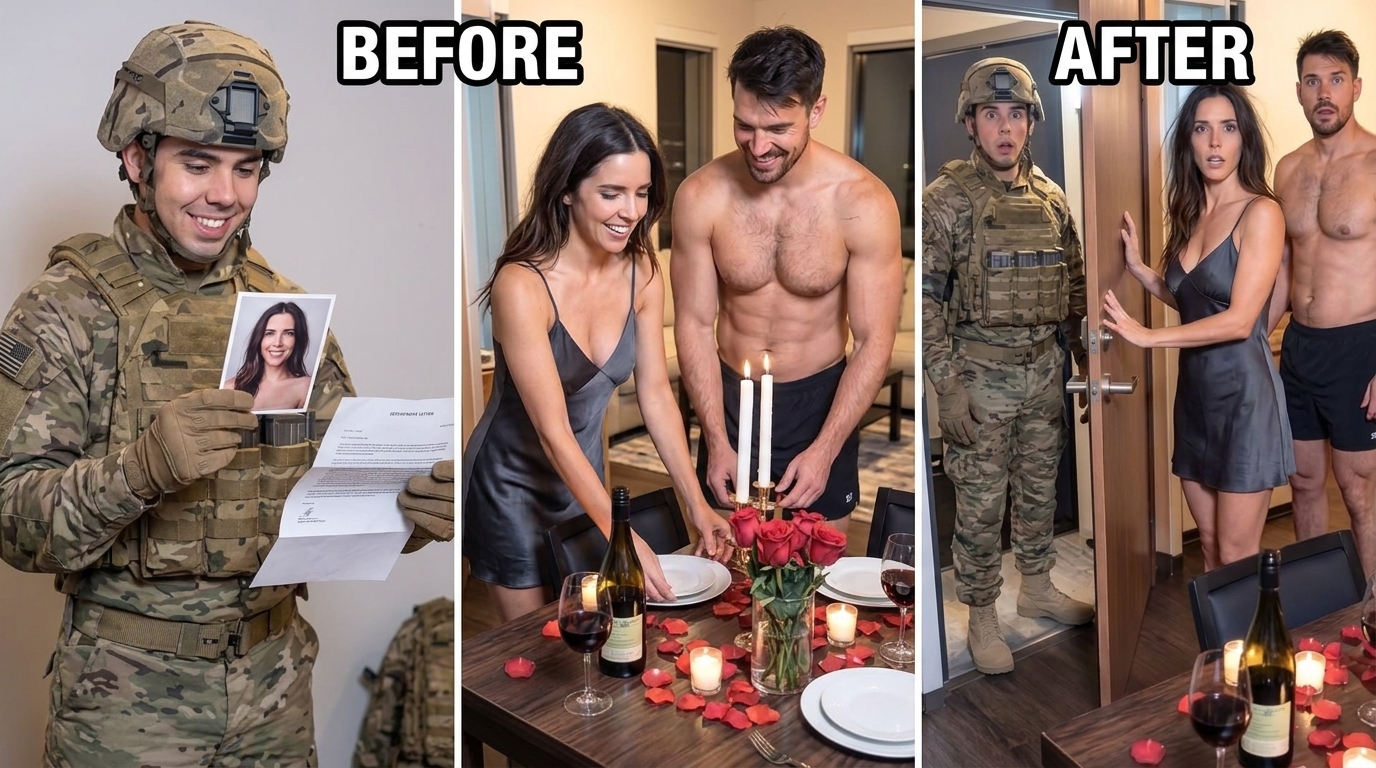
The message arrived a little after midnight, when the base had settled into the dull mechanical rhythm that made one day of deployment feel indistinguishable from the next. I was sitting on the edge of a narrow cot, boots still on, when my phone vibrated against the metal frame. The name on the screen was Haley. My fifteen-year-old daughter almost never messaged me that late unless something mattered.
I opened it expecting a question about school or perhaps one of those small updates she sent when she missed me. Instead, I saw a sentence that made me sit upright.
“Dad, I need to tell you something, but I’m scared.”
My thumb hovered over the keyboard. The noise around me suddenly seemed louder—the ventilation system rattling overhead, someone talking near the doorway, the distant clank of equipment being moved outside. I typed the first thing that mattered.
“Whatever it is, sweetheart, tell me. Are you safe?”
The reply came quickly.
“I’m safe. It’s about Mom.”
For several seconds, I stared at those four words. Kendra was my wife. We had been married for eight years. She was the person I had trusted to keep our home steady while I was away, the person who sent me photographs of the kids, complained about grocery prices, and told me she was counting the days until I came back.
I asked Haley what had happened.
She began typing, stopped, erased something, then started again. The little bubbles appeared and disappeared more than once. Finally, she wrote that her mother had been bringing men to the house.
Not one man.
Different men.
Some came during the evening. Some stayed late. According to Haley, at least some had remained until morning.
I read the message twice before my mind allowed me to understand it. Then I leaned forward, elbows on my knees, and looked at the floor between my boots.
“Are you sure?” I asked.
Haley answered almost immediately.
“Yes. I’ve seen them.”
Then came another message.
“I’m sorry I didn’t tell you before.”
I closed my eyes. My first instinct was anger, but I pushed it aside because the person on the other end of the phone was my daughter. Whatever had happened between Kendra and me, Haley had not caused it.
“You have nothing to apologize for,” I wrote. “You did the right thing by telling me.”
She asked whether I was angry with her.
That question hurt more than the accusation against Kendra. A fifteen-year-old girl had been carrying something she clearly believed might destroy her family, and now she was worried her father would blame her for speaking.
“Never,” I replied. “I’m proud of you for telling me. How have you been dealing with this?”
She told me she usually stayed in her bedroom when someone came over. She put on headphones, turned up her music, and tried to make herself invisible. Cody, my ten-year-old son, seemed unaware of what was happening.
I could picture her immediately: sitting cross-legged on her bed with headphones over her ears, pretending the house beyond her door did not exist.
“Don’t confront Mom,” I told her. “And don’t let her know you told me. Act normally. I’ll handle it.”
She asked what I was going to do.
I wanted to tell her everything I was thinking. I wanted to tell her that I would call Kendra that second and demand an explanation. I wanted to hear her voice and watch her try to explain how strangers had ended up in our home while I was thousands of miles away.
Instead, I wrote, “I’m going to figure out what’s happening. You just take care of yourself and your brother.”
Haley asked whether I was okay.
I looked at the screen for a long moment before answering.
“I’m okay, sweetheart. I love you. We’ll get through this.”
It was a lie in the narrowest sense. I was not okay. But my daughter did not need to carry that weight too.
When the conversation ended, I remained awake.
The marriage I remembered seemed to have been built from hundreds of ordinary things: rushed breakfasts, school concerts, birthdays, arguments over money, vacations that cost more than we planned, and evenings when Kendra would sit beside me on the couch while I watched television. None of those memories disappeared. That was what made the possibility of betrayal so difficult to comprehend.
Kendra had always presented herself as devoted to our family. Her social media accounts were filled with photographs of the children and messages about how difficult military life could be. She posted pictures of flags on national holidays and wrote about missing her husband whenever I deployed.
Now I wondered how much of that image had been genuine.
But I refused to make a decision based only on suspicion, even suspicion delivered by the daughter I trusted completely.
Haley had seen something. That mattered.
It was not the same as knowing everything.
I needed evidence.
The next morning, I called Martinez, a retired service member who had become one of my closest friends. He lived close enough to my house to be useful without being so close that Kendra would immediately notice anything unusual.
He answered on the third ring.
“You sound terrible,” he said.
“I need a favor.”
There was a pause.
“What happened?”
I lowered my voice.
“Kendra’s having company while I’m gone.”
Martinez did not ask what kind of company.
“Haley told you?”
“Yes.”
Another silence.
Then he said, “What do you need?”
I explained that I wanted security cameras around the property. Nothing dramatic. Nothing that would attract attention. I wanted records of who entered the house and when.
Martinez understood.
Within days, the system was arranged. I did not tell Kendra about it. I did not tell anyone else. From that point forward, I stopped asking myself what I hoped the recordings would show and started accepting that whatever they revealed would determine what happened next.
The first footage arrived several days later.
I watched it alone.
A vehicle I did not recognize pulled into the driveway. A man got out and walked toward the front door.
I checked the date.
Then the time.
Then the next recording.
Another man appeared later that week.
A third came after that.
One of them, Brett, seemed different. He returned more than once.
My stomach tightened as I watched him walk toward the house as though he belonged there.
I saved every file.
I labeled every date.
I did not call Kendra.
I did not send Haley another question about what she had seen.
Instead, I began comparing the recordings with the messages my wife had been sending me.
She told me she was tired.
She told me she missed me.
She sent me a photograph of herself holding a glass of wine and wrote that she wished I were there.
The photograph suddenly felt like evidence of something I could not yet name.
Then I checked our bank account.
That was when the situation became larger than the men coming through my front door.
My deployment pay had increased our household income, and I had always considered that money family money. The plan was simple: cover the mortgage, pay the bills, build savings, and make things easier for the kids.
But the statements showed spending that did not fit our usual life.
Expensive clothing.
Restaurants.
Wine.
Charges I could not immediately explain.
Then I saw one transaction that made me stop scrolling.
Four hundred dollars.
Hotel Rosewood.
I checked the date.
It was the same night Kendra had told Haley she was attending an overnight gathering for military spouses.
I leaned back in my chair and stared at the screen.
The security footage was no longer an isolated suspicion.
The financial records had connected it to something concrete.
Still, I wanted more.
I searched through accounts I knew about and then through the public information connected to Kendra. Eventually, I found an Instagram profile I had never seen before.
Private.
Different name.
But the photographs gave it away.
One image showed the same hotel.
Kendra was standing beside Brett.
The caption talked about enjoying life.
I did not read it twice.
I saved a screenshot.
Then another.
I placed everything into one folder.
By then, I was no longer thinking about how to save the marriage.
I was thinking about how to protect my children and myself before the situation became even more complicated.
I opened a separate bank account.
I redirected future income into it.
I left enough money in the joint account to cover the mortgage, utilities, groceries, and the children's normal expenses.
I was not trying to punish Kendra financially.
I was making sure Haley and Cody did not pay for decisions they had never made.
The next call was to an attorney who understood military divorces.
I sent him the records.
Bank statements.
Screenshots.
Security footage.
Dates.
Messages.
He told me to keep documenting everything and avoid confrontations that could complicate the situation.
That advice was easier to hear than to follow.
Every night, Kendra continued texting me as though nothing had changed.
She told me she loved me.
She told me she was lonely.
She told me she was grateful for everything I did for our family.
I answered calmly.
She had no idea that each affectionate message was arriving on a phone beside a folder filled with evidence of what she was doing.
Then I decided I needed to come home.
Not immediately.
Not recklessly.
I needed to do it correctly.
I approached my commanding officer and explained that a serious family crisis had developed.
He listened without interrupting.
Finally, he asked, “How bad is it?”
I looked at him.
“Marriage-ending bad, sir. And my daughter is caught in the middle.”
He studied me for a moment.
“Can it wait until the deployment ends?”
“Every day I wait, more damage can happen at home.”
He did not promise anything.
But he said he would see what could be arranged.
That was enough.
For the first time since Haley's message, I felt something other than helplessness.
I still did not know exactly how I would confront Kendra.
I only knew that I would not be doing it from a phone screen.
Click Here to continue read next: PART2: While his wife believes distance keeps her secret safe, a deployed father quietly builds a case that will change their family forever
A frightened message from home forces a deployed father to question everything he thought he knew about the family waiting for him
Part 1 of 8

