
The first warm week of April arrived with a burst of rain that washed the last dirty snow from the roadside ditches. The mountains still wore white caps, but the lower fields had turned brown and gold, and the air smelled of damp earth whenever the wind came through the open windows.
I left Boulder before sunrise on Friday, packed a small suitcase, and placed the tool kit I'd bought in January on the passenger seat. Grandma had asked me to bring gloves for gardening, and I had added a pair of waterproof boots after checking the forecast.
The drive felt different from the one I had made after Christmas. Then, I had been carrying a check I didn't understand and a growing suspicion that my family had dismissed something important. Now I knew the money was real, the legal arrangements were settled, and the family had begun to adjust—though not always gracefully—to the consequences.
I still had questions about what Grandma wanted from the years ahead. I also knew I could not answer those questions for her.
When I turned into the driveway, she was waiting on the porch with a light jacket over her sweater. She raised one hand, and I waved back before parking beside the cabin.
“You're early,” she said as I climbed the steps.
“I left before the coffee finished brewing.”
“That sounds irresponsible.”
“I drank it in the car.”
“Worse.”
She hugged me, then stepped back to inspect my face as if the winter had changed me.
“You look tired.”
“I teach teenagers.”
“That explains everything.”
I carried my suitcase inside and found the cabin brighter than I remembered. The curtains had been washed, the windows cleaned, and several pots of seedlings lined the kitchen sill. The repaired roof had held through the thaw. A fresh stack of firewood stood beneath the overhang, and the old porch rail no longer wobbled when I leaned against it.
Grandma had not transformed the place into something new. She had simply made it easier to live in.
“Who fixed the rail?” I asked.
“Your father.”
I looked at her.
“He came out last weekend. Stayed for two hours, fixed the rail, checked the heating system, and left before I could make him lunch.”
“Did he say why?”
“He said it needed doing.”
I smiled. “That sounds like Dad.”
“It does.” She paused. “He also asked whether I needed anything else. I told him I would let him know.”
It wasn't a dramatic reconciliation, but I knew how much it meant that Dad had arrived with tools instead of instructions. He had begun doing something useful without turning it into a debate about what Grandma should do with her life.
That afternoon, we carried seed trays into the greenhouse. The air inside was warm and damp, and the windows were clouded at the edges. Grandma showed me which seedlings needed to be moved into larger pots and which ones should remain undisturbed for another week.
“You still remember how to plant carrots?” she asked.
“I remember enough to be dangerous.”
“Then I'll supervise.”
We worked side by side, pressing soil around the seedlings and labeling each tray. Grandma moved more slowly than she had the previous spring, but she seemed pleased to be outside. Every so often, she stopped to rest her hands on the workbench and look through the glass at the garden.
“Walter would have started planting too early,” she said.
“He always thought the weather forecast was a personal challenge.”
“He thought he could bargain with the seasons.”
We laughed. For a while, the conversation stayed with Grandpa, the garden, and the small repairs that needed attention before summer. It felt good to talk about things that had nothing to do with six million dollars.
That evening, Eric arrived with a duffel bag and a pair of work gloves tucked into his back pocket. He had driven from Colorado after finishing a meeting, and he looked tired but relieved to be out of his office.
Grandma greeted him at the door.
“You're late.”
“I said I'd arrive Friday.”
“You said before dinner.”
He glanced at his watch. “It's barely six.”
“Dinner was at five-thirty.”
He laughed and hugged her. “I missed you too, Grandma.”
At the table, he told us about work, though he avoided discussing the deals that had been troubling him. Grandma didn't press. She asked whether he had eaten on the drive, then served him a generous portion of stew and bread.
After dinner, Eric helped me carry dishes into the kitchen. He stood beside the sink, sleeves rolled up, rinsing plates while I dried them.
“She's looking better,” he said quietly.
“She seems happier.”
“Maybe because we're finally visiting.”
I glanced at him. “Maybe.”
He scrubbed a pot that didn't need much scrubbing.
“I've been thinking about what you said on the phone.”
“Which part?”
“About pretending. About not making people responsible for things I won't admit.”
I waited.
“Some of my business decisions haven't gone well,” he said. “I was trying to fix everything before anyone noticed. When Grandma gave us the checks, I thought she was making fun of us because I couldn't imagine that she had planned something that big without telling anyone.”
“Did you ever consider asking her?”
“No.” He shook his head. “I decided I knew what it was. It was easier than admitting I didn't understand.”
I set a plate in the cupboard.
“You can still ask her questions.”
“I know.”
He dried his hands and looked toward the living room, where Grandma was sitting beneath a lamp with Grandpa's old photograph beside her.
“I owe her an apology.”
“Yes,” I said. “You do.”
He didn't look offended this time. He simply nodded.
The next morning, we spent several hours in the garden. Eric was more patient than I remembered, though he still wanted to finish each task quickly. Grandma corrected his spacing between the rows, and he pretended to be wounded by her criticism.
“You're not growing a hedge,” she told him.
“I thought you wanted me to help.”
“I do. That's why I'm trying to stop you from ruining the garden.”
By noon, we had prepared the beds for carrots, onions, and potatoes. We ate sandwiches on the porch, watching clouds move over the distant hills. Eric apologized to Grandma for laughing at Christmas.
“I was wrong,” he said. “I didn't ask what you meant. I just decided you were being ridiculous.”
Grandma looked at him for a long moment.
“Thank you for saying that.”
“I should have done it sooner.”
“Yes,” she said. “You should have.”
She didn't rush to reassure him that everything was fine. She didn't make him repeat the apology until it sounded more polished. She accepted his words and returned to her sandwich.
I could see that the restraint unsettled him. He had expected either forgiveness or condemnation. Instead, Grandma had left him with the responsibility of deciding what his apology would mean in practice.
Later that afternoon, while Eric went into town to buy a new hose connector, Grandma asked me to help her sort a box of papers in the bedroom closet. The box contained old receipts, insurance documents, photographs, and several folders related to the trust. She wanted to make sure the important records were stored together in case she needed them.
We worked slowly, checking dates and discarding duplicate bills. Near the bottom of the box, I found a small envelope held closed by a faded piece of tape. My name was written on the front in Grandma's handwriting.
I turned it over.
“What is this?”
Grandma's hands became still.
“I wondered when you'd find that.”
“What's inside?”
“Something I should have given you years ago.”
I looked at her. She was no longer smiling.
I opened the envelope carefully. Inside was a letter folded into thirds, along with a photograph of me as a child sitting on Grandpa's shoulders. I remembered the day. We had been at the county fair, and Grandpa had carried me through the crowd because I couldn't see over the adults.
The letter was addressed to me and dated nearly ten years earlier, shortly after Grandpa's death.
I began reading.
Grandma wrote about how difficult the first winter had been without him. She described waking in the middle of the night and reaching toward his empty side of the bed. She wrote about the fear of losing the cabin, the worry that she would become a burden, and the way family members had promised to visit more often before returning to their busy lives.
Then I reached a paragraph that made me stop.
She had written that Grandpa had once asked her what she would do if the family stopped coming. She had told him that they wouldn't. He had replied that love was not proved by what people promised during a funeral or a holiday, but by what they continued to do when there was no audience.
I read the paragraph again.
“Why didn't you send this to me?” I asked.
Grandma lowered her eyes.
“I wrote it during a very lonely time. I thought I was asking you to choose sides, and I didn't want to do that.”
“Were you?”
“No. Not consciously. But I was hurt, and I didn't know how to say it without making you feel guilty.”
I held the letter against my knee.
“You could have told me you were lonely.”
“I could have.”
“I'm not a child anymore.”
“I know that now.”
She sat on the edge of the bed, her shoulders slightly rounded. I realized the letter had not been hidden because it contained some terrible secret. It had been hidden because Grandma had been afraid that her honest feelings would become another obligation placed on someone she loved.
I sat beside her.
“You don't have to protect me from every uncomfortable truth.”
She gave a sad little smile.
“Perhaps that is something we both need to learn.”
We stayed there for several minutes, the letter resting between us. I told her that I wished she had sent it. She told me she wished she had written a shorter one and mailed it before she could change her mind. Neither of us tried to make the other feel better by pretending the past had been different.
When we returned to the living room, Eric had come back from town. He was sitting beside the fireplace, examining an old photograph album.
Grandma held the envelope in her hand.
“Would you like to see something Grandpa wrote years ago?” she asked him.
Eric looked up.
“Sure.”
She handed him the photograph of me on Grandpa's shoulders and told him the story of the letter. She didn't read every line, but she explained what Grandpa had said about love and promises.
Eric listened without interrupting.
When she finished, he looked at the photograph for a long time.
“I think I've been treating visits like something I can do when work settles down,” he admitted. “But work never settles down.”
“No,” Grandma said. “It doesn't.”
“I'll come back in May.”
“Then come in May.”
He nodded.
That night, after Eric had gone to bed, I sat with Grandma beside the fire. I asked whether the letter had influenced her decision to distribute the money.
“It reminded me that I couldn't keep waiting for the perfect moment,” she said. “I wanted to tell the family what Walter and I had planned while I was still here. I also wanted to stop pretending that I wasn't hurt when people forgot about me.”
“You could have done that without the checks.”
“Yes,” she said. “I could have.”
“Do you regret the way you did it?”
She considered the question.
“I regret that I gave people an opportunity to laugh before I made sure they were willing to listen. But I don't regret telling the truth. I don't regret giving you the check, and I don't regret asking the family to face what they had become comfortable ignoring.”
I looked at the letter in my lap.
Neither did I.
The following morning, I packed my suitcase and loaded the tool kit back into the car. Grandma walked me to the porch, carrying a container of leftover stew she insisted I take home.
“Call me when you reach Boulder,” she said.
“I will.”
“And Daniel?”
I turned.
“Don't wait for someone to ask you whether they matter before you show them that they do.”
I nodded, though I knew I would need time to understand the full meaning of the advice.
As I drove away, I thought about the letter she had kept for ten years. It hadn't contained a financial secret or a hidden inheritance. It had contained the words she had been too afraid to say aloud.
The six-million-dollar checks had forced my family to look at Grandma's decisions. The letter forced me to look at her loneliness.
I had spent months thinking about what the money would change.
Now I understood that the most important change would have to be something I chose to do, long after the money stopped feeling new.
Click here to continue reading: PART 9: Grandma’s Old Letter Changed How I Saw Our Family, but a Call From the Attorney Revealed One More Decision She Had Made
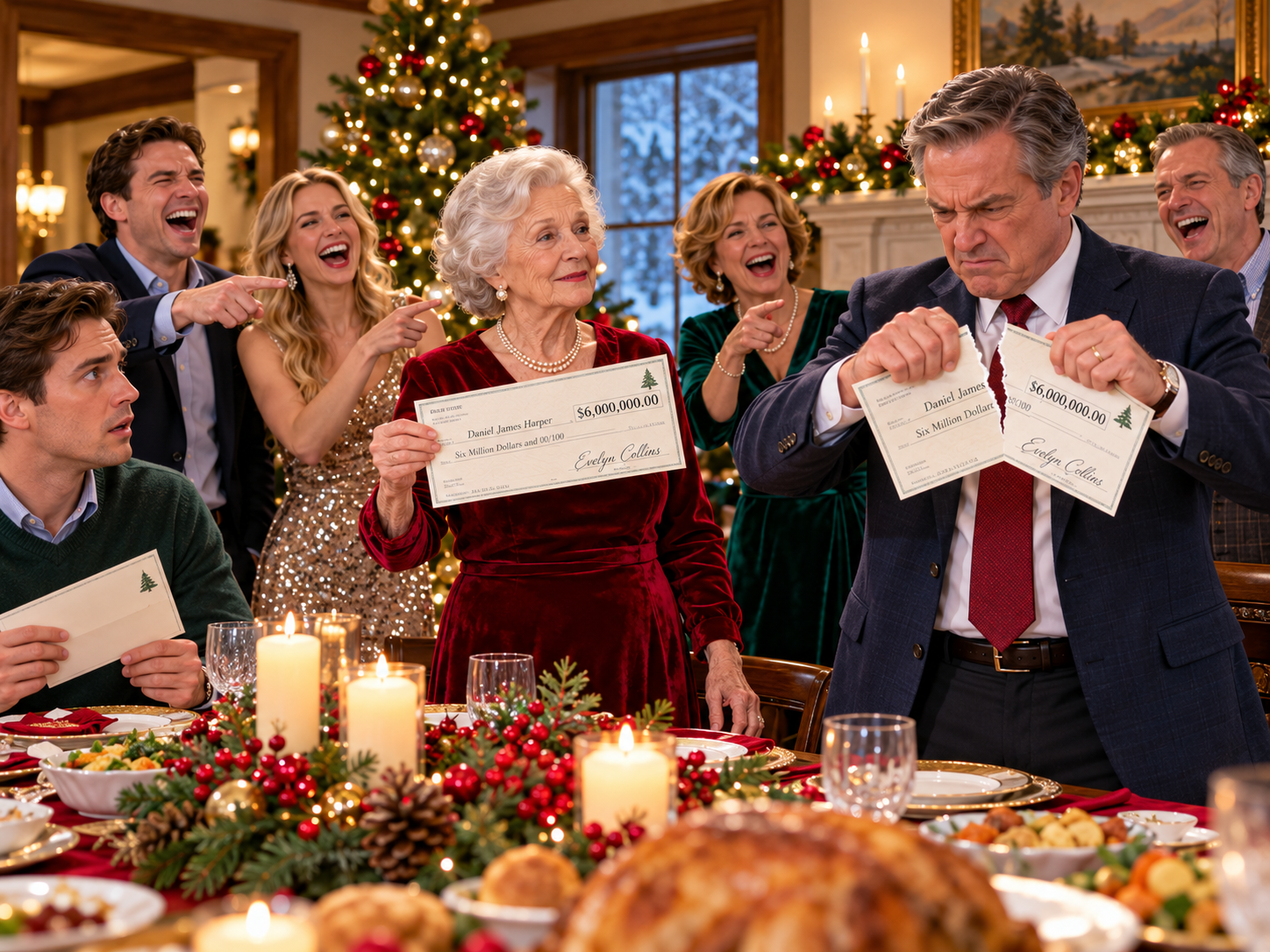
My Father Tore Up Six Million Dollars Before Grandma Could Explain Why She Had Chosen Us
Part 8 of 20

