
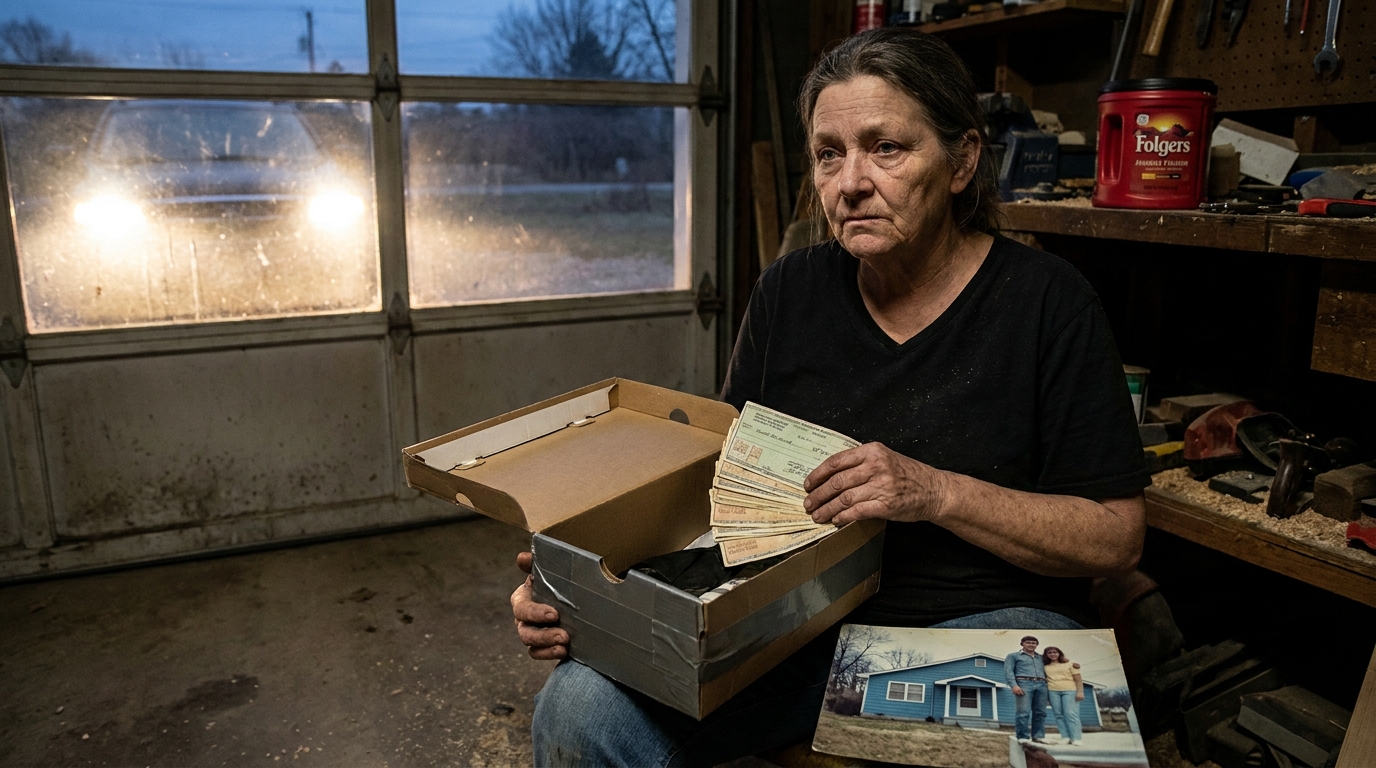
A year after Thomas died, the blue house no longer looked abandoned.
The porch had been repaired.
The faded siding had been repainted the same blue Maryanne remembered from 1979.
Emily insisted on keeping the color.
Daniel built a new railing.
I planted flowers beneath the front windows.
Maryanne brought photographs.
Nobody tried to erase the past.
That mattered.
The nursery became a small reading room.
The old pencil marks remained on the doorframe.
We covered none of them with paint.
They were evidence.
Not of perfection.
Of time.
On the first anniversary of Thomas's death, we gathered there.
Emily had invited several students who had received scholarships funded through the trust.
They knew only that the house belonged to a family who wanted to help people begin again.
They didn't know the story behind it.
I was glad.
The house did not need to become a shrine.
It needed to become useful.
After everyone left, the four of us sat on the porch.
Maryanne brought lemonade.
Daniel complained that it was too sweet.
Emily told him to make his own.
I laughed.
For a moment, it sounded like any family gathering.
Then Emily said, “I think I'm ready.”
She had been saying that for months.
Ready to decide what Thomas meant to her.
I waited.
“I don't forgive everything,” she said.
Maryanne nodded.
“I don't think I ever will.”
“That is fair,” I said.
“But I don't hate him.”
She looked toward the lake.
“I think I love him.”
Nobody spoke.
Emily wiped her eyes.
“I don't know how you can love someone who hurt you before you even knew he existed.”
“You can,” I said.
She looked at me.
“You still love him?”
“Yes.”
“After everything?”
“Yes.”
She nodded.
“I think that's what scared me.”
“What?”
“That love and anger can exist at the same time.”
I smiled.
“They usually do.”
She laughed softly.
Then she reached into her pocket.
She still carried Thomas's final note.
She had folded it so many times that the creases had nearly worn through.
“I used to think he owed me a childhood.”
“He did.”
“I used to think he owed me an explanation.”
“He did.”
She looked at the house.
“But I don't think he owes me the rest of my life.”
I understood.
That was the final thing Thomas had failed to teach her because he had never been there to teach it.
Her future did not have to remain tied to his absence.
The trust had begun generating enough income to support several students each year.
Emily chose the recipients.
Daniel handled repairs and finances.
Maryanne managed the archives.
I kept the kitchen stocked.
Our roles had developed naturally.
Nobody assigned them.
Nobody had to.
One afternoon, Emily found me in the nursery.
She was holding a photograph of Thomas.
“I've been thinking about the recording.”
“What about it?”
“He said he loved your family.”
“Our family.”
She smiled.
“Our family.”
She sat beside me.
“I wondered whether you think he was happy.”
I looked at the photograph.
“Yes.”
“Even though he had this whole other life?”
“He didn't have another life.”
She looked confused.
“He had another part of his life.”
I thought carefully.
“That's different.”
She nodded.
“Did you ever wish he'd never told you?”
I considered the question.
There had been days when I had.
Days when I wished the photograph had remained buried.
Days when I wanted to remember Thomas exactly as he had been before I knew.
But truth had its own weight.
“No,” I said.
“Why?”
“Because you exist.”
She smiled.
“And Daniel.”
“And Daniel.”
She leaned against my shoulder.
For the first time, it felt natural.
Not like a replacement for the family she had lost.
Like a new branch growing from an old tree.
Maryanne joined us.
She carried the original blue-ribbon letters.
She had decided to donate copies to the archive.
The originals would remain with Emily.
“What are you doing?” Maryanne asked.
“Remembering.”
Maryanne smiled.
“That sounds like him.”
“No,” I said.
She looked at me.
“This part is ours.”
She nodded.
That was true.
Thomas had started the story.
But he no longer controlled it.
We did.
On the second anniversary, Emily brought her daughter to the house.
The little girl ran through the yard and stopped beneath the maple tree.
“Grandma Ruth!”
I turned.
The word still surprised me.
Then I smiled.
“What?”
“Uncle Daniel says this was Grandpa's house.”
“It was.”
“Did he live here?”
“Once.”
“Why did he leave?”
I looked at Emily.
She gave me a small nod.
“Because grown-ups sometimes make decisions they think are necessary.”
“Were they good decisions?”
I smiled.
“Some were.”
“Some weren't?”
“Some weren't.”
The child considered that.
Then she ran back toward Daniel.
I looked at Emily.
“You answered that better than I ever could.”
She laughed.
“I learned from everyone.”
The blue house became part of our lives.
Not every week.
Not every month.
Sometimes we went months without visiting.
But the family returned.
That was enough.
The scholarship grew.
The reading room became popular.
A local group asked to use the house for evening classes.
Emily agreed.
Daniel built shelves.
Maryanne donated books.
I made coffee.
The place filled with ordinary noise.
Children laughing.
Chairs scraping.
People arguing over assignments.
Someone always forgetting a coat.
Life.
That was what Thomas had failed to give the house for forty years.
We gave it that.
On the third anniversary of his death, I went alone to the cemetery.
I carried the original photograph of Thomas, Maryanne, and Emily.
I had considered leaving it there.
Instead, I held it in my lap.
“You were complicated,” I said.
The wind moved through the grass.
“You were stubborn.”
I smiled.
“You were afraid.”
I paused.
“And you loved us.”
That was the truth I had finally learned to say without defending him.
“You should have trusted us.”
The silence remained.
“I wish you had been brave sooner.”
I placed my hand against the stone.
“But I think you were trying at the end.”
The photograph rested against the flowers.
“I hope that counts for something.”
I didn't hear an answer.
I hadn't expected one.
When I returned home, Daniel was waiting.
He had a package.
“What is it?”
“From Minnesota.”
Inside was a small wooden box.
Emily had made it.
She had engraved four names on the lid.
Maryanne.
Thomas.
Daniel.
Ruth.
Inside was the old hospital bracelet.
Emily had kept it.
She had added a note.
She wanted it preserved with the family records.
The note said:
He was my father before I knew his name.
That sentence stayed with me.
Not because it erased anything.
Because it didn't.
Thomas had missed birthdays.
He had missed school plays.
He had missed scraped knees, first jobs, heartbreaks, graduations, and ordinary afternoons.
No trust could return those years.
No house could repair them.
No inheritance could transform absence into presence.
But truth had allowed Emily to choose what happened next.
She chose a brother.
She chose a relationship with Maryanne that would take time and honesty.
She chose the house.
She chose the scholarship.
And eventually, she chose a place for Thomas in her life that did not require pretending he had been the father she deserved.
Daniel chose the same thing.
He called Emily on Sundays.
They argued about baseball.
They exchanged terrible birthday gifts.
They discovered they had inherited the same habit of leaving cabinet doors open.
Sometimes they talked about Thomas.
Sometimes they didn't.
That was the part I liked most.
They were becoming siblings rather than two people constantly studying the evidence that made them siblings.
Maryanne changed too.
She apologized without expecting forgiveness.
She answered questions without protecting herself.
She told Emily the truth even when the truth made her look selfish.
It took time.
But they became close again.
As for me, I stopped searching for another secret.
There were no more hidden houses.
No second marriage.
No secret fortune.
No scandal waiting behind another locked drawer.
The central truth had been painfully ordinary.
Thomas had loved two parts of his life and believed, wrongly, that protecting one required hiding the other.
He had mistaken silence for kindness.
He had mistaken money for presence.
He had mistaken delay for responsibility.
And by the time he understood his mistake, he was dying.
His final gift was not the house.
It was permission.
Permission for us to stop carrying his fear.
Years later, I still kept his unfinished birdhouse.
I never completed it.
Neither did Daniel.
We left it exactly as Thomas had abandoned it, with the three sets of initials underneath.
R.B.
D.B.
E.C.
Sometimes Emily brought her daughter to my house.
Sometimes we sat in the workshop.
The little girl would ask why the birdhouse was unfinished.
I always gave her the same answer.
“Because Grandpa didn't get to finish everything.”
She would frown.
“That's sad.”
“Yes.”
“Who finished it?”
I would look at Emily.
Then Daniel.
Then the life around us.
“Nobody,” I said.
And that was all right.
Some things did not need to be finished by the person who began them.
Some promises could survive the people who made them.
Some mistakes could never be undone, only faced honestly.
Thomas had died believing he had run out of time.
Perhaps he had.
But the family he left behind had not.
We still had time.
Time to know one another.
Time to tell the truth.
Time to forgive what could be forgiven.
Time to remain angry where anger was deserved.
Time to laugh about the things that made Thomas impossible.
Time to remember him without making him larger or smaller than he had been.
A flawed man.
A loving husband.
A frightened father.
A stubborn son.
A secretive human being who finally understood that the truth did not belong to him.
It belonged to the people whose lives it touched.
And in the end, that was what the blue house became.
Not proof of an old romance.
Not a monument to guilt.
Not a hidden inheritance.
A place where the next generation could begin with something Thomas had spent most of his life avoiding.
The truth.
The End
Read more original stories on Feel Every Story.
My Husband Had Been Dead for Hours When a Stranger Spoke a Woman’s Name I Had Never Heard Before
Part 8 of 8

