
Thomas Bennett had been dead for less than four hours when the hospice nurse stopped me beside the elevator and asked a question that made the hallway seem suddenly too narrow.
“Mrs. Bennett, I’m sorry to ask you this now, but did you ever get in touch with Maryanne?”
I stared at her.
“Who?”
The nurse, Kelly, tightened her grip on the clipboard against her chest. She looked about forty, with tired eyes and the careful expression of someone who had learned not to intrude on grief unless something truly bothered her. “Maryanne,” she repeated. “Thomas mentioned her several times yesterday. Again this morning. I assumed she was family.”
“My husband never had anyone named Maryanne.”
Kelly glanced toward the hospice room as though the answer might still be waiting inside. “Then I may have misunderstood.”
That should have been the end of it. Thomas had died after a long decline, and the last days had been full of medication, confusion, restless sleep, and sentences that began in one place and ended somewhere else. I had spent the morning signing paperwork and answering calls from our son, Daniel, while nurses moved quietly around me. My mind was exhausted enough to accept almost any explanation.
Still, I asked, “What exactly did he say?”
Kelly hesitated.
“He wondered whether Maryanne knew,” she said finally. “And he mentioned something about a house. I couldn't make sense of it.”
“What house?”
“I don't know.”
Daniel appeared before I could ask anything else. His shoulders were hunched beneath the weight of the week, and his face looked older than forty-one. He put a hand around my shoulder.
“Mom. Janice is downstairs. We should go.”
I looked back at Kelly. The nurse gave me an apologetic nod.
I almost told Daniel about Maryanne.
Instead, I thanked the nurse and followed my son toward the elevator.
My husband was dead. That seemed like enough truth for one afternoon.
Thomas and I had been married for forty-two years. We had met before either of us had learned how much of a person's life can disappear simply because nobody thinks to ask the right question. We had raised Daniel, paid bills, argued over paint colors, survived surgeries and layoffs, repaired a flooded basement, buried parents, celebrated birthdays, and spent thousands of ordinary evenings sitting beside each other without needing to fill the silence.
I knew Thomas's habits so well that sometimes I could predict what he would say before he opened his mouth.
I knew which knee ached before storms. I knew he hated dill pickles but secretly drank the juice from the jar. I knew he kept spare screws in coffee cans and sharpened pencils with a pocketknife. I knew the password he used for nearly everything and had complained about it for years.
A woman named Maryanne did not belong anywhere in that map.
The funeral took place at the Lutheran church where we had married in June of 1984. Men from Thomas's old building-supply company stood in a row near the back, all of them uncomfortable in suits. Neighbors brought casseroles. Daniel spoke about his father teaching him to measure twice before cutting once.
People laughed at that because Thomas had said it so often.
I watched the photograph beside the urn. Thomas was sixty-eight in it, squinting into the sun while holding a fish he had spent years insisting was enormous.
The man in the picture looked alive in a way that hurt.
After the service, people told stories. A plumber remembered Thomas lending him money when his truck broke down. A neighbor described the porch railing he had repaired without accepting payment. Daniel's former baseball coach recalled finding Thomas at the field before sunrise, dragging a rake across the dirt.
Every story sounded right.
That should have comforted me.
Instead, each time someone said, “Thomas never forgot anybody,” I heard the nurse again.
Maryanne.
Two nights later, I woke at 3:17 in the morning and reached across the mattress before remembering that the other side was empty.
Thomas's reading glasses still sat on the nightstand. A paperback rested beside them, its place marked by an old receipt.
I turned on the lamp.
That was when another memory surfaced.
During his final week, Thomas had asked me whether the maple trees were changing color.
I had told him they were still green.
He had frowned.
“Not ours,” he'd murmured. “The big ones by the house.”
I had kissed his forehead and told him he was dreaming.
Now I wondered whether he had been.
The next morning, I began sorting his belongings.
My younger sister Janice called while I stood in front of his closet with three empty boxes. She told me I was moving too quickly. I told her I couldn't spend six months staring at seventeen nearly identical plaid shirts.
She finally made me promise not to throw away his fishing vest.
I started with the shirts.
Then the dresser.
Then his desk.
Everything was painfully ordinary. Receipts. Old batteries. Pocketknives. Eighty-seven dollars in cash. Tax papers. Appliance warranties. A stack of manuals for machines we no longer owned.
By lunchtime, I felt foolish for having listened so closely to a dying man's confused words.
Maybe Maryanne had been a childhood friend.
Maybe she was someone from work.
Maybe there was no Maryanne at all.
Then I went into the workshop.
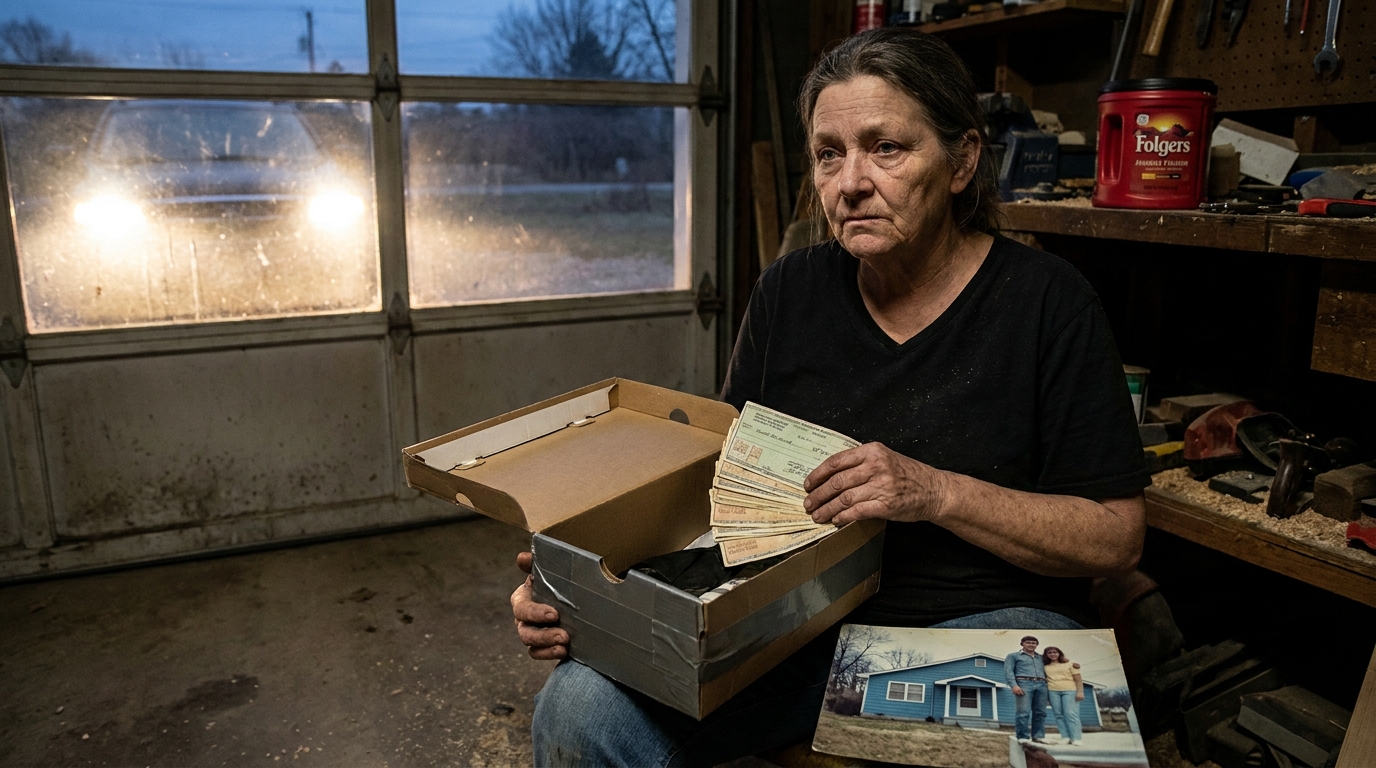
Thomas had converted our detached garage twenty-five years earlier. It smelled of sawdust, machine oil, and peppermint candies. His radio sat beneath the window. Tools hung in neat rows. A half-built birdhouse was clamped to the workbench, and his pencil lay beside it.
I touched the roof of the little house.
That broke me.
I sat on his stool and cried until my ribs hurt.
It wasn't the funeral that finally defeated me. It wasn't the hospice room.
It was a birdhouse he had expected to finish.
When I could breathe normally again, I began opening cabinets.
The bottom cabinet resisted when I pulled it.
I tugged harder.
Something scraped behind it.
I crouched and reached into the narrow gap between the cabinet and the wall. My fingertips touched cardboard.
A dusty brown shoebox came free.
I had never seen it before.
There was no lock and no label.
I lifted the lid.
Inside were envelopes, money-order receipts, and a photograph.
The photograph had faded yellow around the edges. A much younger Thomas stood beside a small bungalow painted an almost absurd shade of blue.
I recognized him instantly.
He couldn't have been more than twenty-two or twenty-three.
Beside him stood a dark-haired woman holding a baby.
Thomas's arm was around her waist.
They weren't standing like strangers.
They looked like people who belonged together.
I turned the photograph over.
Thomas had written something across the back in handwriting I barely recognized as his.
The note referred to a time before Ruth.
Before me.
I sat down on the concrete floor.
The money-order receipts slipped from the box when my hands began shaking.
I gathered them and looked at the destinations.
Duluth, Minnesota.
Again.
And again.
Most were addressed to M. Cole.
The amounts varied from a few hundred dollars to several hundred more. Some were decades old.
The newest had been issued only weeks before Thomas entered hospice.
There were twenty-seven of them.
I counted twice.
Twenty-seven.
I stared at the photograph again.
The baby was wrapped in a pale blanket.
My first thought was the one I didn't want to have.
Was that Thomas's child?
I found one remaining envelope that wasn't empty.
Inside was a Christmas card from a woman named Maryanne. She thanked “Tommy” for remembering Emily and said Emily was doing well. She added that he didn't need to keep sending money.
I read it three times.
The name from the hospice hallway was real.
So was Emily.
That evening Daniel called.
“You eating?”
“Yes.”
“What?”
I looked at the untouched bowl of soup.
“Soup.”
“You're lying.”
“I'm considering soup.”
He laughed softly.
For a moment, he sounded like the boy Thomas had carried on his shoulders.
Then I asked, “Did Dad ever mention Duluth?”
There was a pause.
“Duluth?”
“Specifically.”
“No. Why?”
I looked at the photograph lying on the table.
“No reason.”
After we hung up, I hated myself for lying to my own son.
I returned to the workshop.
Near midnight, while searching through old property-tax files, I found a photocopy of a deed.
The paper was faded, but two names were still clear.
Thomas Andrew Bennett.
Maryanne Louise Cole.
Both were listed as owners.
The property was in Duluth.
I stopped breathing for a moment.
My husband had not merely known Maryanne.
He had owned a house with her.
A blue house.
And suddenly the strange question he had asked me in hospice came back with terrifying clarity.
Not ours.
The big ones by the house.
I sat alone beneath the workshop light, staring at the deed.
For forty-two years, I had believed I knew where my husband's life began.
I had been wrong.
Click Here to continue read next: PART2: Twenty-Seven Payments, an Old Photograph, and One Name Forced Me to Wonder Whether My Son Had a Sister
My Husband Had Been Dead for Hours When a Stranger Spoke a Woman’s Name I Had Never Heard Before
Part 1 of 8

