
The records kept arriving.
They did not form a single clean story. They formed several overlapping ones.
There were transfers from the joint checking account, divided into amounts of twelve thousand, eight thousand five hundred, nine thousand five hundred, and ten thousand dollars. Some went to accounts I did not recognize. One went to Hale Offshore Consulting.
The timing mattered.
The transfers had happened within forty-eight hours.
Travis had not moved the money because of our argument.
He had moved it before I knew there was an argument.
Credit-card records revealed hotel charges, expensive dinners, a jewelry store, marina expenses, and other purchases I could not immediately explain. Evelyn refused to tell me what they meant.
“They could be business expenses.”
“They could.”
“They could be personal.”
“They could.”
I almost smiled.
“You always do that.”
“I prefer evidence.”
One payment bothered me most. A contractor invoice for work on the house had ultimately been funded from money traceable to my inheritance.
Travis had thanked himself for paying it.
I had thanked him too.
That memory hurt more than the amount.
Then Evelyn received an email dated January 19.
Nine days before Travis formed Hale Offshore Consulting.
The subject concerned property separation planning.
Travis had been discussing the possibility of separating from me.
He had written that he wanted to protect liquid assets.
He had also acknowledged that the house was titled in my name.
I read the sentence twice.
“He knew.”
Evelyn nodded.
“The email indicates he understood how the property was titled.”
That changed the meaning of everything that followed.
The company had been created after the email.
The property-tax information had been redirected afterward.
The savings account had been closed afterward.
The cashier's check had been issued afterward.
And then the checking account disappeared.
The next discovery came from a title company.
Hale Offshore Consulting had made an inquiry concerning my property.
It was not a lien.
It was not a completed transfer.
But the company had explored using the land as collateral for financing.
I remembered the papers Travis had put beside my breakfast plate.
Insurance updates.
They had not been insurance updates.
They had apparently been part of something larger.
Then Lauren entered the story.
Her message appeared on Travis's phone while he was home.
Are you going to tell her today?
He tried to hide the screen.
I asked what it meant.
Eventually he admitted that he had told Lauren we were separating.
“How long?”
“Several months.”
“You told another woman before you told me?”
“She knew I was unhappy.”
“Why did she know?”
“We talked.”
I asked about the hotel charges.
He answered too quickly.
“They weren't connected to Lauren.”
“You didn't even ask which hotels.”
His expression changed.
I did not pursue the accusation.
Facts first.
That principle had become the only thing keeping me from drowning in guesses.
A few days later, Lauren contacted Evelyn.
She had a document.
A financing package titled Property Owner Consent and Collateral Authorization.
My name appeared on it.
My address was correct.
The legal description of the property was correct.
The parcel number was correct.
Everything looked legitimate.
Then I saw the signature.
June E. Hale.
I stared at it.
For one terrifying second, I wondered whether I had signed it and forgotten.
Then I saw the J.
My father had taught me cursive when I was six. My capital J always curved left first.
The signature on the document curved right.
It was a tiny distinction.
It was also unmistakably wrong.
“That isn't mine.”
Evelyn studied it.
“You're sure?”
“Yes.”
She preserved the original document and arranged for a signature specialist to compare it against my old checks, tax forms, estate papers, and insurance documents.
While that process began, another record arrived.
Travis had personally certified the financing package.
He had certified that the required owner authorization had been obtained.
My signature appeared on the document.
I had never signed it.
Evelyn was careful.
“We can say he certified the submission. We can say you deny signing. We can say the package came through his company account. We still need evidence about who physically wrote the signature.”
That caution protected the case from becoming a story built on anger.
The financial records brought another surprise.
Hale Offshore Consulting had received the $27,500 from our money.
Then it received additional funds.
Then money began moving outward.
Some went to equipment and office expenses.
Some went to Pritchard Holdings.
Some went to an unknown account.
Then we found the Hale Family Preservation Trust.
The trust named Travis as grantor and primary beneficiary.
Lauren appeared as a contingent beneficiary under certain circumstances.
And the schedule of intended assets included the legal description of my property.
Next to it was an estimated value.
$684,000.
I stared at the number.
The trust did not actually transfer my property.
That mattered.
But emotionally, seeing my childhood home listed as a future asset of a trust I had never heard of was enough to make my hands shake.
Evelyn opened another file.
A note from Douglas Pritchard contained four words.
Need June before she knows.
I wanted to treat it as a confession.
Evelyn refused.
Pritchard later explained that he meant before I knew the final projected valuation of Travis's company.
That explanation did not make the arrangement look innocent.
A preliminary business projection valued Hale Offshore Consulting at as much as $1.2 million under an expected scenario involving financing and future contracts.
The settlement draft valued it at one dollar.
I asked why.
Evelyn explained that a projected value was not the same as a present value.
The company could fail.
Its contracts were not guaranteed.
The financing could collapse.
But the difference between one dollar and a projected seven-figure business was still significant.
The more troubling part was the timing.
Travis had apparently expected me to sign before I knew enough to understand what I was signing.
Then Pritchard produced an email dated February 6.
He had warned Travis that inherited real estate could not be used as collateral without proper owner authorization.
He had explicitly told him not to represent ownership or authority he did not possess.
Travis's reply was brief.
Understood. I'll handle June.
That sentence stayed with me.
Not because it proved every accusation.
Because it showed he knew there was an obstacle.
The obstacle was me.
The tax records revealed another layer.
Someone had accessed my online tax profile from an unfamiliar device.
The contact email had been changed.
Tax statements had been downloaded.
Information about delinquency procedures had been viewed even though my property taxes were current.
I locked down the account.
Then Evelyn found evidence of offshore transfers.
Hale Offshore Consulting had wired twenty-two thousand dollars to a financial institution in the Cayman Islands.
Later came another transfer of eighteen thousand five hundred.
Then twelve thousand.
More than fifty thousand dollars in confirmed foreign transfers.
Again, legitimate explanations were possible.
But another message from Travis removed much of the ambiguity.
Once the land closes, I can move enough offshore that June won't have the resources to keep fighting.
I read it until the words blurred.
He had not merely been planning a division of property.
He had been thinking about how long I could afford to resist him.
Then came the email chain between him and Pritchard.
Pritchard warned him not to move funds in a way designed to impair my ability to obtain representation or pursue lawful claims.
Travis replied:
You're overthinking it.
Pritchard wrote that he was documenting his advice.
Travis answered:
Document whatever you want.
That was when I understood that even the people around Travis had begun preserving themselves against him.
The final piece of the financial puzzle arrived through a recovered spreadsheet.
RUNWAY_FINAL.
Travis had deleted it, but forensic review recovered a later version.
His combined personal and business financial runway was only 5.8 months.
Revenue projections had fallen.
Two expected contracts were delayed.
Loan payments had begun.
Offshore transfers had reduced domestic liquidity.
The company was burning cash.
The spreadsheet contained a section labeled ACCELERATE.
Move remaining accessible cash.
Finalize J agreement.
Complete property entity.
Refinance company.
I looked at Evelyn.
“He was running out of time.”
“That appears consistent with the records.”
Suddenly his pressure made sense.
He had not simply been hiding money.
His business needed something.
More financing.
More revenue.
Or my property.
And he had been building the plan long before I knew I needed to protect myself.
Then another loan appeared.
Two hundred eighty thousand dollars.
Hale Offshore Consulting had borrowed the money in May.
The loan was secured by business assets and Travis's personal guarantee.
Not my house.
Not my signature.
For one brief moment, I felt relief.
Then Evelyn asked whether the underwriting file contained marital assets.
The attorney representing Travis hesitated.
That hesitation told us there was another document to request.
When it arrived, the lender asked a simple question.
Had the anticipated marital settlement been executed?
Had title to the residence been transferred?
If not, Travis's financial statement had to be updated.
The answers were obvious.
No.
No.
The property remained mine.
Three days later, Travis submitted a new financial statement.
The $681,500 property value had disappeared.
His reported net worth fell sharply.
For the first time, I saw exactly what my property had represented to him.
Not merely a home.
A future resource.
A number on a balance sheet.
A source of financing.
Something he had assumed he could eventually make available.
And he had built his entire plan around the belief that my refusal would not last.
Click Here to continue read next: PART4: When the Last Offer Arrived, I Finally Understood That the Real Thing Travis Wanted Was Not My Property but My Permission
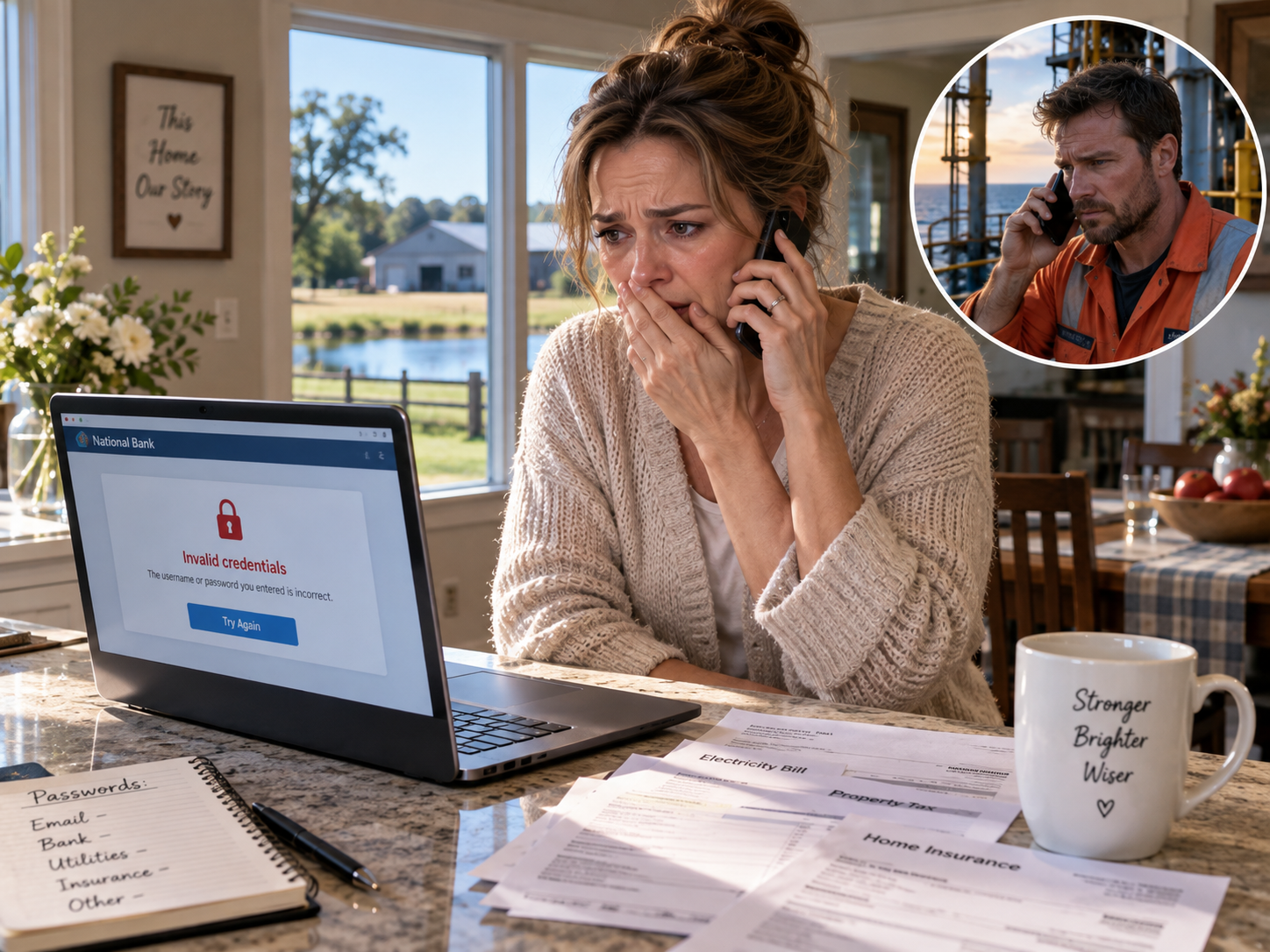
The Morning My Password Failed, I Realized My Husband Had Quietly Moved Our Money and Changed More Than I Knew
Part 3 of 16

