
Travis eventually made me a private offer.
Two hundred thousand dollars.
At another time in my life, the amount would have frightened me with its size.
Instead, I asked a different question.
“What exactly am I giving up?”
Evelyn helped me respond through counsel.
We requested complete financial disclosure before negotiating the final settlement.
Travis began sending messages.
You're making a mistake.
Every month you drag this out costs you money.
You should ask yourself how long you can afford to be stubborn.
The language was familiar.
He still believed time was something he could use against me.
Then my health-insurance access was suddenly marked for dependent eligibility review because Travis had told his employer that we were separated.
I documented it.
The coverage remained active while the issue was reviewed, but the timing mattered.
Another invisible connection of marriage had become leverage.
Insurance.
Banking.
Taxes.
Retirement.
Emergency contacts.
Financial accounts.
For years, I had treated those systems as part of one shared life.
Now I understood how easily someone controlling the information could make the other person feel helpless.
The lender gave Hale Offshore Consulting ten business days to present a cure plan.
The company had to explain related-party transfers, identify ownership of pledged equipment, address restricted funds, and demonstrate that it could operate without relying on property it did not own.
Lauren also became entangled in the financial problems.
Her company, Pierce Equipment Services, had taken a ninety-five-thousand-dollar loan.
Hale Offshore Consulting appeared in the loan package as a guarantor.
Some equipment appeared on both companies' schedules.
Nothing about that automatically proved wrongdoing, but the overlap created another problem.
Lauren suspended the equipment arrangement until her own lawyer could review everything.
Without the equipment, one of Travis's expected contracts became harder to perform.
His structure was beginning to collapse under the weight of all the separate agreements he had tried to make behave like one controlled system.
Then Travis offered seventy-five thousand dollars for confidentiality.
I considered it.
For eleven minutes.
Seventy-five thousand dollars was real money.
It could repair the roof, build savings, cover taxes, and create security.
The confidentiality clause was broad.
It covered the business, the trust, Mariner Reserve, planning documents, lender communications, Lauren's involvement, and disputed events in our marriage.
I asked Evelyn what would happen to the false signature if I signed.
“Third parties would still have their records.”
“The lender would still know?”
“Yes.”
“Pritchard would still know?”
“Yes.”
“Lauren?”
“Yes.”
“The signature specialist report?”
“Yes.”
I leaned back.
“So Travis is buying privacy, not erasure.”
“That is a fair distinction.”
I decided for myself.
The offer did not make the underlying questions disappear.
Meanwhile, the signature issue moved through the proper channels.
Eventually Travis met with me.
He looked exhausted.
“I didn't sign your name,” he said.
“I know that's what you say.”
“It's true.”
“Then tell them everything.”
His jaw tightened.
“Lauren could have done it.”
“She says she didn't.”
“Pritchard could have.”
“He says he didn't.”
“Someone did.”
“Yes.”
He looked at me.
“You really don't believe me.”
“I believe the signature isn't mine.”
He looked down.
I continued.
“You certified the package.”
Silence.
“You knew I hadn't gone to a bank.”
Silence.
“You knew I hadn't signed in front of anyone.”
His hands tightened.
“You knew the property was mine.”
“Yes.”
The answer was barely audible.
I stared at him.
“Then you knew there was a problem.”
He closed his eyes.
After a long pause, he said something that changed everything.
“I thought you'd sign the final version.”
I felt my heartbeat in my throat.
“What?”
“The first version was supposed to get the lender moving. I thought I could get your actual signature later.”
I did not let him explain further.
He had admitted that he knew the signature on the financing package was not mine.
I told Evelyn exactly what he had said.
No embellishment.
No dramatic interpretation.
Just the words.
From that point forward, the matter moved beyond what I wanted or did not want.
The lender had its records.
The lawyers had theirs.
The signature specialist had the comparison.
I did not need to decide what consequences Travis deserved.
I needed to decide what I wanted my own life to look like.
The final asset review uncovered one last surprise.
An old brokerage account in my name.
It had been opened thirteen years earlier, four years before I married Travis.
My father had encouraged me to invest.
A small inheritance and money from my employment had funded it.
I had forgotten the account after my parents became ill and my life changed.
Dividends had continued to reinvest.
The account was mine.
It had existed outside Travis's financial system the entire time.
For years, I had believed I depended on him more than I did.
That belief had been one of the strongest parts of his control.
The final settlement recognized my sole ownership of the inherited residence and acreage.
Travis retained Hale Offshore Consulting and its future upside as well as its business risks.
Mariner Reserve was accounted for.
The trust no longer contained any contemplated interest in my property.
My separate brokerage and inheritance interests were preserved to the extent established through tracing.
Retirement assets were divided according to the negotiated terms.
The agreement was forty-three pages.
I read every one.
No one rushed me.
No one stood beside me holding a travel mug.
No one told me I had five minutes before a flight.
I could sign.
I could ask another question.
I could refuse.
That was the difference.
The final divorce hearing lasted less than forty minutes.
The judge asked whether I understood the settlement.
Yes.
Had anyone forced me to sign?
No.
Had I reviewed it with counsel?
Yes.
Was I entering it voluntarily?
Yes.
When Travis answered the same questions, he did not look at me.
The marriage ended.
Nine years became past tense.
I expected to feel something sharper.
Instead, there was a strange emptiness, like stepping outside after a machine shuts off and realizing how loud it had been.
Marlene waited outside.
“It’s done,” I told her.
She hugged me.
Then she asked if I wanted lunch.
We went to the diner where Travis and I had eaten after signing our marriage license.
I almost turned around when I recognized the place.
Then I stayed.
The legal consequences for Travis continued separately.
His financing relationship ended.
There were financial penalties.
Business representations had to be corrected.
Future borrowing became more difficult.
The company survived, but on a smaller scale than he had once imagined.
There was no dramatic arrest.
No theatrical courtroom confession.
Just consequences that arrived through records, contracts, lenders, and institutions.
Slow.
Expensive.
Real.
One spring afternoon, a certified property-tax notice arrived.
My name was on it.
My email.
My address.
My account.
Nothing had been redirected.
Nothing had been hidden.
I laughed at the kitchen counter.
Not because the tax bill was funny.
Because I had once been afraid of envelopes.
Now the envelope contained exactly what it said.
A bill.
I paid it.
Then I walked to my father's workshop.
His framed letter still hung beside the workbench.
He had once written about having a safe place to stand.
For years, I thought he had left me a place where nothing bad could happen.
I finally understood differently.
He had left me a place from which I could face what did.
Months later, a regional medical group offered to buy six acres along the far boundary.
The first offer was $410,000.
It eventually rose to $455,000.
I walked the land alone.
For a few nights, selling part of the property bothered me.
I had fought so hard to keep it that selling any of it felt like surrender.
Then I realized I was repeating the same mistake from the opposite direction.
I was letting the emotional meaning of the land decide what I was allowed to do.
The point had never been to keep every acre forever.
The point had been that the decision belonged to me.
I sold the six acres.
I kept the house, workshop, pond, and remaining land.
Later, Travis sent me a letter.
He wrote that he had finally understood something.
He had believed I did not understand money.
Now he knew I understood what money was for.
He admitted that he had thought a “no” was temporary.
That sentence stopped me.
The entire disaster had grown from that belief.
He had treated my refusal as an inconvenience.
A delay.
A problem that enough pressure, urgency, secrecy, money, paperwork, or expertise would eventually solve.
He had never understood that my answer was already complete.
No.
I replied only once.
I told him I was glad his company had become stable.
I told him I was glad he was doing better.
Then I wrote one final sentence.
You were right about one thing. No was the answer you needed to hear.
Years passed.
Eventually, maintaining eleven acres became more work than pleasure.
I sold the house.
People were surprised.
Marlene certainly was.
“You fought a war over that place.”
“No,” I told her. “I fought for the right to decide what happened to it.”
I sold it to a family with two young children.
The father loved the workshop.
The mother loved the pond.
Their daughter climbed the oak tree during the showing and refused to come down.
I knew then that they loved the place.
That was enough.
At closing, I signed the deed.
Voluntarily.
Carefully.
No fear.
No hidden entity.
No business waiting behind the transaction.
The money went into accounts I understood.
I bought a smaller house outside town.
Two bedrooms.
A small garden.
No pond.
No barn.
No eleven acres.
And I loved it.
I hung my father's letter above my desk.
Then I opened my laptop.
My checking account.
My savings.
My investments.
My property reserve.
My tax account.
I knew what each one was.
I knew where the money came from.
I knew what I had signed.
I knew what I had not signed.
Outside, rain tapped against the windows.
The sound no longer frightened me.
For years, I had thought my father left me land.
He had left me something more useful.
The ability to choose.
To read before signing.
To ask before agreeing.
To refuse without apology.
To change my mind.
To stay.
To leave.
To keep something because I loved it.
To sell it because I wanted something different.
And, most importantly, to love someone without giving that person authority over what I knew to be true.
My name was on the deed.
My name was on the accounts.
My decisions were mine.
That was what my father had actually left me.
Not eleven acres.
A life I was allowed to own.
Click Here to continue read next: PART5: The First Quiet Morning in My New House Forced Me to Face the One Question I Had Avoided Since Leaving Travis Behind
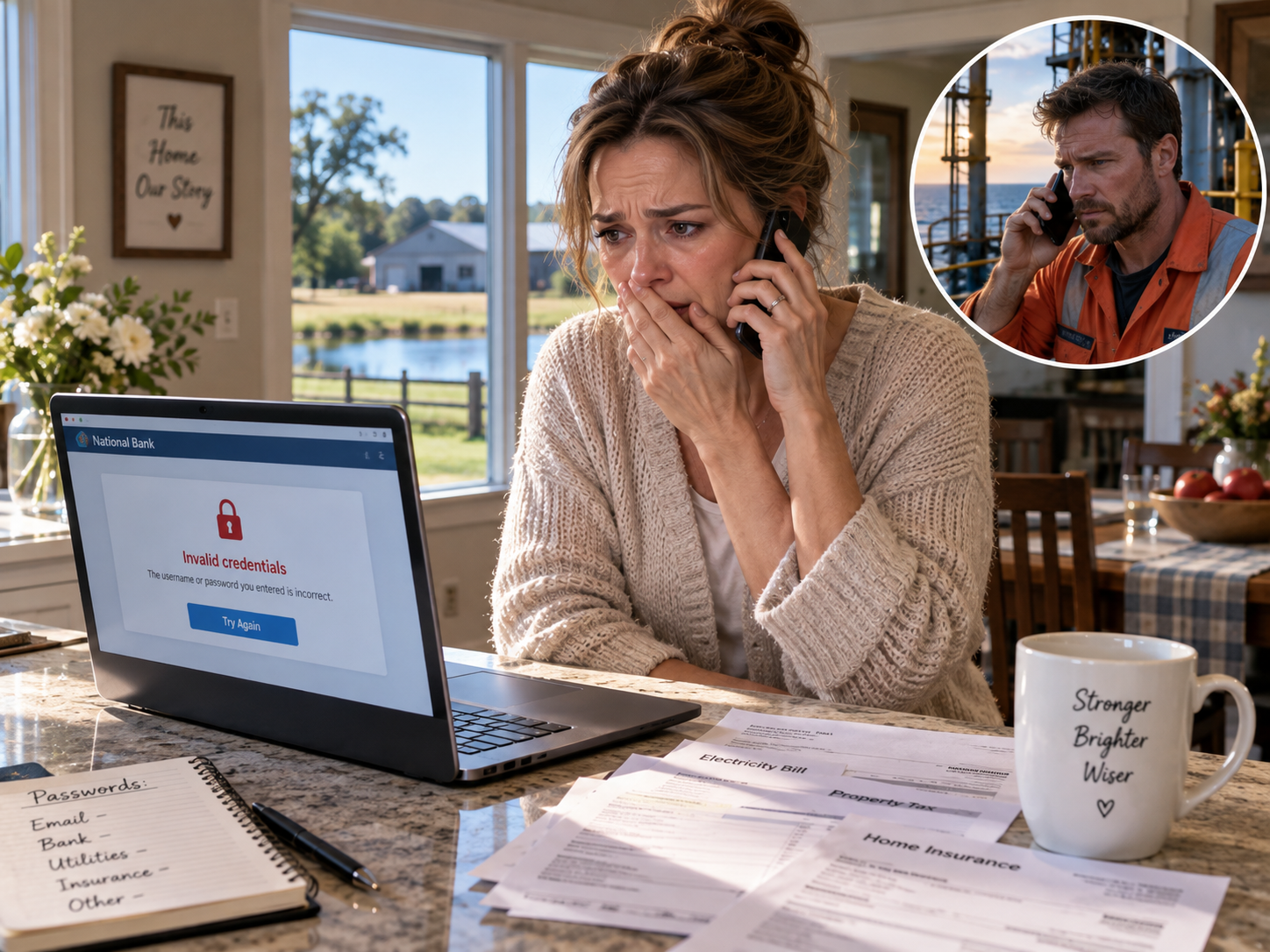
The Morning My Password Failed, I Realized My Husband Had Quietly Moved Our Money and Changed More Than I Knew
Part 4 of 16

