
The bank manager's office smelled faintly of carpet cleaner and burnt coffee.
Her name was Celeste Ramirez. She checked my identification, opened the old account, and studied the screen for nearly a minute before speaking.
“Mrs. Hale, the account was closed through an authorized transaction.”
“Authorized by whom?”
“I can confirm that you did not initiate the closure.”
That was enough.
“Travis.”
She did not confirm it directly, but she did not need to.
I asked about the balance. She told me the formal statement would be provided through the proper process. Then I asked about other accounts.
Savings.
Emergency savings.
A credit-union account.
Anything carrying my name.
The savings account I remembered had been closed months earlier.
February 18.
Six days after the property-tax information changed.
I wrote the date down.
“Was my name on it?”
“It had been.”
“And I wasn't notified?”
Celeste explained that notification depended on account settings and the method used to close or transfer an account. She printed a request form so I could obtain the historical records.
Outside, I called Travis.
He answered quickly.
“Our savings account was closed in February.”
“I told you I consolidated things.”
“Into what?”
“Investments.”
“What investments?”
He sighed.
That sigh had always made me feel as if I were wasting his time.
“June, this is why I handle the finances.”
“Because you won't tell me what you do with them?”
“Because you panic.”
“I went to the bank because you closed an account without telling me.”
“My paycheck funded most of it.”
“Most?”
“You know what I mean.”
“Yes,” I said quietly. “I think I finally do.”
He became silent.
Then his voice softened.
“Go home. Relax. I'll explain everything when I get back.”
“When?”
“You know my rotation.”
“Seventeen days.”
“Nothing is going to happen in seventeen days.”
Something already had.
“I want access restored.”
“We'll talk.”
“I want copies of every account.”
His voice cooled.
“You're not listening.”
“No,” I said. “For once I am.”
“Be careful, June.”
I tightened my grip on the steering wheel.
“About what?”
“About turning this into something it isn't.”
The call ended.
I drove back to the parish offices and requested the full chain of title. The clerk helped me retrieve the records.
There was no mortgage.
No added owner.
No recorded lien.
Nothing that gave Travis a legal interest in my property.
“Would I know if someone borrowed against it?” I asked.
“A valid mortgage or certain recorded liens would generally appear.”
“Could my husband borrow against it without me?”
She looked at the deed.
“Is he on the title?”
“No.”
“Then don't sign anything involving the property without legal advice.”
I had never hired a lawyer for myself.
My father's estate had had one. Our home closing had involved attorneys. But I had always imagined lawyers as people who appeared when marriages ended, companies were sued, or something had already gone terribly wrong.
My marriage had never seemed like that.
Until now.
On the way home, I stopped at the grocery store. I reached for the debit card attached to our closed account, remembered it would not work, and froze.
I used another card.
Declined.
A second card worked.
I bought milk, bread, eggs, coffee, chicken, and vegetables. Twenty-eight dollars and some change.
It was not the amount.
It was the humiliation.
Travis was hundreds of miles away, yet his decision had reached my hand at the checkout counter.
At home, I checked the secondary household account.
$312.47.
No transfer pending.
I sat at the kitchen table and began opening drawers.
Receipts appeared.
Roofing.
Plumbing.
Fence repairs.
Tree removal.
Pond maintenance.
Insurance.
Taxes.
The roof invoice alone was $8,700. I remembered Travis standing beneath the leak and saying we could not afford a new roof yet.
I had paid for it with my own money.
Then, months later, when someone admired the repairs, Travis had said, “That roof cost me a fortune.”
I stared at the receipt.
The list grew.
By late afternoon, the kitchen table was covered with evidence of a marriage I had apparently been measuring incorrectly.
My paycheck had been smaller than Travis's.
That did not mean I had contributed nothing.
I had paid bills from inherited money. I had covered repairs. I had sacrificed work to care for my mother. I had maintained the property that Travis now treated as a potential financial resource.
My friend Marlene called about a church fundraiser.
Instead of answering her question, I asked, “Do you know a good lawyer?”
There was silence.
“What happened?”
“I don't know yet.”
She gave me the name Evelyn Morgan.
The next morning, I carried my folder into Morgan & Reed.
Evelyn had silver threaded through dark hair and a calm manner that made me slow down when I spoke.
She read the deed.
Then the probate papers.
Then the marriage certificate.
Then the tax records.
Finally she looked at me.
“How long have you been married?”
“Nine years.”
“Was the property inherited before the marriage?”
“Yes.”
“Has title ever changed?”
“No.”
“Did you sign anything pledging it as collateral?”
“I don't think so.”
“You don't think so?”
I told her about the papers Travis had called insurance updates.
When I mentioned the words security interest, her pen stopped.
She wrote them down.
Then she asked about the accounts.
I told her everything.
When I finished, she gave me two instructions.
“Do not sign anything Travis sends you without having it reviewed.”
I nodded.
“Second, stop confronting him about every discovery.”
That surprised me.
“Why?”
“Because you don't yet know what you're looking at. If this is ordinary financial conflict, records will clarify it. If it is deliberate, warning him gives him time to react.”
I felt cold.
“You think he's hiding assets?”
“I think we need evidence before deciding what he's doing.”
That distinction mattered.
She gave me a list of records to gather: statements, tax returns, retirement accounts, insurance, credit cards, property expenses, proof of inheritances, transfers, and anything I had signed.
I went home and turned the kitchen into an archive.
Hours passed.
Then I found a folded bank receipt in an old house folder.
The amount was $27,500.
Cashier's check.
February 16.
The payee was Hale Offshore Consulting LLC.
I read the name again.
I had never heard of it.
I checked the date.
Travis had been home that week.
He had spent several days in my father's workshop, supposedly working on his fishing boat.
There had been no boat in the workshop.
I photographed the receipt.
Then I opened my notebook and wrote one word across the top.
EVERYTHING.
That evening, Travis called.
“I've been thinking about this mess,” he said.
I looked at the notebook.
“So have I.”
“Where is the forty thousand dollars?”
“It's safe.”
“Where?”
“Somewhere you can't interfere with it.”
My chest tightened.
“What does that mean?”
“It means you don't understand money.”
“I understand enough to know joint money doesn't disappear because one person decides the other shouldn't see it.”
His voice sharpened.
“You're going to regret making this difficult.”
I recorded the exact words in my notebook after the call ended.
The next morning, I showed Evelyn the cashier's check.
She searched the state business registry.
There it was.
Hale Offshore Consulting LLC.
Registered agent: Travis Hale.
Formation date: January 28.
Weeks before the property-tax change.
Weeks before the cashier's check.
Months before he locked me out of the checking account.
The business address was a small office suite in Lake Charles.
Not our home.
Not his employer.
Not anywhere he had ever mentioned.
My phone vibrated.
A message from Travis.
We need to talk when I get home.
Another appeared.
Don't involve anyone else in this.
Then:
This can still be fixed.
Then:
If you make this ugly, you will lose everything.
I showed Evelyn the messages.
She did not react dramatically.
“Save them.”
I did.
Then I checked Travis's work rotation.
Seventeen days.
Seventeen days until he returned home expecting to find the same wife who had accepted summaries instead of statements.
He did not know about the cashier's check.
He did not know I had found his company.
He did not know I had verified the deed.
And he certainly did not know Evelyn Morgan had begun building a timeline.
For the first time, I understood something simple.
Travis controlled information.
That had made him powerful.
I was beginning to take the information back.
Click Here to continue read next: PART3: The Document With My Name on It Looked Real Until One Small Detail Exposed What Travis Had Been Preparing Behind My Back
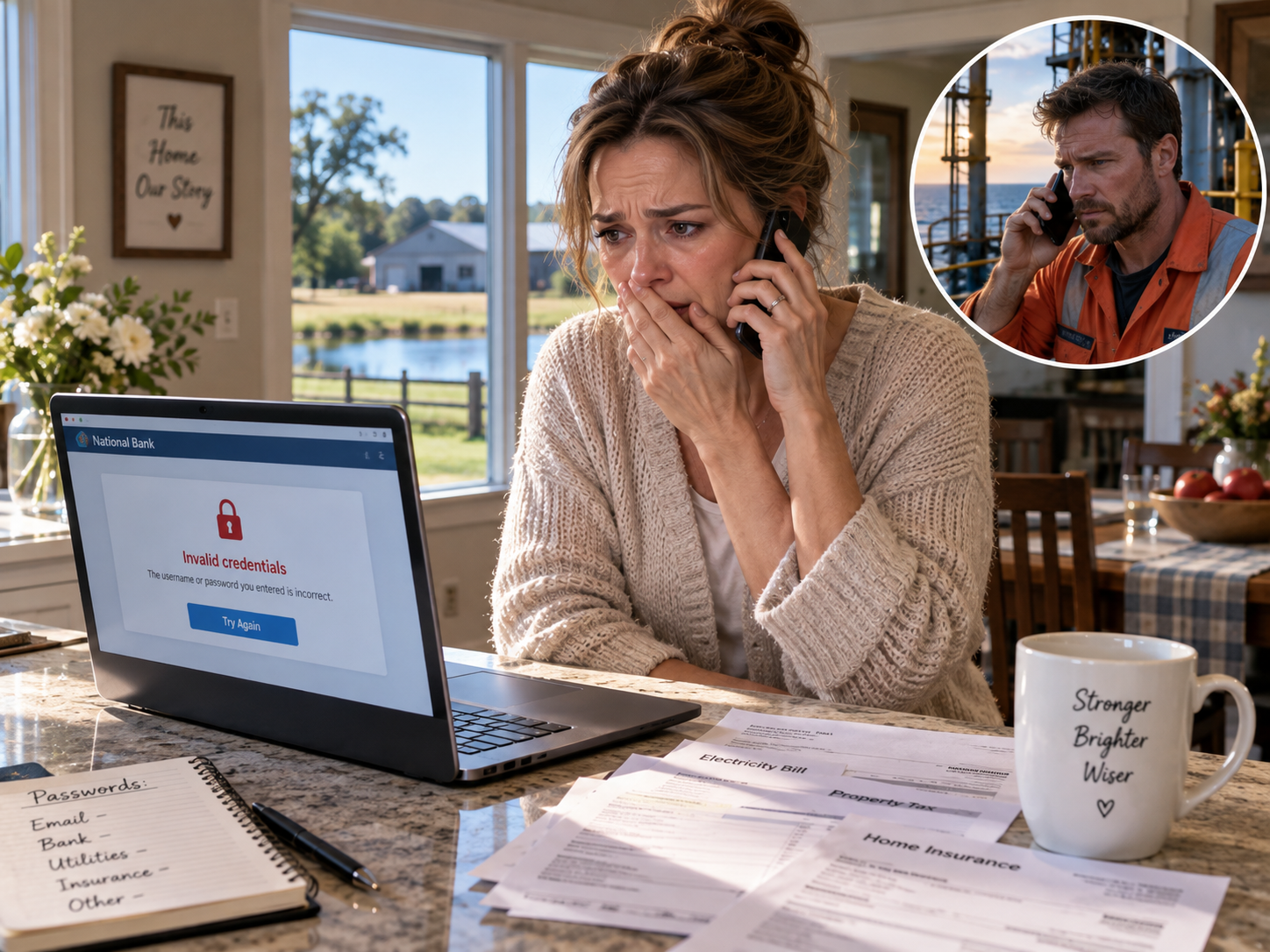
The Morning My Password Failed, I Realized My Husband Had Quietly Moved Our Money and Changed More Than I Knew
Part 2 of 16

