
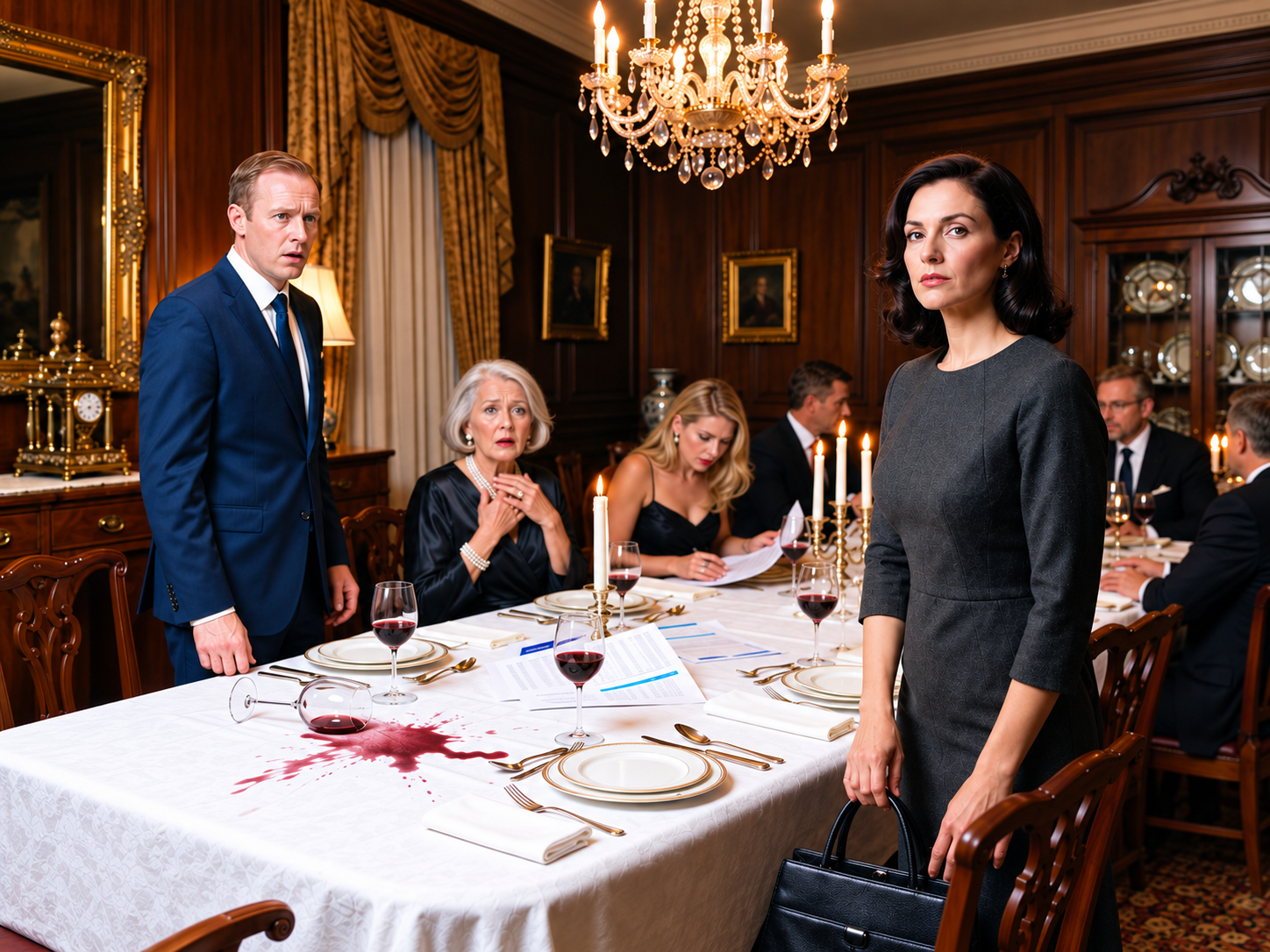
The wineglass struck the white linen with a thin, almost delicate crack, and for three seconds nobody moved. Red wine spread beneath the overturned bowl in branching streams, slipping between the silverware and staining the tablecloth as if something alive had begun leaking across it.
“Don’t touch that.”
The command came from Clara Voss.
She stood at the end of the dining table, one hand still resting on the back of a carved mahogany chair, her black handbag hanging from her other wrist. Her charcoal-gray dress was severe enough to make her look as though she had arrived for a business meeting rather than dinner. Her expression had not changed, but her eyes were fixed on the fallen glass.
Edward Hale was the first to look at her.
He had been standing beside the table for less than a minute, still wearing his dark blue dinner jacket, his face pale beneath carefully combed blond hair. He looked from the wine to Clara, then to the papers lying near the center of the table.
“Why?” he asked.
Clara did not answer immediately.
Across from him, Margaret Hale pressed two fingers against her throat. The elderly woman’s pearl necklace trembled with the movement. She was dressed in black silk, and although her posture remained upright, something frightened had appeared behind her eyes.
Nora Bell, seated beside Margaret, slowly lowered the pen she had been holding.
“I didn’t spill it,” she said.
“No one said you did,” Edward replied.
Nora glanced toward him. “You looked at me.”
“I looked at everyone.”
“That is not what it felt like.”
At the far end of the room, two other guests had gone silent. One was a narrow-faced solicitor named Simon Price, who had spent the previous twenty minutes explaining the terms of Margaret’s revised will. The other was Thomas Reed, Margaret’s private secretary, a quiet man in his fifties whose hands had not stopped fidgeting since dinner began.
The room itself seemed designed to make secrets feel heavier.
Dark walnut panels covered the walls from floor to ceiling. Gold-framed portraits watched over the table. A chandelier crowded with crystal drops burned above them, throwing warm light across polished silver, porcelain plates, and half-filled wineglasses. Heavy curtains framed the tall windows, shutting out the cold November night.
On the wall behind Edward stood an antique clock.
Its minute hand had just reached nine.
Margaret looked at it.
Then she looked at Clara.
“You knew,” she whispered.
Edward turned sharply. “Mother?”
Margaret closed her eyes.
Clara walked toward the table.
The spilled wine had reached the edge of a document Simon had placed beside Margaret’s plate. A few drops had darkened the bottom corner, but the important writing remained dry.
Clara leaned closer.
It was a photocopy of a bank transfer.
Her expression tightened.
“Where did you get this?” she asked.
Simon cleared his throat. “Mrs. Hale provided it.”
Margaret looked down.
“I found it in the study this afternoon.”
“You said you had never seen it before.”
“I said I didn't remember seeing it.”
“That is different.”
Edward stepped between them.
“Clara, what is going on?”
She looked at him.
For a moment, the years between them seemed to disappear.
They had once been close enough to finish each other’s sentences. Before his marriage to Laura, before Laura died, before Clara left the family estate after an argument that no one ever discussed openly, Edward had trusted her more than anyone.
Now he looked at her as though she had walked into his home carrying a weapon.
Clara lowered her voice.
“You should ask your mother why she called me here.”
Margaret flinched.
“I did not call her.”
Silence settled over the table.
Edward stared at his mother.
Thomas stopped moving.
Nora slowly looked toward Simon.
Simon’s face had become very still.
Clara understood the significance of that stillness immediately.
“Then who sent me the invitation?” she asked.
Nobody answered.
She reached into her handbag and removed a cream-colored envelope.
The paper had been addressed by hand.
Inside was a single card.
Come tonight. Bring the photograph. Do not trust anyone at the table.
There had been no signature.
Clara had assumed Margaret had sent it.
She had been wrong.
Edward held out his hand.
“Let me see.”
Clara gave him the card.
He read it once.
Then again.
His jaw tightened.
“I didn't send this.”
“I know.”
“How?”
“Because you would have signed it.”
His eyes met hers.
It was such a small statement, but something changed in his face.
The old familiarity returned for half a second.
Then Margaret spoke.
“Clara.”
Everyone turned toward her.
The older woman looked exhausted.
“Did you bring it?”
Clara did not pretend not to understand.
“Yes.”
Edward looked between them.
“Bring what?”
Clara reached into the inner compartment of her handbag.
She removed a small photograph.
It was old enough that the edges had softened. The image showed a younger Margaret standing outside the estate with three people beside her.
One was her late husband, Henry Hale.
The second was a much younger Thomas Reed.
The third was a woman Clara had never met.
Edward leaned closer.
“Who is that?”
Margaret stared at the photograph.
“My sister.”
Edward's expression changed.
“You told me you were an only child.”
“I lied.”
The chandelier seemed suddenly too bright.
Nora looked at Simon.
Simon did not look back.
Clara placed the photograph beside the stained document.
“Her name was Elise.”
Margaret swallowed.
“She died thirty-two years ago.”
“How?”
Margaret's fingers tightened around the edge of the table.
“She disappeared.”
Edward stared at her.
“That isn't the same thing.”
“No.”
Margaret looked toward the windows.
“She disappeared the night your father changed his will.”
A chair scraped loudly against the floor.
Thomas had stood up.
Everyone looked at him.
He seemed startled by his own movement.
“Sit down,” Simon said quietly.
Thomas remained standing.
“You knew about Elise,” Clara said.
Thomas looked at her.
“I knew she existed.”
“Did you know what happened to her?”
“No.”
The answer came too quickly.
Clara noticed.
So did Simon.
Margaret's eyes dropped toward the table.
“Your father believed Elise had stolen money from him,” she said to Edward. “He accused her of forging signatures. She denied it. The next morning she was gone.”
“And you said nothing for thirty-two years?”
“I was afraid.”
“Of my father?”
Margaret shook her head.
“Of what he would do if the truth came out.”
Edward stepped away from the table.
His face had lost its color.
“What truth?”
Margaret looked at Clara.
“The money wasn't stolen.”
The room seemed to contract around them.
Clara reached for the bank transfer.
“Then where did it go?”
Margaret whispered a name.
“Edward.”
Edward froze.
Nora stood.
“What?”
Margaret looked at her son with an expression that contained something deeper than fear.
Regret.
“The money was transferred into an account bearing your name.”
Edward stared at her.
“I was six years old.”
“I know.”
“Then someone used my name.”
“Yes.”
“Who?”
Margaret did not answer.
Simon slowly gathered the documents.
“Perhaps we should continue this in the study.”
“No,” Clara said.
Everyone looked at her.
She pointed toward the table.
“The papers stay here.”
Simon frowned.
“You have no authority—”
“I have enough authority to recognize when someone is trying to move evidence out of sight.”
The word evidence changed the atmosphere.
Edward looked at Simon.
“What evidence?”
Clara turned over the photocopy.
There, beneath the bank information, was a handwritten notation in blue ink.
The handwriting was unmistakably familiar.
Edward recognized it before anyone else.
“That’s my father’s writing.”
Margaret closed her eyes.
Clara looked at the note.
Three words had been written beneath the account number.
Ask Thomas where.
Thomas backed away from the table.
“No.”
Edward turned toward him.
“What does that mean?”
“I don't know.”
“You're lying.”
Thomas shook his head.
“I swear to you, I don't know.”
Then something fell from the pocket of his jacket.
A small brass key struck the floor.
Nobody moved.
Thomas stared at it.
Clara stared at Thomas.
Edward slowly bent down and picked up the key.
There was a tiny engraved number on it.
17.
Margaret made a sound that was almost a gasp.
“No.”
Edward looked at her.
“What is seventeen?”
Margaret stood so quickly that her chair nearly toppled.
“The old archive.”
Thomas whispered, “It was supposed to be destroyed.”
Clara turned toward him.
“What was?”
Thomas looked at the key in Edward's hand.
“The ledger.”
A sudden crash came from the hallway.
Everyone turned.
The dining-room doors had swung open.
No one stood there.
But somewhere deeper inside the house, a door slammed shut.
Edward moved first.
“Stay here.”
Clara caught his sleeve.
“No.”
He looked at her.
“You don't know this house anymore.”
She released him.
“Neither do you.”
And then the lights went out.
Click Here to continue read next: PART2: Behind the Locked Archive Door, a Ledger Waited With One Name Missing From the Family’s History
The Dinner Was Meant to Settle an Inheritance, Until a Glass Fell and Everyone Stopped Pretending
Part 1 of 16

