
Ruth opened the cottage door before the taxi driver had finished pulling my suitcase from the trunk.
“There she is.”
“You were watching for me.”
“For twenty-three minutes.”
“That sounds unhealthy.”
“So does letting people choose your retirement home without you.”
I laughed.
Then she hugged me.
The joke disappeared between us.
For months I had prepared for that morning with lawyers, bank accounts, property documents, moving boxes, and keys.
None of those things had prepared me for the simple relief of being welcomed somewhere by someone who expected nothing in return.
Ruth carried one box inside.
I carried another.
The cottage smelled of fresh paint, bread, and the lavender cleaner she used on everything.
Flowers stood in a glass pitcher.
A bowl of strawberries sat on the table.
My blue sofa was exactly where I had wanted it.
The brass lamp stood beside the reading chair.
On the refrigerator was Thomas's photograph.
I touched the frame.
“Hello, Tom.”
Ruth busied herself with the kettle.
After a moment she asked, “How bad?”
“Bad enough.”
“Graham?”
“Shocked.”
“Paige?”
“Interested in the money.”
Ruth made a noise.
“Don't.”
“I said nothing.”
“You made a noise.”
“My noises are protected speech.”
I smiled.
She poured tea.
“And the children?”
“That was the hardest part.”
“You told them it wasn't their fault?”
“Yes.”
“Good.”
We sat in the yellow kitchen.
Late-morning sunlight moved across the floor.
For the first time in years, nobody asked what I was making for lunch.
Nobody left a cup beside the sink.
Nobody called my name from another room because they needed something.
The silence felt almost suspicious.
Ruth left around four.
That evening I unpacked slowly.
Thomas's watch went into the top drawer.
My books went onto the shelves.
My coat went behind the front door.
My toothbrush went into a glass beside the sink.
Small acts.
But every one felt important.
Nobody could tell me to move those things.
Nobody could announce that someone else needed my room.
Nobody could pay a deposit somewhere and inform me afterward.
That night I slept for nine uninterrupted hours.
When I woke, sunlight slipped around the curtains.
For a moment I didn't know where I was.
Then I saw Thomas's photograph.
I made coffee.
Opened the back door.
Cold air entered the kitchen.
The rose bushes were mostly dormant, but one stubborn flower remained near the porch.
I stood there with both hands around my mug.
Then I cried.
Nothing dramatic had happened.
Perhaps that was why.
I had spent years mistaking usefulness for belonging.
Now I was learning that peace could be overwhelming when it finally arrived.
Three days later, Graham came to the cottage.
He did not call first.
I heard his car on the gravel.
He remained inside for nearly a minute before getting out.
When I opened the door, he looked exhausted.
His shirt was wrinkled.
His hair was untidy.
There were dark shadows beneath his eyes.
“Hi, Mom.”
“Hello, Graham.”
He looked past me.
“So this is it.”
“This is it.”
“Can I come in?”
I stepped aside.
He entered carefully, almost like a visitor.
His eyes moved across the room.
Blue sofa.
Oak table.
Reading chair.
Photographs.
Then he entered the kitchen.
When he saw the yellow walls, his expression softened.
“You always wanted a yellow kitchen.”
I looked at him.
“You remember?”
“Dad used to tease you about it.”
“He said yellow made food taste nervous.”
Graham smiled.
“That sounds like him.”
For a few seconds, we were simply mother and son remembering the same man.
Then he saw Thomas's photograph.
“I miss him.”
“So do I.”
He sat at the kitchen table.
I made coffee.
Neither of us mentioned the house until his mug was in front of him.
Finally he said, “We found two rentals.”
“That’s good.”
“One is close to Owen's school.”
“Convenient.”
“The other is cheaper.”
“You have choices.”
He winced.
“I deserved that.”
“It wasn't punishment.”
“I know.”
He turned the mug slowly.
“Paige is furious.”
“I assumed.”
“She says you humiliated us.”
“I didn't announce anything publicly.”
“She means emotionally.”
“I can't control how truth feels.”
He nodded.
Then he asked the question I had expected.
“How much money did you actually get?”
I looked at him.
He saw my expression change.
“Mom, I'm not asking because I want it.”
“Why are you asking?”
“I need to understand how different everything is.”
“Everything important is the same.”
“No. You own this place. You bought our house. You created trusts. You have millions.”
“And I'm still your mother.”
“I know.”
“Do you?”
He looked down.
After a long silence he said, “Paige thinks you could help us buy a house.”
There it was.
I had expected Paige to ask.
I had hoped Graham would refuse to carry the request to me.
He looked embarrassed.
“She didn't tell me to say it exactly like that.”
“But she wanted you to ask.”
“Yes.”
“And you came.”
“I came because I wanted to see you.”
“Yet you asked.”
His fingers tightened around the mug.
“I'm trying to be honest.”
“So am I.”
I stood and walked to the counter.
Not because I needed anything.
I needed distance.
“Do you remember the night you gave me the Pine Harbor brochure?”
“Yes.”
“What did you tell me?”
“That it was a good place.”
“You told me it was the best choice for me.”
He closed his eyes.
“I thought it was.”
“You thought it was the easiest solution.”
“That isn't fair.”
“Then tell me what you asked before choosing it.”
He said nothing.
“Did you ask whether I wanted to live alone?”
“No.”
“Whether I wanted to stay with you?”
“No.”
“Whether I was lonely?”
“No.”
“Whether I had friends nearby?”
“No.”
“Whether I wanted a garden?”
His eyes moved toward the window.
“No.”
“Whether I wanted to live near Ruth?”
“No.”
“Whether I wanted yellow walls in my kitchen?”
His face tightened.
“No.”
I returned to the table.
“You weren't choosing for me, Graham. You were solving me.”
He covered his face.
For several seconds he said nothing.
When he lowered his hands, his eyes were wet.
“I thought you wanted to stay with us.”
“I did.”
That surprised him.
“For a long time, I did. After your father died, I wanted family. I wanted to matter in the ordinary way people matter to one another.”
“You mattered.”
“I became useful.”
“That's not the same thing.”
“No.”
Tears slipped down his face.
I did not immediately reach for him.
Sometimes comforting someone too quickly only gives them an escape from understanding what they need to face.
“I made a mistake,” he said.
“Yes.”
“I don't know when.”
“I do.”
He looked at me.
“It happened gradually. Every time my plans became easier to cancel than yours. Every time my help became expected. Every time I became part of the machinery of the household.”
He wiped his face.
“Why didn't you tell me?”
“I tried in small ways.”
“I didn't hear you.”
“No.”
He stared into his coffee.
“Dad would be ashamed of me.”
I looked toward Thomas's photograph.
“I don't know what your father would feel.”
“I do.”
“Graham—”
“When I was little, I thought you were the strongest person alive.”
I smiled.
“I was younger.”
“No.”
He shook his head.
“You still are. I just started seeing you as old.”
“Seventy-three is old to a forty-year-old.”
“I started thinking your life needed managing.”
“Yes.”
“And because you didn't complain, I thought you agreed.”
“Yes.”
He leaned back.
“I’m sorry.”
This time the apology sounded different.
Not complete.
But different.
After a while he asked, “Did Dad leave you money?”
“Some.”
“How much?”
I smiled.
He caught himself.
“Sorry.”
“Thomas left me more than money.”
“What?”
I looked toward the fishing journal.
“Things I needed time to understand.”
Graham followed my gaze.
“His journal?”
“Yes.”
“Can I see it?”
“Not today.”
He stopped.
“All right.”
That answer mattered.
He did not argue.
Before leaving, he stood on the porch.
“Can I come again?”
“Yes.”
“Should I call first?”
I smiled.
“Yes.”
“I will.”
I watched him drive away.
For the first time since leaving the old house, I wondered whether losing the old version of our relationship might make room for a better one.
That hope lasted until Martin called.
“Evelyn, we have a development.”
I put down my book.
“What kind?”
“Graham contacted the property office.”
“I expected that.”
“He asked whether T&E is legally connected to you.”
“What did they say?”
“Nothing beyond information available through proper channels.”
“Fine.”
Martin paused.
“There is something else.”
I sat straighter.
“What?”
“Paige has spoken with an attorney.”
“About the tenancy?”
“Not primarily.”
“What, then?”
“Your assets.”
The room became very quiet.
“What exactly is she asking?”
“Questions about whether any of your holdings could be considered family property. Whether Graham might have a claim related to Thomas's estate. Whether the children's trusts can be reached.”
I closed my eyes.
“How much I have.”
“Yes.”
“What Graham might inherit.”
“Yes.”
“Whether the grandchildren's trusts can be touched.”
“Yes.”
My disappointment was colder than anger.
“What should I do?”
“Nothing impulsive. Do not lend money. Do not sign anything. Do not explain your financial structure.”
“I won't.”
“There is another matter.”
“What?”
“The letter from Thomas.”
I looked toward the photograph.
“You once asked me to keep a certified copy with your estate documents.”
“Yes.”
“Do you still intend Graham to receive it?”
Three days earlier, I would have said no.
But Graham had sat in my kitchen.
He had apologized.
He had asked permission to return.
He had accepted my refusal when I would not show him the journal.
Yet he had also carried Paige's request for money to my table.
Perhaps Thomas's letter belonged in the space between those two versions of my son.
“Yes,” I said.
“When?”
“Tomorrow.”
Martin was silent.
“Are you sure?”
“Yes.”
After the call, I took Thomas's fishing journal from the shelf.
The letter was still inside the back cover.
I unfolded it.
Thomas's handwriting pulled me backward five years.
He had written the letter to Graham before he died.
He had told me to deliver it only if I believed our son had reached a point where he needed to hear it.
I had never known whether that moment would come.
Now I did.
The next morning, before Martin could arrange delivery, someone knocked.
A courier stood outside.
“For Evelyn Mercer.”
I signed.
The envelope carried Graham's handwriting.
I brought it into the kitchen.
Inside was one sheet.
Mom,
I don't know whether I deserve another chance, but I would like to earn one.
Not because of the house.
Not because of the money.
Because you are my mother, and I finally understand that I stopped treating that as something precious.
I read it twice.
Then a third time.
I folded it and placed it beside my coffee.
Outside, the oak tree at the edge of the garden moved in the wind.
Thomas and I had planted a tree together at our first home decades earlier.
This was not that tree.
But standing beneath it brought back an afternoon when Graham was nine and Thomas was trying to teach him how to tie a fishing knot.
Graham had become frustrated.
Thomas had made him start again.
He had taught him patience by refusing to do the work for him.
I wondered whether that was what my husband had been trying to teach me too.
My phone rang.
Martin.
“The courier can deliver Thomas's letter this afternoon.”
I looked at Graham's note.
“Do it.”
“To Graham personally?”
“Yes.”
“Once he reads it, you cannot control what happens next.”
“I know.”
I ended the call.
Across town, my son was about to receive words written by his father nearly five years earlier.
Words Thomas had left behind because he understood something neither Graham nor I had understood at the time.
Graham had spent years believing that caring for me meant taking responsibility for me.
I had spent years allowing him to believe it.
The lottery had not created that problem.
It had only stripped away the excuses surrounding it.
And now Thomas's letter was on its way.
Click Here to continue read next: PART5: Thomas’s Letter Reached Graham at the Worst Possible Moment, and the Words Inside Forced Him to Face What He Had Been Avoiding
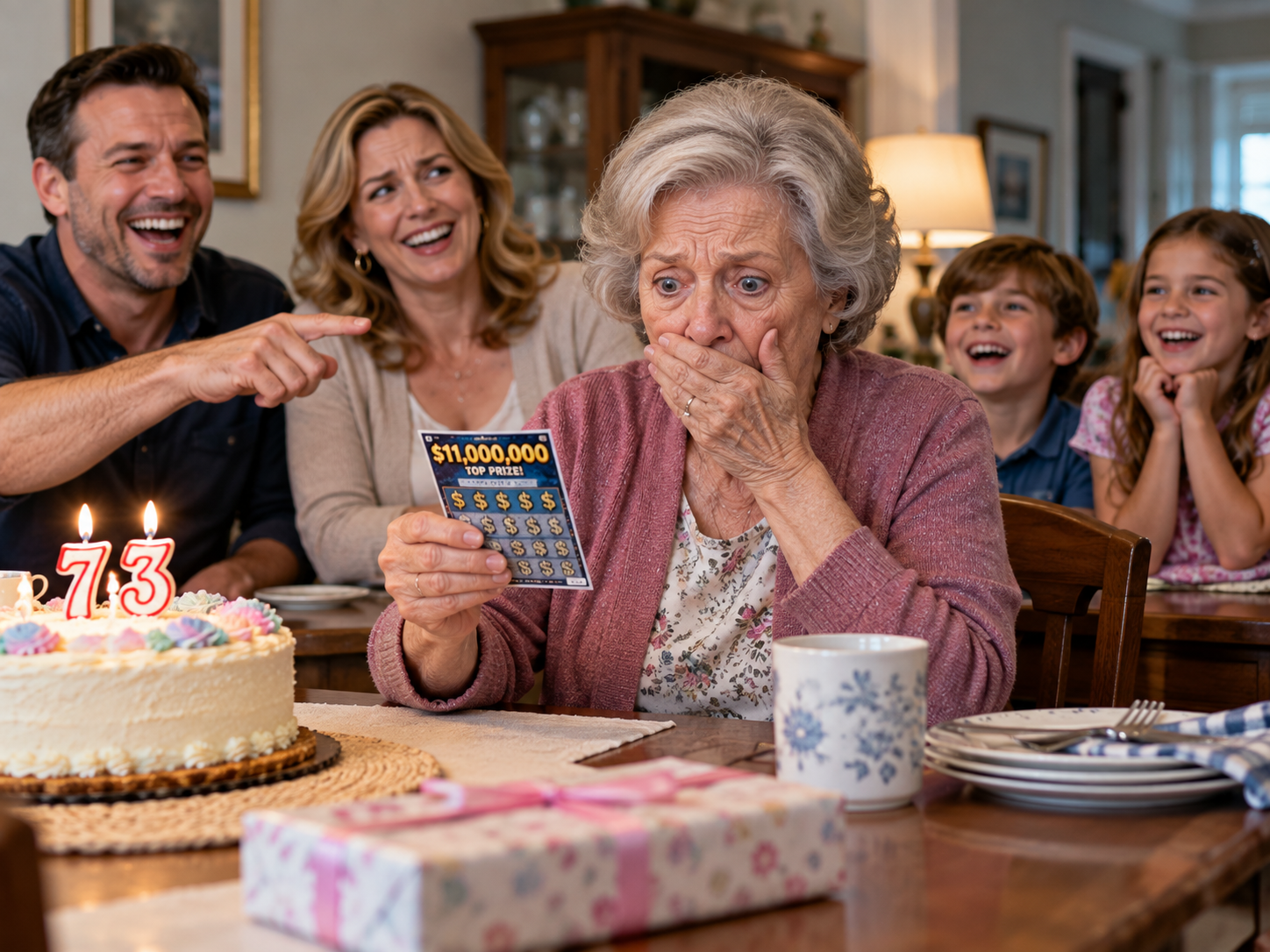
A Birthday Joke Became Worth Millions Before Anyone at the Table Realized I Had Just Found My Way Out
Part 4 of 8

